WASHINGTON—The United Arab Emirates has opened talks with the U.S. about obtaining a financial backstop in case the Iran war plunges the oil-rich Persian Gulf state into a deeper crisis, U.S. officials said.
U.A.E. Central Bank Gov. Khaled Mohamed Balama raised the idea of a currency-swap line with Treasury Secretary Scott Bessent and Treasury and Federal Reserve officials in meetings in Washington last week, the officials said. The Emiratis emphasized that they had so far avoided the worst economic effects of the conflict but might still need a financial lifeline, the officials said.
The talks highlighted the U.A.E.’s concern that the war could inflict major damage on its economy and its position as a global financial hub, depleting its foreign reserves and scaring away investors who once saw it as a stable and secure place for their money. The conflict has damaged Emirati oil-and-gas infrastructure and shut off their ability to sell oil using tankers transiting the Strait of Hormuz , depriving it of a key source of dollar revenues.
Emirati officials haven’t made a formal request for a swap line, which would give the U.A.E. central bank inexpensive access to dollars to support its currency or shore up its foreign reserves in case of a liquidity crisis. In talks with the U.S. in recent days, they have portrayed the proposal as preliminary and precautionary, the U.S. officials said.
But they have also argued that it was President Trump ’s decision to attack Iran that entangled their country in a destructive conflict whose effects may not be over, some of the officials said. Emirati officials told the U.S. officials that if the U.A.E. runs short of dollars, it may be forced to use Chinese yuan or other countries’ currencies for oil sales and other transactions, some of the officials said.
In that scenario is an implicit threat to the U.S. dollar, which reigns supreme among global currencies partially because of its near-exclusive use in oil transactions.
The U.A.E. Central Bank didn’t respond to requests for comment. A Fed spokesperson declined to comment.
Swap lines are typically administered by the Fed, but its 12-person policy committee, the Federal Open Market Committee, is unlikely to approve one for U.A.E., some of the officials said.
It usually reserves them for relieving severe funding-market pressures that could spill back into the U.S. economy. It has standing arrangements with central banks in the U.K., Canada, Japan, Switzerland and the European Union. During periods of acute stress, most recently in 2020, it extended swap lines to nine other central banks, including in Mexico, South Korea and Brazil. The U.A.E. has fewer ties to U.S. markets than traditional swap recipients.
The Treasury Department has recently provided alternative swap arrangements without the Fed. The department signed off on a $20 billion swap for Argentina through the Exchange Stabilization Fund last year.
Before a cease-fire took effect on April 17, Iran targeted the U.A.E. especially hard, firing over 2,800 drones and missiles, according to the U.A.E.’s Ministry of Defense, although most were shot down.
The Emirati dirham is pegged to the dollar and backed by foreign-currency reserves of $270 billion, but the war has put it under pressures from capital-flight risks, stock-market volatility and other disruptions, analysts said.
The credit-rating firm S&P Global said in a March 6 report that the U.A.E.’s “substantial fiscal, economic, external, and policy flexibility will act as an effective buffer” against the war’s economic effects. But it warned that “the potential for prolonged disruption” to its oil exports and damage to infrastructure “add clear risk to our expectations.”
The U.A.E. has threatened to freeze billions of dollars of Iranian assets held in the Gulf state, The Wall Street Journal has reported, a move that could sever one of Tehran’s most important economic lifelines. But such a move would also upend lucrative trade and banking ties with Tehran and damage the U.A.E.’s ability to attract and retain capital from other politically charged sources, such as Russia.
The war also has driven the Emiratis closer to the U.S. and, at least for now, to abandon the notion that forging diplomatic and financial ties to Iran would help insulate it from the region’s conflicts.
Treasury officials invited Gulf countries on the sidelines of the International Monetary Fund and World Bank meetings in Washington last week to outline their needs for repairing infrastructure and rebuilding their economies, promising to put them at the front of the line if assistance is needed.
The Fed used swap lines heavily used during the 2008 financial crisis, buying the currency of other borrowing central banks with dollars and later selling it back. It also used swap lines to support foreign central banks after the start of the Covid-19 pandemic.
Countries that don’t have a swap line with the Fed can still exchange their holdings of Treasury bonds for dollars through a program administered by the New York Fed.
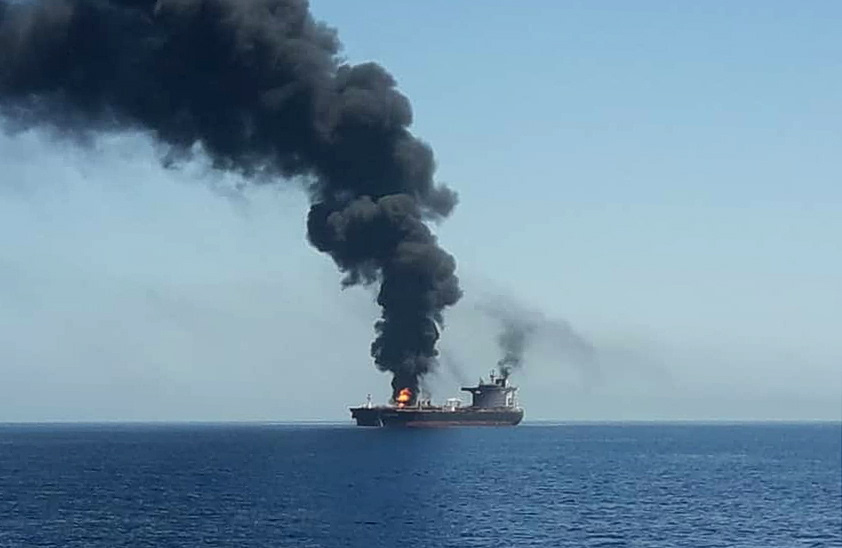
A handout photo made available by Iran’s official state TV (IRIB) allegedly shows the crude oil tanker Front Altair on fire in the Gulf of Oman, 13 June 2019.
Gulf countries have also raised billions of dollars in debt from investors over the past week, highlighting their push to have cash on hand as they face what the International Energy Agency has called “the most severe oil-supply shock in history.”
Abu Dhabi, the U.A.E.’s capital and the richest of the seven emirates that make up the country, raised around $4 billion from investors in private-placement transactions arranged by banks including Goldman Sachs earlier this month, people familiar with the matter said. The emirate borrowed at a premium to avoid a drawn-out fundraising process, they said.
Bahrain also set up a roughly $5 billion swap line with the U.A.E. earlier this month to help improve financial stability, the countries’ central banks said.
Finance ministers and central bankers in Washington for the IMF and World Bank meetings said they didn’t expect an easy or swift recovery for the region.
“The basic logistics of scheduling tankers and bringing them back after the chaos we have seen, that will take possibly to the end of June,” said Mohammed Al-Jadaan, Saudi Arabia’s finance minister, during a panel on Thursday. “Anyone who’s counting for a quick recovery, even if there is a total end of hostilities, will need to recalculate that.”