
 Μake us preferred on Google
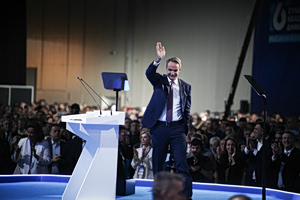
 Greece is set for a limited government reshuffle on Thursday, June 11. Government spokesperson Pavlos Marinakis confirmed the timeline on Saturday, signaling that Prime Minister Kyriakos Mitsotakis will announce the changes following the election of a new secretary general for the governing party.
Konstantinos Kyranakis, the current deputy minister of infrastructure and transport, is widely expected to fill that secretary general role. Marinakis, speaking on SKAI television, said the prime minister would announce replacements for both the new secretary general’s vacated post and for the deputy environment minister position, left vacant after the death of Nikos Tagaras, who passed away at 70 following a battle with cancer.
Marinakis was careful to frame the scope of the changes as limited. “My assessment is that we will not see an extensive reshuffle,” he said, adding that adjustments made at the three-year mark of a government’s term are nonetheless significant.
The mini reshuffle comes as Mitsotakis prepares for the Thessaloniki International Fair in September, Greece’s premier annual economic forum where prime ministers traditionally lay out their policy agenda and economic priorities for the year ahead. Marinakis offered a preview, announcing that the government’s next round of tax relief would target businesses, with a focus on small and medium-sized enterprises.
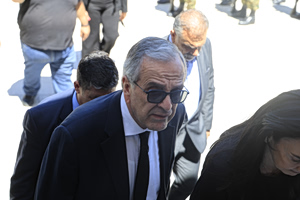
The spokesperson also pushed back sharply against Antonis Samaras, who on Friday delivered a speech in Crete. The former PM drew pointed comparisons between Mitsotakis and Alexis Tsipras, the left-wing leader whose tumultuous tenure from 2015 to 2019 has been framed as a cautionary tale among New Democracy supporters.
Samaras, who was expelled from New Democracy in November 2024, appears to be laying the groundwork for a new political party. In Crete, he framed both Mitsotakis and Tsipras as leaders more interested in image management than in substance. “I will say it plainly: they don’t only resemble each other in foreign policy, they resemble each other in many other ways. And they are often like two drops of water,” Samaras said. “Do they not, ultimately, have the same approach to politics? That everything is about optics? Moves designed to impress, guided exclusively by the management of their personal image?”
Samaras went further, drawing a direct structural parallel between the two leaders. “Did Tsipras not dissolve his own party, break it into five or six pieces and undermine it to this day, so that he himself could return as a ‘Messiah’? Did Mitsotakis not expel two former party leaders and prime ministers from New Democracy, so that he could appear as the absolute ‘Sovereign’?” he said. “Neither one nor the other cares about political substance. They care about political branding, about communication. They don’t care if their current allies were their former political and ideological opponents. All that matters to them is that these people praise their personal political ‘authority.’ They don’t believe in ideologies, only in political ‘products’ and marketing.”
Marinakis dismissed Samaras’s comparison as illogical. “Equating the prime minister with Mr. Tsipras is illogical,” he said, attributing Samaras’s stance to personal bitterness over his expulsion. The government spokesperson described the expulsion itself as inevitable given the severity of the language Samaras had used. He also noted the irony of Samaras’s position, pointing out that the former prime minister was himself among the politicians who suffered under Tsipras’s governance.
On the prospect of Samaras launching a new party, Marinakis declined to predict electoral outcomes but moved to minimize its potential impact. “I cannot predict an electoral outcome,” Marinakis said, adding that based on Samaras’s rhetoric and stated platform, his message was unlikely to resonate with either committed or potential New Democracy voters.