Jacqueline Kennedy wore one of his creations when she wed Aristotle Onassis. So did Elizabeth Taylor as she danced with Kirk Douglas at the premiere of “Spartacus.” When Farah Pahlavi fled Iran with her husband, the Shah, in 1979, her dress bore the label, as did the vintage black number Julia Roberts wore when she accepted an Oscar for her performance in the 2000 film “Erin Brockovich.”
A history of the second half the 20th century could be written through the prism of the women who wore Valentino.
From Audrey Hepburn to Nancy Reagan, Princess Diana to Jennifer Lopez, Valentino was the go-to designer for the rich, famous, powerful and glamorous. With Giancarlo Giammetti, his partner in life and business, he presided over the eponymous fashion house that made him one of the most dominant figures in the world of high fashion—his impossibly deep, bronze tan as recognizable as the Valentino V and signature color, Valentino Red, of his designs.
Valentino refused to use the runway to make artistic statements, and was often baffled by what he saw as unwearable designs from other fashion houses. “I make dresses for women who actually wear them,” he said in “Valentino: The Last Emperor,” a documentary about the lead-up to Valentino ’s 45th anniversary celebrations, just before he retired in 2008.
Trends came and went, but Valentino was dismissive, even at times disgusted by them.
“Forget about fashion—the grunge look, the messy look. I cannot see women destroyed, uncombed, or strange,” he told Vanity Fair in 2004. “I want to make a girl who arrives someplace and makes people turn and say: You look sensational!’”
He died Monday at his home in Rome, according to a statement from Fondazione Valentino Garavani e Giancarlo Giammetti. He was 93 years old.
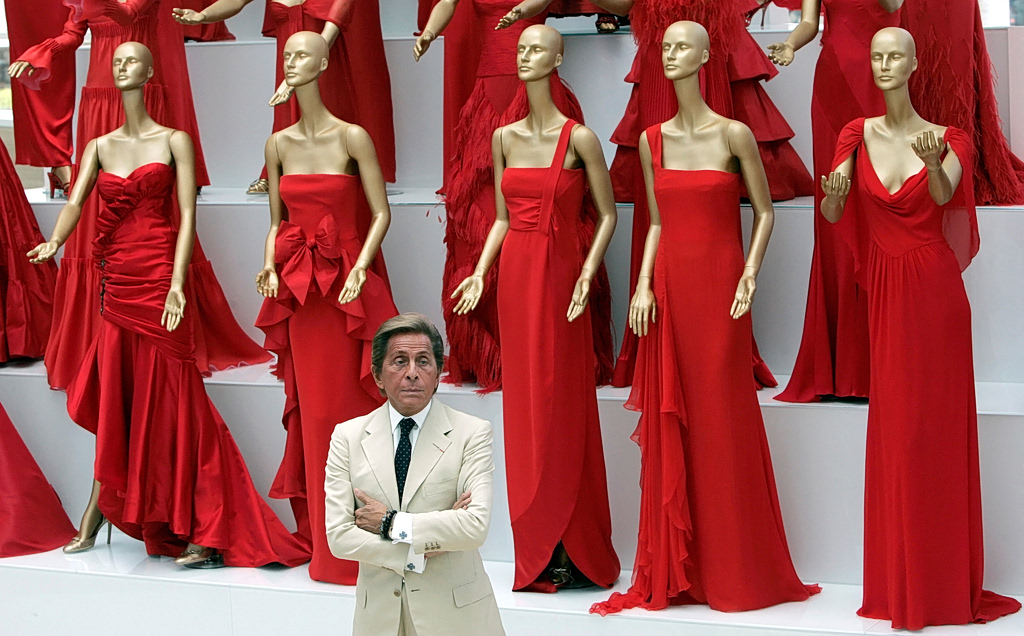
Valentino Garavani poses during the opening of his exhibition at the Ara Pacis Museum in Rome July 6, 2007. Valentino will snub Paris and unveil his latest haute couture collection in Rome to mark his 45th year in the city where he got his start. REUTERS/Alessandro Bianchi (ITALY)/File Photo
Seeing Red
Valentino Clemente Ludovico Garavani was born in Voghera, Italy, on May 11, 1932, to Teresa de Biaggi and Mauro Garavani. Even as a child, he was taken by beauty, glamour and fine clothes.
When he was 6 years old and ill with a fever, Valentino persuaded his mother to take him to see one of his cousins; she was getting dressed in pink tulle to attend a ball, he recounted to Vogue in 1985, and just had to see her.
“Vivien Leigh, Hedy Lamarr, Lana Turner, and Katharine Hepburn—I am a designer today because I would dream of those ladies in fox coats and lame, coming down those grand staircases they had in the movies,” he told the New Yorker in 2005. “That was what I thought about. That was what I wanted.”
His parents indulged their son’s passion and, when he was 17, set him up in Paris, where he studied at a number of schools and studios. On a holiday in Barcelona in 1949, he was fascinated to see so many women in the audience at an opera house wearing red. He went crazy for color and later became known for designing with “Valentino Red,” an eye-popping shade that, despite its brilliance, the designer thought could work like basic black: as both a color and noncolor.
“It gives lots of energy to the woman when she’s wearing red,” he told broadcaster Charlie Rose in 1996. “But, you know, unfortunately, you go around, you go to parties, you go to dinners, you see 20 women and they are all dressed in black.”
In 1959, backed by his father, he started a couture house in Rome. The following year, Valentino began the most significant relationship of his professional and personal life when he met an architecture student named Giancarlo Giammetti. At first, the two were lovers, but even after their romantic relationship ended, they remained inseparable, a tightly knit family in life and business. In “The Last Emperor,” Giammetti estimated that in 45 years, he’d been apart from Valentino for maybe two months.
Valentino was already in business when he met Giammetti, but the designer’s finances were a mess. Giammetti abandoned architecture and the two went into business together. Giammetti turned out to have as deft a hand with the business of high fashion as Valentino had with taffeta and lace.
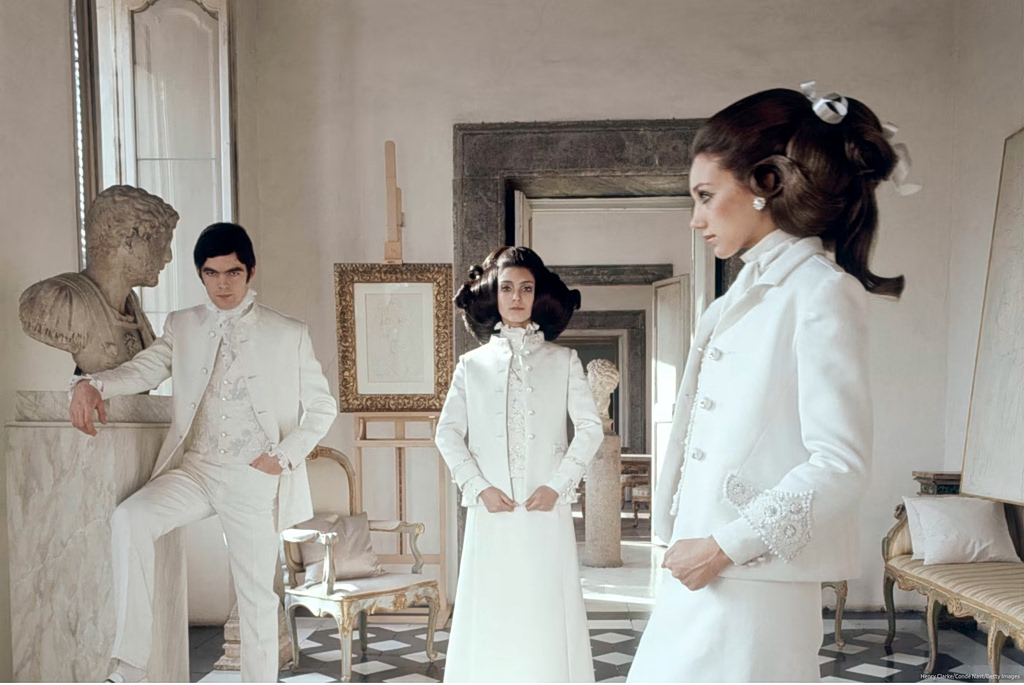
Models wearing Valentino in the Roman apartment of Cy Twombly in 1967. Henry Clarke/Condé Nast/Getty Images
“Every other designer looks and says, ‘How do they live the way they do?’ ” said John Fairchild, the late publisher and editor of Women’s Wear Daily, in Vanity Fair in 2004. “I don’t think they made the money that Valentino and Giancarlo did, because Giancarlo knows how to make money.”
Valentino put on his first show in Florence in 1962. But the real turning point came in 1964, when Jackie Kennedy bought six dresses to wear while she was in mourning for her late husband, President John F. Kennedy. She became a client and a friend for the rest of her life. When she wore a lace dress from Valentino’s celebrated 1968 “white collection” at her wedding to Aristotle Onassis in 1968, she put Valentino on the cover of newspapers and magazines around the world.
For the next four decades, princesses from the Middle East, starlets in Hollywood and entrepreneurs in Washington all stood for fittings in Valentino’s ateliers—with at least one red dress in every collection.
A license to print money
Valentino had been founded as a couture shop—bespoke dresses created for individual customers—but by the 1970s the company branched out into the ready-to-wear market. Business boomed, and Valentino and Giammetti cashed in.
Valentino was among the first of the major high-fashion designers to license its brand. The Valentino name turned up on everything from sunglasses and jeans to bathroom tile, perfume and, in the early 1980s, even a Lincoln Continental. The couture side of the business could lose a few million dollars a year because the licensing brought in tens of millions of dollars annually.
The company’s growth in the ’80s was largely due to Giammetti’s diligence. “Valentino gets better and more sure of himself all the time,” Giammetti told Vogue. “He is serene, I get more anxious. Every day in Italy, there are six thousand people working on Valentino products. I worry about the organization, the running of everything.”
Success bought Valentino a life of luxury that transcended even the standards set by his most famous clients. His château near Paris once belonged to one of Louis XIV’s mistresses, and he also owned homes in Rome, London, New York and the Swiss Alps, with dozens of employees—housekeepers, chauffeurs and armed guards—to staff them. His custom linen bedsheets, made exclusively for him by “a lovely lady in Rome,” were, he told Harper’s Bazaar, “of course, ironed every morning and every night.”
His art collection included pieces by Rothko and Warhol and multiple Picassos, some of which were kept on his 152-foot yacht, “T.M. Blue One,” named after his parents. He flew with an entourage that could include five or six pugs.
For Valentino, the man and the brand, luxury was a necessity. “You cannot talk about the dresses of Valentino without thinking about him, and when you think about him, you think about the glamorous life he leads, and all that adds to the product,” Giammetti told Vanity Fair in 2004, adding: “Our world is part of the product.”
The pair sold Valentino to an Italian holding company in 1998 for $300 million (the company has changed hands several times since; his namesake brand continued to thrive under the designer Alessandro Michele). He remained with the organization for the next decade, until he retired at 75.
“At some point, you do get to the end,” he told the New Yorker in 2005. “And when I do, I hope I will be remembered as a man who pursued beauty whenever he could.”
Write to Chris Kornelis at chris.kornelis@wsj.com