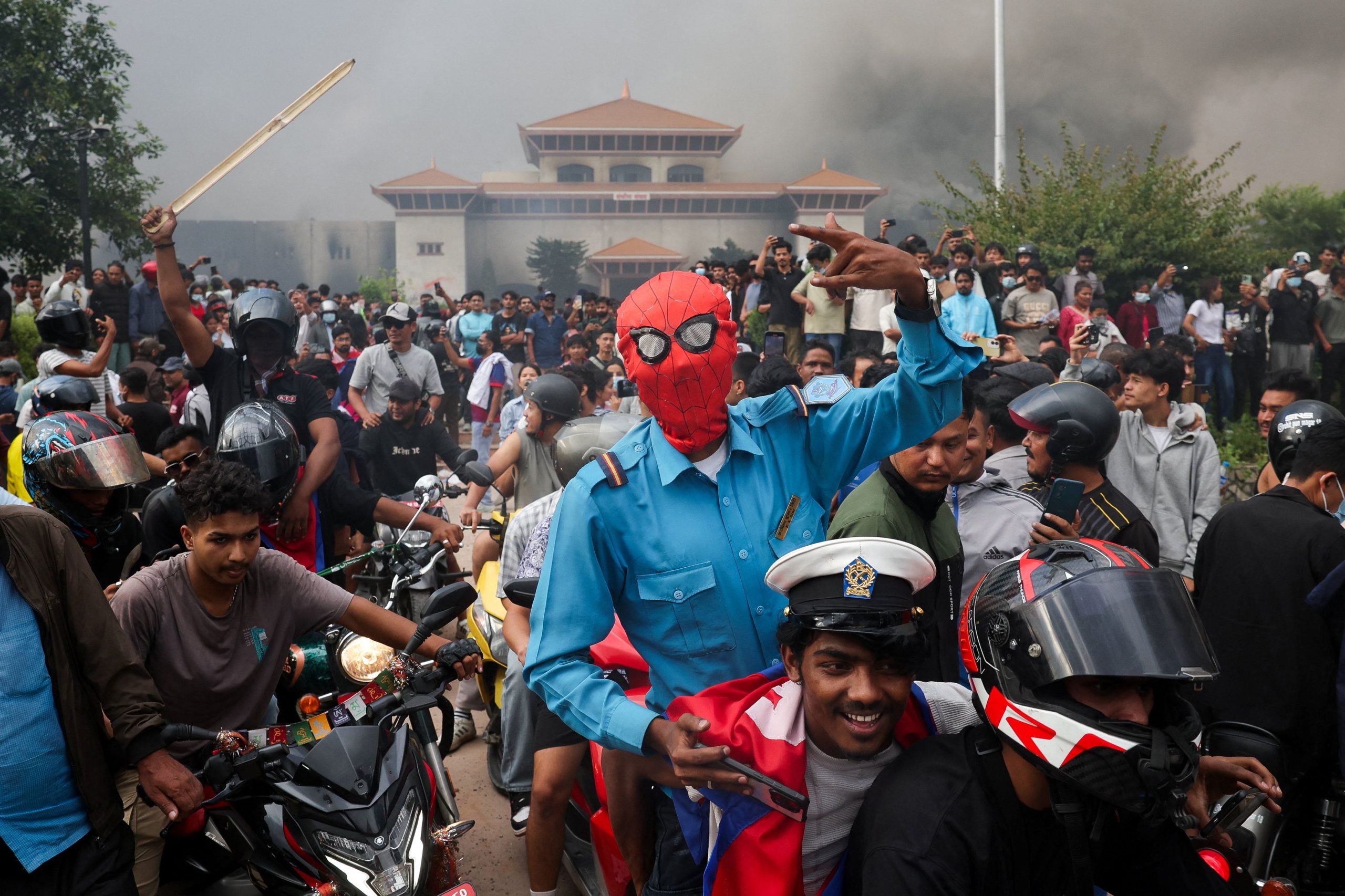
In Nepal, it was a politician’s son posing next to a Christmas tree made from designer shopping bags. In Indonesia, it was a lavish housing allowance for lawmakers amounting to 10 times the minimum wage. In East Timor, it was a multimillion-dollar plan to buy new SUVs for parliamentarians.
The perceived privileges enjoyed by an entrenched political elite have sparked a wave of protests across several Asian countries, where a large generation of young people is feeling deprived of economic opportunities .
Earlier this month, Nepali Prime Minister Khadga Prasad Sharma Oli became the third South Asian leader to be toppled by a popular rebellion in as many years, following his counterparts in Bangladesh and Sri Lanka. Smaller protest movements have popped up in Southeast Asia and forced concessions from politicians. These include East Timor lawmakers and Indonesian President Prabowo Subianto , who responded by removing a series of official perks , and the speaker of the Philippines’ House of Representatives, who resigned on Wednesday amid allegations of stolen public funds.
“On one side there are nepo babies flaunting corruption and on the other side there are common young Nepali people who are forced to leave their beloved country and families for studies and work abroad,” says Samip Paudel, a 22-year-old mobile-app developer who joined the protests outside parliament in Kathmandu.
Paudel said he carried a pamphlet he made using artificial intelligence depicting Oli eating bundles of money. “The nepo babies issue became a tipping point for our age group to rise up,” he says.
Protest movements led by Gen Z and young millennials are emerging in countries that for years had been promised the payoffs of a “demographic dividend,” in which an unusually numerous cohort of young people was meant to supercharge economic growth. In South Asia alone, one million people are due to enter the labor market every month between 2025 and 2030, according to the World Bank. The dynamics are similar in parts of Southeast Asia, especially in Indonesia, the world’s fourth-most populous country.
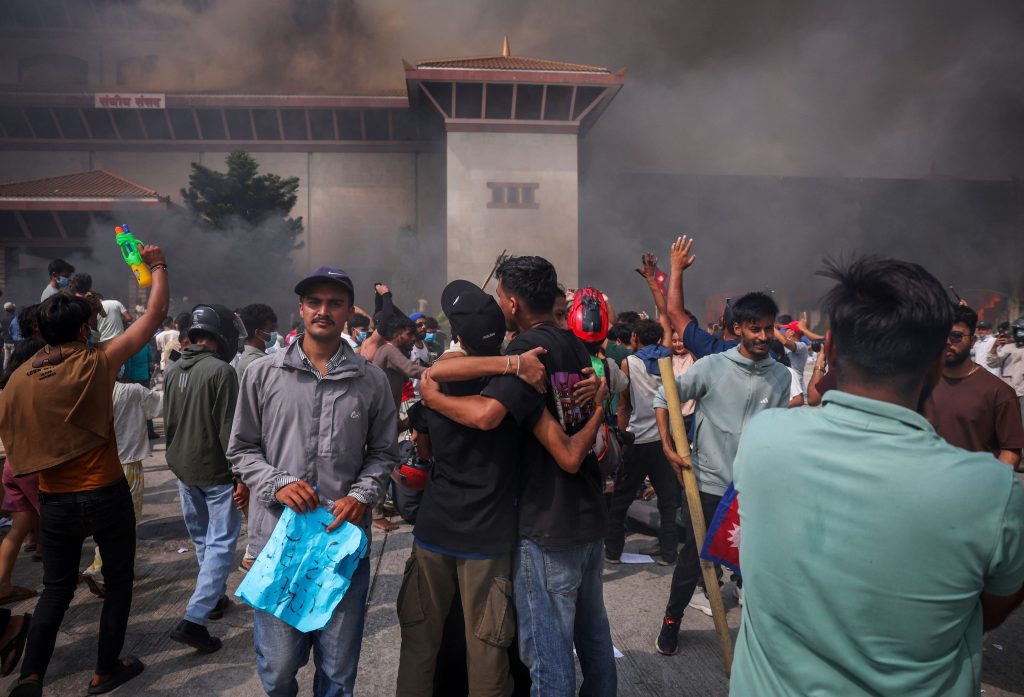
Demonstrators celebrate as smoke rises from the Parliament complex following a fire set during a protest against Monday’s killing of 19 people after anti-corruption protests that were triggered by a social media ban, which was later lifted, during a curfew in Kathmandu, Nepal, September 9, 2025. REUTERS/Adnan Abidi
Instead, economists are now talking about a “demographic deficit.” Many Asian countries aren’t creating enough jobs to keep up . Data from the International Labor Organization shows that the share of people aged 15 to 24 that isn’t in any form of employment, education or training was 33% in Nepal last year, 30% in Bangladesh and 21% in Indonesia. Those are some of the highest rates in the world outside of countries with active conflicts.
At the same time, two-thirds of the workforce in the Asia-Pacific region—some 1.3 billion people—are still informally employed, according to the United Nations. That means they lack the protections and benefits that come with more stable jobs that allow people to get ahead, instead of just getting by.
In the weeks before the protests, young Nepalis started sharing images taken from the social-media accounts of politicians’ children, tagging them #nepobaby or #nepokid. Among those that went viral were photos of Saugat Thapa, the son of Bindu Kumar Thapa, a businessman and provincial minister, wearing expensive clothes in high-end hotels or exotic travel destinations. In one photo, Saugat Thapa stands next to a Christmas tree made of bags and boxes from brands such as Louis Vuitton, Cartier and Gucci.
Young Nepalis, some in school uniforms, took to the streets after the government banned the use of several social-media platforms, including Facebook , Instagram and WhatsApp. The day after 21 protesters died in clashes with the police, crowds looted Bindu Kumar Thapa’s house in Pokhara, setting it on fire along with the national parliament in Kathmandu and the capital’s five-star Hilton Hotel .
“We realized with the government’s social-media ban that they were trying to silence us just when we started to raise our voice against corruption,” says Paudel, the app developer.
Oli, who resigned on Sept. 9, said Friday that his government hadn’t ordered the police to shoot at protesters and that Nepal had been on a path of economic progress. Bindu Kumar Thapa and his son didn’t respond to requests for comments. In an Instagram post, Saugat Thapa said outrage over the designer Christmas tree was an “unfair misinterpretation,” while his father said on Facebook that his properties had been reduced to ashes over baseless corruption accusations.
In Indonesia, last month’s demonstrations fizzled out after President Subianto canceled some parliamentary privileges and security forces detained protest leaders. The ruling coalition also revoked the seats of several lawmakers who were seen to have made insensitive remarks about the protesters.
In recent days, an Instagram account with the handle @cabinetcouture_idn has started tracking what it says are pricey designer items worn by politicians and their families, such as the minister of tourism and the wife of a prominent member of parliament. It has picked up over 174,000 followers since it began posting on Sept. 10. The lawmaker’s wife, herself a member of a regional legislature, declined to comment. The office of the tourism minister, Widiyanti Putri Wardhana, said the photo was taken before she entered politics, when she worked for a large palm-oil company. “As a government official, she has adjusted her lifestyle accordingly,” her office said.
Politics in Indonesia, as with other Asian countries, have become increasingly dynastic, says Yoes Kenawas, a postdoctoral research fellow at Atma Jaya Catholic University of Indonesia in Jakarta. In the current parliament, for instance, nearly one in four members has at least one relative involved in politics, according to the Jakarta-based Centre for Strategic and International Studies.
That figure still limps behind the Philippines, where 71 out of 82 provincial governors selected in midterm elections in May were members of political dynasties, according to the Philippine Center for Investigative Journalism. Martin Romualdez , the house speaker who resigned this week, is the cousin of President Ferdinand Marcos Jr. , who himself is the son of the country’s former, eponymous dictator.
Kenawas says many young people without political and family connections feel locked out from opportunities they see as accessible mostly to the rich and powerful.
“What we have right now is an educated youth, who are connected through social media,” he said. “And when they graduate from high school or from universities, they cannot get proper jobs.”
Write to Gabriele Steinhauser at Gabriele.Steinhauser@wsj.com and Krishna Pokharel at krishna.pokharel@wsj.com