
The nation’s fertility rates hit record lows in 2025 as childbearing continued to shift toward older women, according to new federal data released Thursday. For the sixth straight year, the number of children born in the U.S. remained at roughly 3.6 million.
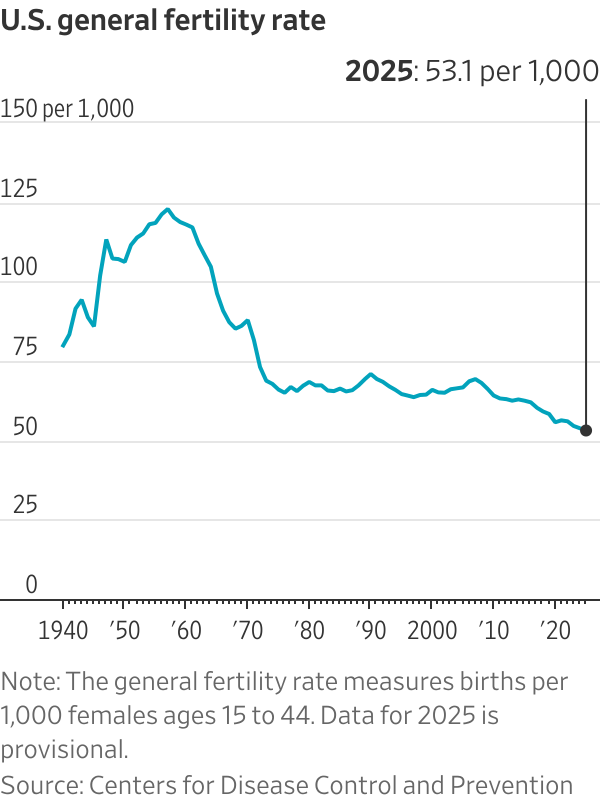
The number of births per 1,000 women ages 15 to 44—the general fertility rate—reached a record low of 53.1 in 2025, according to provisional data from the Centers for Disease Control and Prevention. The rate has mostly headed down since 2007, a prerecession peak when millennial women started to enter their prime childbearing years.
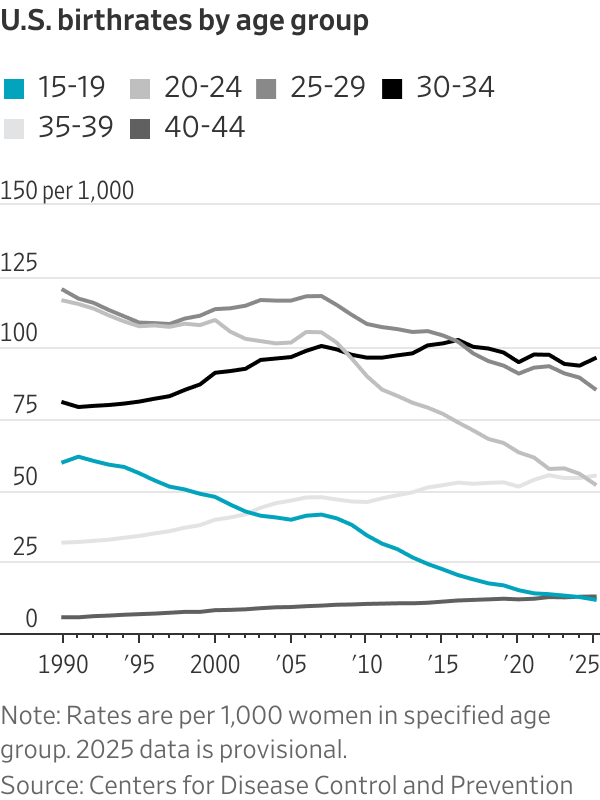
One long-term trend driving the slide: a sharp decrease in birthrates for teens and women in their 20s. In 2025, birthrates for women in their late 30s exceeded those for women in their early 20s for the first time.
The lack of growth in births continues to be driven by uncertainty about the future, including concern over finances, relationship stability and the political climate, according to Wendy Manning , a demographer at Bowling Green State University. But research shows many women still desire to have children.
“People are waiting longer to enter parenthood and probably want to make sure that things are set in their lives before they do so,” said Manning, co-director of the university’s National Center for Family & Marriage Research. “There might be a lot of uncertainty, and that might not be good for a society in general.” undefined undefined The teen birthrate fell 7% last year, extending a yearlong decline related to public-health campaigns and growing use of longer-acting contraceptives.
Since 2007, the birthrate for 15- to 19-year-olds has fallen 72% in the U.S.
“We spent decades and lots of money trying to discourage early childbearing, saying, ‘This will ruin your life. This will ruin your kid’s life. Don’t do it,’ ” said Karen Benjamin Guzzo , director of the Carolina Population Center at the University of North Carolina at Chapel Hill. In the 1980s and 1990s, the U.S. had much higher teen birthrates than many other developed countries, she said.
Among adolescents ages 15 to 17, the birthrate dropped 11% in 2025. Among those ages 18 and 19, the rate fell 7%, according to CDC data.
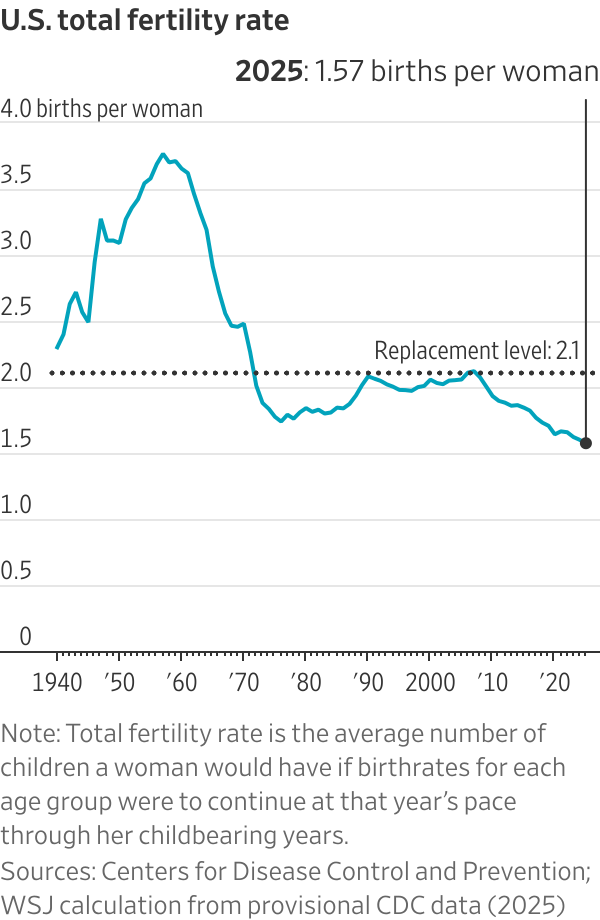
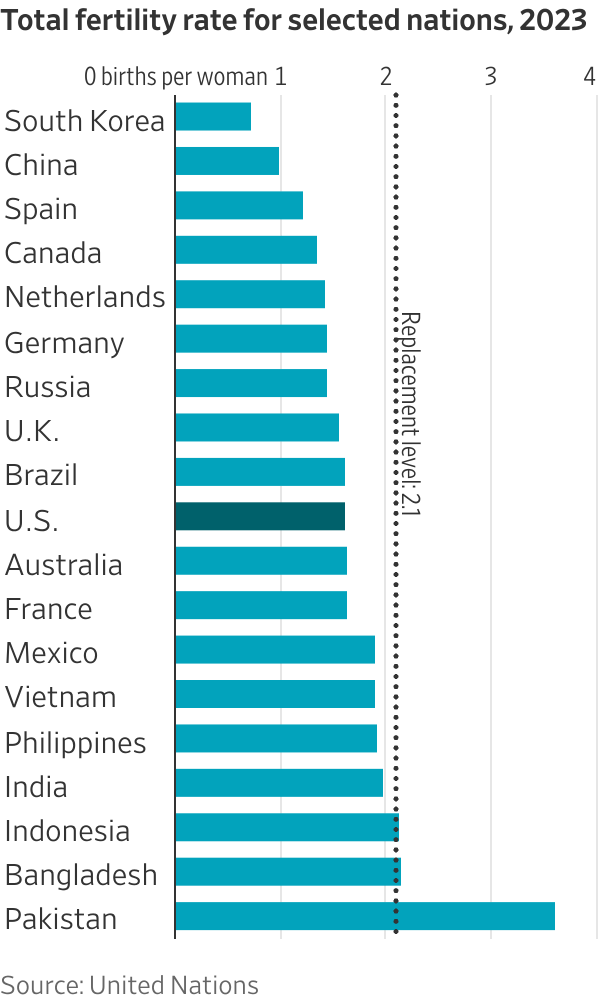
Another measure—the total fertility rate—also hit a record low. The total fertility rate is the average number of children each woman would have in her lifetime if birthrates for each age group were to continue at that year’s pace through her childbearing years. A rate below 2.1 means a population isn’t replacing itself and will eventually shrink without immigration .
Last year, America’s total fertility rate fell to 1.57 births per woman, according to a Wall Street Journal calculation using provisional CDC data.
The drop in total fertility in the U.S. follows worldwide trends, but it remains higher than in many developed nations. The most recent estimates from the United Nations show that the worldwide rate continued to fall in 2023 and was nearing replacement level. It had dropped below replacement level in more than half of all countries.
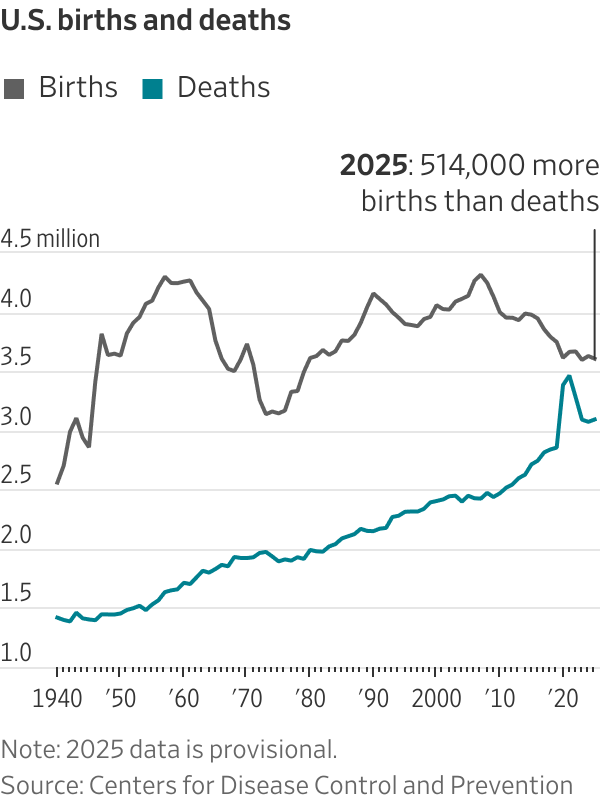
Flat births and a rising number of deaths are eroding a perennial source of population growth. Last year, the U.S. recorded just over a half million more births than deaths.
Census Bureau and Congressional Budget Office projections show that this small surplus of births over deaths will end in the next decade. Should that happen, growth would depend on immigration.
While non-Hispanic white women saw a small increase in births last year, births by women of other racial and ethnic groups declined slightly.
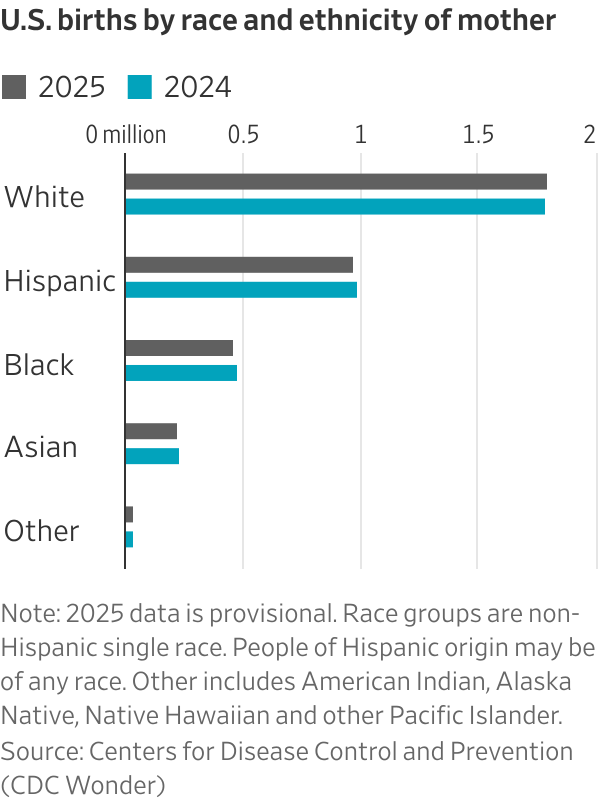
Provisional births data for 2025 reflects more than 99% of birth records analyzed by the federal government. The totals and rates are typically adjusted when the final data is released.
Write to Anthony DeBarros at anthony.debarros@wsj.com , Paul Overberg at paul.overberg@wsj.com and Andrea Petersen at andrea.petersen@wsj.com