Michael Steel prepared for the Boston Marathon by toggling between short and long runs. His training regimen for the Marathon du Medoc next month adds stopping at different pubs to down a glass of wine.
The course through France’s Bordeaux region requires runners to prepare their bodies not only for the harsh physical toll of a 26.2-mile road race, but also for the 20 wine stops along the route.
It’s not a combo that nutritionists endorse—but that’s part of the thrill.
“You also need to ensure that you’re going to get to the end in one piece,” said Steel, 43, from Southampton, England.
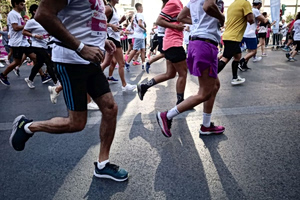
Drinking while marathoning is serious business. On social media, runners post clips of themselves drinking along the racecourse, even during major marathons like Chicago’s and New York’s. Some come prepared with drinks for the race. Others take drinks passed to them by spectators.
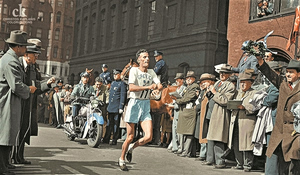
Medoc, the original marathon to layer in drinking wine, marks its 40th running on Sept. 5. It is more popular than ever. The race’s 8,500 slots sold out in nine minutes, and the wait list is now three times the size of the field of competitors, according to race president Vincent Fabre.
Runners have 6.5 hours to complete the race, a cutoff time comparable to some of the major marathons. Besides wine, the course is marked with tables of cheese, croissants, oysters, steak and ice cream. Oh, and every runner wears a costume. This year is ’80s-themed.
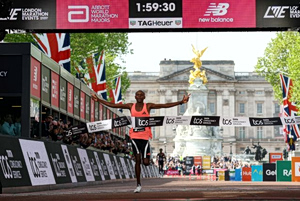
Steel is no stranger to marathon training. He has run all seven of the Abbott World Marathon Majors. He did Boston during a notoriously challenging cold, rainy year in 2018 . He takes Medoc just as seriously. Sort of.
“In the serious world of running, Boston is the crown to do,” he said. “But in the nonserious, drinking and fine-dining world, it’s the Medoc Marathon.”
Dietitian Farah Khan says wine is dehydrating and impedes the body’s ability to process carbohydrates, which would otherwise give runners energy. Runners also feel the effects of alcohol more quickly while exercising.
Khan, who teaches sports nutrition at Lehman College and Long Island University, said runners should consume lots of carbs and electrolytes the night and morning before the race. For those who insist on drinking, she has one recommendation: taste the wines like professionals, by sipping and spitting them out.
Fabre, the race president, doesn’t exactly disagree. He is also a professional winemaker. He said the point of Medoc isn’t to get drunk. It’s to sample the wines the region has to offer. Given the average age of runners is over 40, Fabre said he expects people to behave well and be safe on the course to enjoy the beautiful landscape.
“At 42, you are calm and you are mature,” Fabre said. “All the strange years are over.”
Unfortunately for Khan and Fabre, not everyone is sipping and spitting at Medoc. And while it’s not mandatory to stop at every château for a drink, some runners make a concerted effort to get their fill.
Runners say drinking is half the fun. Laura Lee and Lorri Fechtman, friends in their 50s from Pennsylvania who have a running podcast together, prepared to do the Marathon du Medoc last year by bringing a bottle of wine to a local 10-mile run. They snuck it into the race at the one-mile mark and took swigs throughout.
The pair feared they would get in trouble, but race security was more amused than angry, they recalled. They took a picture with Philadelphia police and firefighters.
“These guys were hysterical laughing,” Lee said.
She was thankful for the preparation when she arrived at the race and found that drinking didn’t mix particularly well with the late-summer heat in France. When Lee started to feel sick at Medoc, she skipped a few of the châteaus and drank water instead.
Samantha Montero, a 36-year-old flight attendant who ran the race last year, said training with wine made all the difference. While in Chicago, where she’s based, Montero did a run while drinking a swig of wine every half-mile with her friends. Naturally, she documented the training on Instagram.
“That just kind of lets your runner body know what you’re like when you’re running and drinking at the same time,” Montero said.
Guzzling that much wine presents another challenge: Unlike at a bar, there’s not always a bathroom when you need it. Thankfully, Lee and Fechtman said the vast vineyards on the route offer a workable alternative.
“There is very much a vineyard-peeing culture,” Fechtman said. “We were dropping trou in the vineyards.” (No one batted an eye, according to Lee.)
Steel, in the U.K., said he’s coming to this year’s race stocked with anti-inflammatories, ibuprofen and sunscreen to stay safe on the course. He’s planning to do the race with his partner, Joe Cousins, 36, and two friends.
“I will probably be beaming from ear to ear as we set off,” Cousins said. “Whether I’m still beaming at the end or whether I’m drunk, we can decide that on the day.”
Write to Elyse Goncalves at elyse.goncalves@wsj.com