Greece’s installed wind energy capacity has surpassed 6 gigawatts (GW) for the first time, marking a major milestone for the country’s renewable energy sector, according to new data released by the Hellenic Scientific Association for Wind Energy (ELETAEN).
By the end of the first half of 2026, total wind power capacity connected to the national electricity grid had reached 6,017 megawatts (MW). During the six-month period, 65 new wind turbines with a combined capacity of 320.6 MW were brought online, representing investments of approximately €400 million.
The increase amounts to a 5.6% rise compared with the end of 2025 and means that nearly as much new wind capacity was connected during the first half of 2026 as in the whole of the previous year.
ELETAEN described the figures as evidence of the sector’s resilience, crediting wind energy companies, engineers and researchers for continuing to deliver projects despite what it called a demanding environment marked by significant bureaucratic hurdles.
More projects in the pipeline
Around 700 MW of new wind farms were under construction at the end of the first half of the year, with the vast majority expected to be connected to the grid within the next 18 months. If those projects proceed as planned, Greece’s total installed wind capacity is expected to comfortably exceed 6.5 GW.
However, the association also noted that the pace of new construction has slowed compared with the previous six-month period, arguing that the country’s project development and permitting system requires substantial improvements.
Regional leaders and top operators
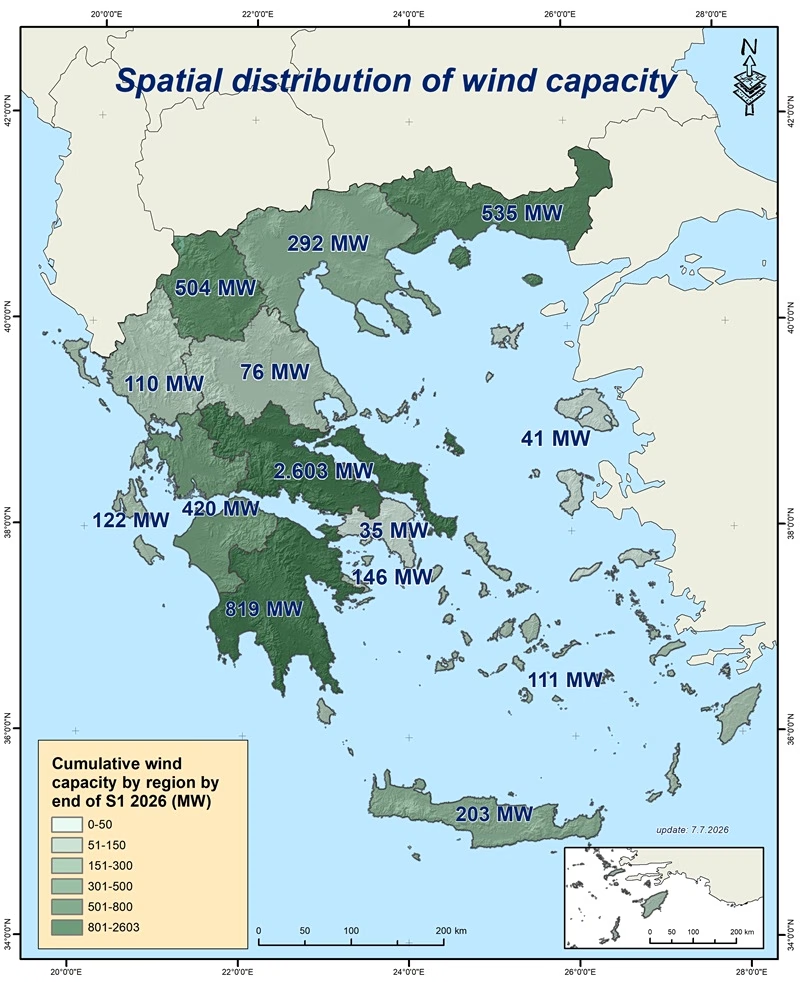
Central Greece continues to host the largest concentration of wind power capacity, accounting for 2,603 MW, or 43.3% of the national total. It is followed by the Peloponnese with 819 MW (13.6%) and Eastern Macedonia and Thrace with 535 MW (8.9%).
Among energy companies, TERNA Energy remains the largest wind power operator in Greece with 1,040.3 MW, followed by MORE (796.4 MW), Principia (514.1 MW), Iberdrola Rokas (409.2 MW) and PPC Renewables (319.2 MW).
On the manufacturing side, Vestas accounts for 43.1% of Greece’s installed wind turbine capacity, ahead of Enercon (23.6%), Siemens Gamesa (15%), Nordex (12.2%) and GE Renewable Energy (4.1%). During the first half of 2026, Nordex supplied the majority of newly installed turbines, followed by Vestas and Goldwind.
Permitting delays remain a challenge
ELETAEN also highlighted delays affecting wind farms selected through renewable energy auctions between 2018 and 2022. Those tenders awarded projects with a combined capacity of 1,592 MW, all of which should already be operational.
By the end of the first half of 2026, however, only 1,191 MW—or around 75%—had entered service, with the association attributing the delays primarily to administrative and permitting obstacles.
According to ELETAEN, these delays have broader economic implications, as many of the delayed wind farms would produce electricity at a lower cost than power generated from natural gas.