 Μake us preferred on Google
 Jean-Luc Mélenchon belongs to the category of political figures whom one can easily either hate or adore. It is difficult, however, to ignore him. With a Spanish grandfather and an Italian grandmother, he was born in 1951 in Morocco, later moved to France where, as a Trotskyist school student, he took part in the events of May 1968, attended the Épinay Congress as a socialist student alongside François Mitterrand, and subsequently worked as a printer, watchmaker, journalist, high school teacher, Freemason, senator, Member of the European Parliament, minister, and, in his political old age, leader of the French radical left.
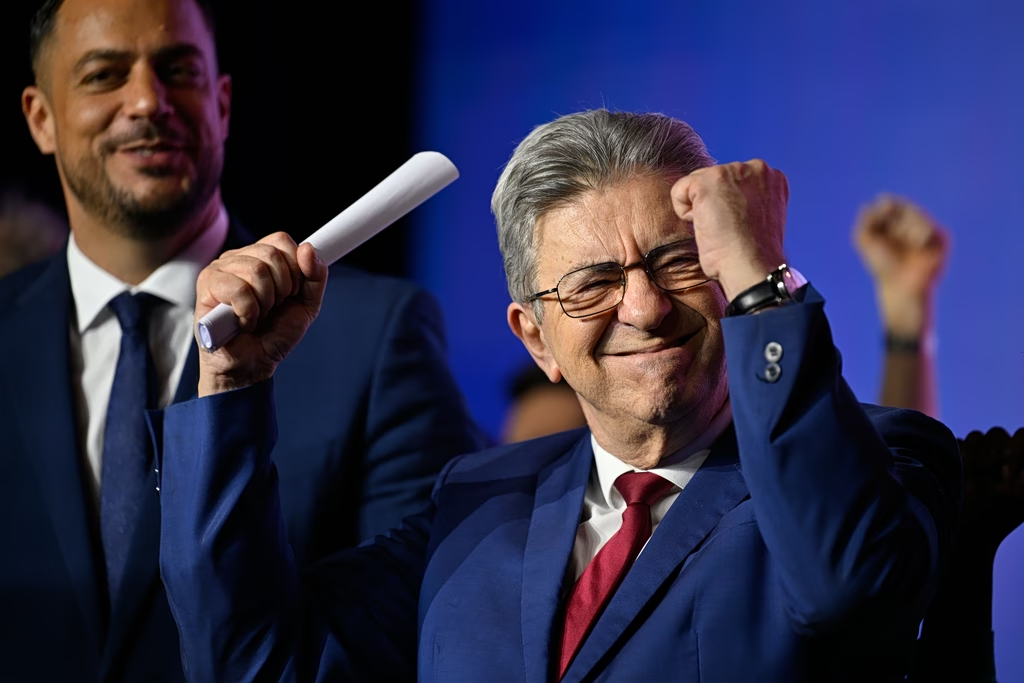
On 7 June, at an impressively large rally by French standards, attended by 20,000 people in the Paris suburb of Saint-Denis, he announced his intention to run in the spring of 2027, for the fourth time in his political career, for the presidency of the French Republic. He also assured all his political allies that “this time we will succeed,” because, as he put it, “the political alignment of the stars is favorable.”
Of course, Mélenchon’s greatest problem has never been of an astrological nature. It has always been himself—his fixations and his inability to restrain what is universally acknowledged to be his torrential rhetorical talent. Something like a French version of Theodoros Pangalos.
“This Is Our Home”
However, those who had the opportunity to watch his speech in Saint-Denis reached more or less the same conclusion: the Mélenchon they saw was not the one they knew. He was a different Mélenchon, one who repeatedly used the term “New France” and almost never referred to “La France Insoumise,” the name of the party he himself founded. It is telling that nine out of every ten flag-bearers at the rally carried French flags, while only one in ten carried the party’s flag. Even more telling was the fact that he delivered his speech from a written text, something he rarely does.
The political staging of the rally was certainly no coincidence. Mélenchon spoke with two iconic buildings behind him. One was the Saint-Denis Town Hall, and the other was Paris’s most important cathedral, the Basilica of Saint-Denis. The first is headed by a mayor named Bakayoko, who was elected a few months ago under the banner of La France Insoumise; the second houses the tombs of all the kings of France. “Look at the Basilica. France was created here. France is politically self-created,” Mélenchon told the crowd, whose dominant slogan was: “This is our home.” It was a slogan that Mélenchon did not hesitate to borrow from National Rally of Marine Le Pen, giving it, however, not a racial but a social meaning.
Notre force, c’est notre nombre !
Nous sommes 26 000 à Saint-Denis.
Rejoignez-nous !
Aidez-nous !
Ici est la force !#JLMSaintDenis #Melenchon2027 pic.twitter.com/k9JmwGsNdI— Jean-Luc Mélenchon (@JLMelenchon) June 7, 2026
At Le Pen’s rallies, the slogan is chanted by the supposedly “true French” against foreigners, whereas at Mélenchon’s rallies it is chanted, among others, by many children of immigrants who are now French citizens but do not belong to the economically privileged classes.
There is no doubt that, following the impressive rally of 7 June, Mélenchon has the political wind at his back. This is due, to a large extent, to the fact that, ten months before the presidential election, he is the only officially declared candidate in France whose candidacy is certain. Everyone else is either waiting or still considering whether to run.
Le Pen is waiting, as her political future depends on whether French judges, within the coming days, strip her of her right to stand for office because of her involvement in financial scandals. If they do, the French far right will contest the election with its protégé, Jordan Bardella, as its candidate. If not, Le Pen herself will run. Beyond that, the situation is chaotic, as the number of potential candidates from both the center-right and the center-left currently exceeds ten.
Meanwhile, Mélenchon has the entire field to himself. So much so that, taking advantage of the World Cup—and to help finance his campaign—he is selling French national team football shirts bearing the number 27 and his name.

In the past, Mélenchon had declared that he “hates football,” but in politics such things are details. At present, the undeniably tireless Mélenchon dominates, “not so much in terms of programme as in terms of visibility, ideology and theory,” as the newspaper Libération aptly wrote.
As for the policy aspect of his campaign, he is promoting it not through La France Insoumise but through his political institute, the Institut La Boétie. Étienne de La Boétie, after whom it is named, lived in the sixteenth century and was a judge, writer, early anarchist, and one of the founders of modern political philosophy in France.
During a speech ten days ago at a foreign policy seminar organized by the institute, the French politician most frequently cited by Mélenchon was none other than Charles de Gaulle. Arguing in favor of France leaving NATO and strengthening cooperation with China, he reminded the audience that the first Western leader to recognize the People’s Republic of China, breaking its diplomatic isolation during the Cold War, was Charles de Gaulle in 1964. He also argued in favor of dialogue with Russia “once it withdraws from Ukraine,” while adding that “this conflict was largely created by those who today lament its consequences.”
“He Got Off at Saint-Denis…”
Ten months before the presidential election, quite a few people now regard Mélenchon as the favorite in what is likely to be his final attempt to enter the Élysée Palace. If he succeeds, many will hail him. If he does not, he might perhaps find consolation in reading the wonderful poem by Orestis Laskos about “a very strange gentleman who always speaks in peculiar words whenever he sits with our company about Paris.”
That gentleman, the poem says, “for that dreamed-of journey killed fleeting desires and made bloody savings… until one day, late in life, he finally succeeds. And one morning, inside a train carriage, drunk with excitement, he sets off for Paris.”
But then, Laskos continues, “as soon as he caught sight of the Eiffel Tower faintly outlined against the sky, a dreadful thought burst into the chamber of his mind: ‘And then? And then what would happen?’ And so he made an enormous decision, one that no one has ever been able to forgive him for. Instead of continuing to Paris, he got off in a suburb, in Saint-Denis. And the next morning, by the very same route, he came back here.”