Every heavy downpour is now treated as an “extreme weather event.” It isn’t always. What is extreme, experts argue, is our refusal to accept that water has memory.
Hydrologists are unequivocal: the most effective flood-protection systems are open streams and free floodplains. When water is given space, it disperses. When it is trapped, it accelerates—and devastates.
In densely built cities like Athens, however, streams are suffocated by concrete and asphalt. Carefully designed flood-control projects can help, but only up to a point. Torrents cannot be tamed by underground tunnels when rainfall is intense. Streams overflow, roads become rivers, and urban space is quickly overwhelmed. What is needed are bold planning decisions: freeing up space for water and building works that delay or divert runoff before it reaches residential areas.
Torrents Through the City
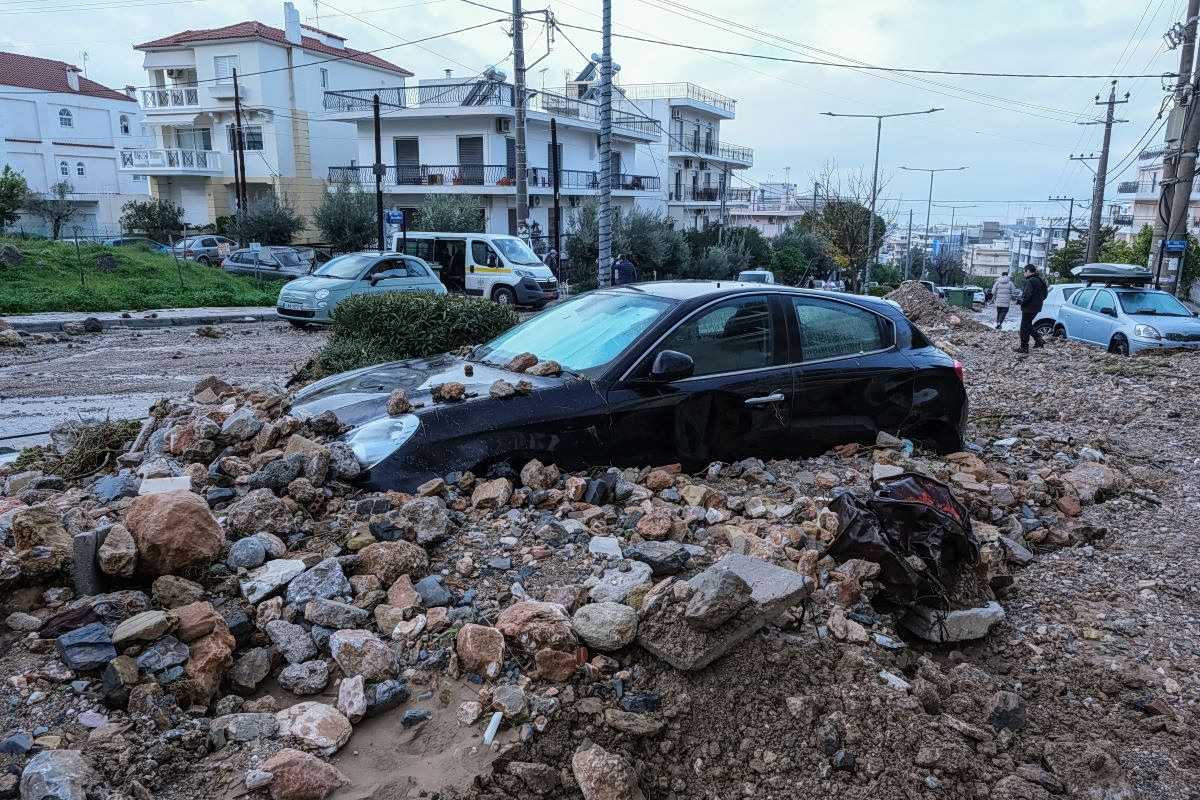
Last week, rivers and streams across Attica—the wider Athens metropolitan area—swelled once again. Large parts of the basin flooded, including Upper Glyfada, where a 56-year-old woman lost her life after being swept away by raging waters in a newly developed neighborhood at the foothills of Mount Hymettus.
According to George Tsakiris, President of the European Water Resources Association and Emeritus Professor at the National Technical University of Athens, intense flooding is typically accompanied by large volumes of sediment and debris. These materials are carried by streams originating outside the urban fabric and will continue to threaten settlements downstream—as seen in Glyfada during the recent storm.
To reduce the risk, Tsakiris explains, a combination of targeted small-scale interventions is required: check dams, perimeter drainage ditches, debris-retention barriers and sorting structures to prevent sediment from being carried into residential areas. These are projects designed either to slow water down or, in some cases, to guide it safely.
“Concreting streams is not a solution,” he stresses, “especially on sloped terrain, because floodwaters will move faster and become more dangerous.”
When Roads Become Flood Channels
The same principle applies to asphalt roads built on steep gradients without flood-control infrastructure.
“A paved road with significant slope acts as a linear flood accelerator,” Tsakiris explains. “Its surface roughness—the resistance water encounters—is three times lower than that of a natural stream. Essentially, there is nothing to slow the water down.”
He adds that the high flow velocities observed in residential streets—particularly those descending from Attica’s mountains such as Hymettus and Penteli—are caused not only by runoff volume but also by poor road design: the absence of storm drains, proper gradients and cross-sections with protective grates that would allow water to enter drainage systems.
A Road Without Protection
A stark example is Kyprillou-Methodiou Street, where the fatal incident in Glyfada occurred. The downhill road begins at the slopes of Mount Hymettus and ends abruptly at Agios Nektarios Street, directly in front of three homes that flood every time a torrent forms.
“We’ve lived here for 40 years,” says resident Stavroula Mouzouki. “When we first arrived, this road didn’t exist. There were empty plots that were later built on, and the road was created for access—without any flood-protection infrastructure. It ends right at our houses. Every time it rains heavily, all the water comes to us. We almost drowned.”
Another long-time resident, Theodoros Filios, recalls a similar disaster in 2009 after a wildfire stripped the area of vegetation. “After the first heavy rain, all the houses were filled with mud,” he says.
This time, he notes, floodwaters carried construction debris. “The area is under rapid development. Many new houses are being built, and bricks and materials had been illegally dumped on the mountain slopes. The rain brought them all down.”
Neighbor Fratzeskos Divanis describes the terrifying moments on Wednesday night: “What happened was tragic. Within the first 20 minutes of rainfall, the water was already above knee height.”
Rethinking Flood-Control Design
According to Tsakiris, large-scale flood-control projects also need a fundamental shift in design philosophy.
“They must ensure adequate channel dimensions and sufficient storage capacity within the drainage basin to temporarily retain water until the flood peak subsides,” he explains.
High-Risk Areas and Legal Battles
Areas along the Kifisos River—especially near its mouth—are marked “red” in Attica’s flood-risk management plans. While conditions improved after the Attica Regional Authority cleaned the river’s underground channel last year, major projects planned by the Ministry of Infrastructure to enclose the river’s open sections have stalled.
Two legal challenges are currently pending before Greece’s top administrative court, the Council of State (Symvoulio tis Epikrateias). The lawsuits contest the environmental approval of flood-control works along the stretch from “Three Bridges upstream of Red Mill to the Attiki Odos motorway.” Plaintiffs include the Municipality of Nea Filadelfeia, local residents, and the environmental group Roi (“Flow”).
After repeated postponements, the case is scheduled to be heard on March 4—a ruling that will determine the future of the project.
Deputy Mayor for Technical Services Efychia Papalouka notes that during the recent storm, the river’s natural sections functioned as relief zones, keeping damage limited. Opponents of the proposed enclosure argue that it fails to address the root causes of flooding, calling instead for a mix of smaller, flexible projects and the removal of illegal structures pressing against riverbanks.
Projects Underway—and Unresolved Questions
Legal obstacles also affect other projects promoted by the government and regional authorities, including works on two of Attica’s last free-flowing streams: Erasinos and the Great Stream of Rafina.
By contrast, at Faliro—near the mouth of the Ilissos River—dredging works and the reconstruction of three bridges are currently underway and expected to be completed by next summer.
According to Attica Regional Governor Nikos Hardalias, twelve additional flood-control projects are under construction in areas including Varkiza (Korpi stream), Saronida, Acharnes, Patima Vrilission and Ano Liosia.
Still unresolved is the fate of the Pikrodafni stream, where entire residential blocks precariously overhang the watercourse—a symbol of how closely urban development and flood risk remain intertwined in Athens.