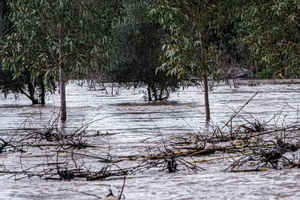
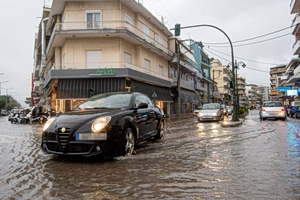
Severe flooding hit several Greek coastal towns in mid-February 2026, as stormy south winds and a combination of natural factors caused the sea to spill over into ports and streets. Authorities issued emergency alerts in areas including Chios and Serifos, with damages in Chios alone estimated at over €250,000.
Meteorologists attribute the floods primarily to an unusually deep low-pressure system, which lowered atmospheric pressure in the Northern Aegean to 982.7 hPa—about 30 hPa below normal. This drop caused the sea level to rise roughly 30 centimeters in some areas.

Tidal forces played a secondary role, coinciding with the new moon and spring tide. While this alignment slightly amplified water levels, the effect was limited as the moon was not at its closest point to Earth.
Climate change, though not the direct cause, has already raised the average sea level in the Eastern Mediterranean by 10–15 cm since the early 20th century, increasing the impact of extreme weather events. Projections suggest that, if global temperatures rise by 3 °C by 2100, sea levels could climb 50–70 cm in the region.
Experts warn that such flooding events, like the one in mid-February, are likely to become more frequent and destructive in the coming decades as sea levels continue to rise, combining natural storm processes with long-term climate trends.