There is something rather touching about movies with grit that still show admiration for a craft. “Couture” starring Angelina Jolie is one of those movies. Director Alice Winocour takes us to a fictitious Paris Fashion Week through the personal moments of 3 working women. The respectful nod to the work done by people in the entertainment industry does not undercut the glamour of the legendary fashion event, but instead gives it new dimension. Or perhaps it serves as a cautionary tale of the real consequences that accompany those sacrifices.
View this post on Instagram
Plot points & characters
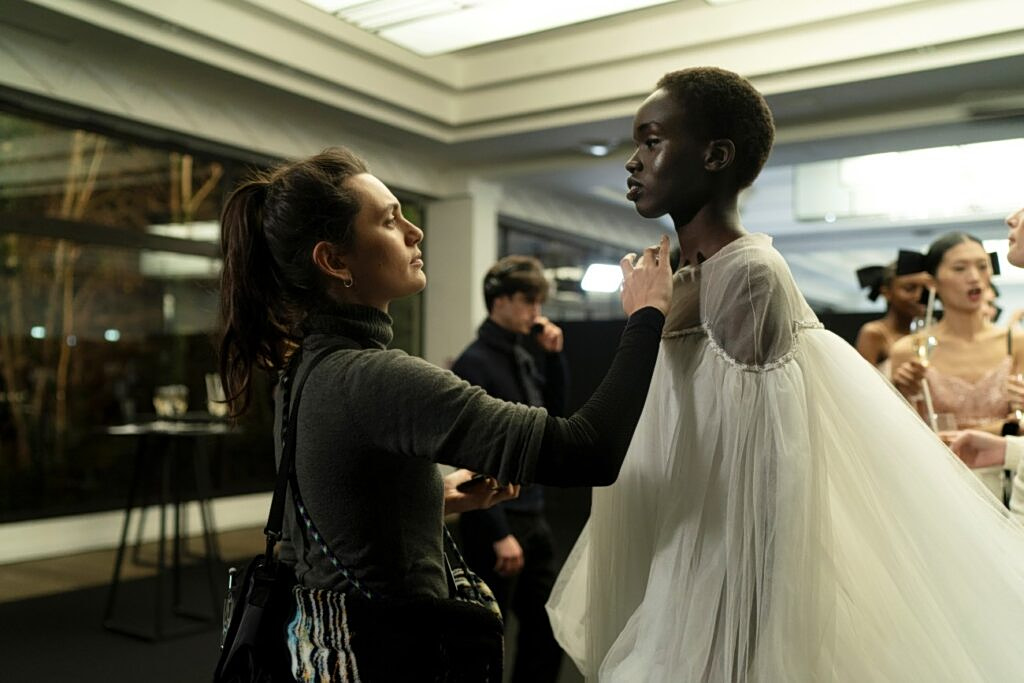
American filmmaker Maxine Walker (Angelina Jolie) is commissioned to direct a gothic short film, meant to act as a prequel of a Paris Fashion Week runway. While in the process of getting a divorce from her husband, she flies to Paris to complete the shooting and editing in time for the upcoming fashion show. For the new face of the French maison and the film, 18-year old Sudanese pharmacy student Ada (Anyier Anei) is scouted and flown to Paris. Even though Ada still plans on becoming a pharmacist, she took the job to help pay for her family’s expenses back home. On the set of her first photoshoot, Ada meets veteran makeup artist Angèle (Ella Rumpf) who is in the process of writing a book about her interactions with women in the fashion world.
Each woman faces her own private dilemma within the confines of the busy Fashion Week schedule. Maxine is hit with a devastating medical diagnosis, which exasperates her desire to reconnect with her daughter amid her divorce. Ada is facing a choice between a lucrative career as a model abroad and finishing her studies. As for Angèle, she is trying to write her own and others’ experiences in the fashion industry, but is failing to get publishers’ support. Show day approaches while we see glimpses of Ada’s couture dress being constructed by a young fashion designer. Between the 3 women’s struggles, we see the girl meticulously craft the first look of the runway. Skipping breaks, pricking herself, restarting, and showcasing a few fashion show superstitions.
View this post on Instagram
Look beyond the ‘rush’
When one thinks of fashion portrayed on film, it’s like a high-speed chase: everything needs to be done fast and needs to be done perfectly. Winocour’s choice to ‘slow down’ Fashion Week and hone into the emotional responses of our heroines is different and innately satisfying. One moment that stands out is when Maxine is told she has breast cancer by Dr. Laurent Hansen (played by Vincent Lindon). The palpable panic Jolie expresses is enough to transfix your eyes. No extraneous asphyxiating close-ups, no real visual change or heavy editing at any point (that I am distinctly remembering).
Contrastingly, Rumpf’s scene FaceTiming during a hectic work day, with what is presumed to be an author or publisher, is claustrophobically shot. What can’t have been more than a two-minute call feels like time stands still as Angèle’s eyes start welling up from the publisher’s harsh comments. Again, this is a directing choice I’ve often seen abused or overdone—but here it makes sense. In a room full of models, production assistants yelling out times and commands, Angèle is our only focus. Devastatingly, the call ends with him asking how she plans on paying for what was not constructive criticism but a discouraging “you’re not a writer, just a makeup artist”.
View this post on Instagram
Continuing on this isolated path, Anyier Anei’s slow motion scene the night before her runway debut shows her character lost. In thought, pain (literally, as she twisted her ankle practicing her walk), and surrounded by drunken models doing karaoke in a lavish hotel room. Ada’s doe eyes are blank, the instrumental soundtrack consumes all her surroundings as she ices her ankle in a champagne cooler. There is no room for error or pain in Paris Fashion Week, or most entertainment disciplines for that matter—your contract is your bond and privilege. Winocour’s “Couture” shows the audience what that means for women in art and their never-ending personal sacrifice. Physical, psychological, ideological and mental.
The unreal
There was a time where #MeToo spread like wildfire, and with it came a lot of sexual assault and rape allegations against many known names in the entertainment industry. What we have yet to fully acknowledge is abuse that goes beyond gendered discrimination, dehumanizing behaviors that still plague industry professionals. Having to step off set, needing 15 minutes for a phone call, or having a literal medical emergency is frowned upon. Nothing is more important than the set, the runway, and the completion of the project. The young seamstress seen intermittently in the film refusing breaks as she has too much work to do, director Maxine walks off set reluctantly for an hour and returns with a serious diagnosis she has no time to process. Experiences like these aren’t few and far between, they are everywhere, sometimes even considered necessary evils. Paying your dues, as it were.
When Angèle is told by an author that her stories from the makeup chair are “unrealistic”, it was laughable. Hopefully after several documentaries, institutionalizations of well-known stars and our own individual experiences in the adult world, a majority of the population does not think this way. As it is important to acknowledge Ada’s storyline; there is a powerful conversation within the film between Anyier Anei and Ukrainian model Yuliia Ratner (who plays herself). Both have left behind families in war-torn countries, and both have their eyes on the money as they miss their life back home. In an interview with DTF Magazine, Ratner shared the story she portrays is largely based on her own. “The story was written based on what I shared and, I think, on director Alice Winocour’s impressions from our personal conversations. Besides my character, parts of my story are also reflected in the protagonist, Ada. About ten years ago, when I was still a teenager, I came to Paris in much the same way to try my luck in the tough, adult world of fashion.” she recalls.
Furthering this film’s realism is its photography, which seems to be mostly relying on the natural lighting of the space. There is a fine line between “real-looking” and optical illusion, and it seems like it’s all harmoniously illusionary. While the chances to look like Angelina Jolie in a dimly-lit Paris hotel room are slim to none, “Couture” makes me as a viewer believe that I could.
View this post on Instagram
Male characters as frames and mirrors
If you do decide to watch “Couture”, I invite you to pay close attention to the leading women’s conversations with men.
There are two ways men are interacting with the main cast in this film: they are either naysayers or supportives. No part of the film shows a nuanced male character, the only exception arguably being Maxine’s director of photography played by Louis Garrel. He doesn’t offer much in terms of dialogue but shows a character range other men in the film don’t. The use of supporting characters to echo or antagonize the leading three’s thoughts is good; and necessary in some instances.
There are mentions of Ada’s little brother in almost all of her scenes. It’s clear that she persists in this job she feels unfit for to provide for him. Eventually we see them FaceTiming moments before she goes on the runway, begging her to return home and crying that he can’t be without her. We don’t get much context as to why he is this helpless without her; all we know is Ada’s father is tough. This temper tantrum coupled with her sprained ankle she is fighting to conceal drives Ada over the edge, as she spouts the all-too-familiar line: “Don’t cry, I’m doing this for you.”
Maxine’s ex is another male voice with the sole purpose of exasperating her emotions. At the start of the film as she’s unpacking in her hotel room, they share one phone call where he calls her negligent. Towards their teenage daughter Eden who she forgot to call back once she landed, and in terms of their pending divorce papers. This conversation is our introduction to her broken bond with her daughter, an open wound for Maxine that she finds herself unable to patch up while also keeping her professional life intact.
When Ada first lands in the office she will be working with for Paris Fashion Week, she is met by two dismissive French men. One undermining glance after another, with veiled compliments and exasperated sighs. Once she meets Angèle, the veteran makeup artist offers some encouraging words and a helping hand to the lost lamb. Regardless, Ada continues to feel like a fish out of water rather than the dynamic, new face of a French fashion house.
Is it ever enough?
“Couture” by Alice Winocour is an excellent answer to the question “Why do high fashion clothes cost so much?”. You can theorize about working conditions for ready-to-wear for days, but for high fashion/runway pieces the truth is one: each garment is made by hand. So one could only imagine how many weeks of painstaking sewing, planning, and fittings it takes to create one look.
For those already familiar with this reality, the film also acts as a point of reflection. Is it really a point of pride to have your life revolve so heavily around your career that you are unable to look after yourself? Blood, sweat and tears indeed; does the cost ever outweigh the benefit?