Athens and the wider Attica region will host a wide-ranging program for European Heritage Days, bringing together archaeological sites, museums, historic neighborhoods, schools and cultural organizations from September 24 through September 30. The activities explore both tangible and intangible heritage, with a strong focus on preservation, memory, climate change, traditional practices and the ways communities can keep the past alive.
The program includes guided tours of ancient sites, educational activities for children, exhibitions, workshops, performances, oral-history projects and discussions on the protection of cultural heritage. Several events also examine the risks facing monuments and collections, from environmental pressures and climate change to neglect, natural disasters and the loss of traditional knowledge.
Sept. 24: Language, memory and intangible heritage
“Let the Language Begin…” — Piraeus Group Cultural Foundation
The program gets underway on Sept. 24 at the Piraeus Group Cultural Foundation’s building in Tavros with “Let the Language Begin…”, an experiential exploration of intangible cultural heritage through language, memory and creative expression.
Traditional songs in different Greek dialects provide the starting point for an exploration of oral tradition and intergenerational knowledge. Participants are invited to connect the material with personal and family memories, recalling words, expressions, melodies and stories associated with their places of origin.
Sept. 25: A day focused on children, conservation and living heritage
“Walk with Aris the Frog” at the Lyceum Archaeological Site
Young children will be introduced to the archaeological site of the Lyceum, where Aristotle taught, through an educational program designed for kindergarten and first- and second-grade elementary students.
The activity aims to build awareness of the importance of preserving and conserving monuments, archaeological sites and finds. It also introduces children to the work of archaeological conservators.
“Games Without Borders” at the National Archaeological Museum
The National Archaeological Museum will invite third- and fourth-grade students on a hands-on journey through the history of play. Using objects from its collections as a starting point, children will discover games played in ancient Greece and compare them with games that remain familiar today.
“Writing, Drawing and Communicating Through Time” at the Hellenic Children’s Museum
Families with children ages 5 to 12 can explore how different civilizations recorded and communicated ideas in “Writing, Drawing and Communicating Through Time.” The activity looks at writing practices associated with the Minoans, Mycenaeans, ancient Egyptians and Chinese.
Participants will take on the roles of archaeologists and linguists, experimenting with forms of communication from different cultures and periods. The program connects ancient systems of writing with the creation of new forms of communication for the present and future.
“Protecting the Acropolis Monuments” at the Acropolis
A program for secondary-school students at the Acropolis archaeological site will focus on the protection of monuments as carriers of historical memory and cultural values.
Students will examine natural and human-made risks to cultural heritage, with particular attention to the monuments of the Acropolis. The activity encourages them to consider why preservation matters and how monuments can remain meaningful for future generations.
“Eve After Eden” — Public Sculpture Conservation Workshop
At Nikolopoulou Square in the Kypriadou area, elementary-school students will take part in a live conservation workshop centered on “Eve,” a marble sculpture by Grigoris Zevgolis.
The children will learn about the sculpture’s history and watch conservation work up close. They will also become familiar with conservators’ tools and methods and explore how public artworks are protected in an urban environment.
“Deterioration and Conservation” at the Municipal Gallery of Athens
The Municipal Gallery of Athens will open up the less visible side of museum work with an educational program for students ages 10 to 12.
Participants will meet specialists, view audiovisual material documenting conservation work and become familiar with conservation materials, tools and terminology, including cleaning, retouching and preventive conservation.
“Recording Memories” at the Basil and Elise Goulandris Foundation
The Basil and Elise Goulandris Foundation will host an oral-history station where participants can share and record personal experiences and memories connected to social and cultural life.
Topics include agricultural work, everyday customs, social relationships and connections to place. The recordings are intended to highlight the importance of intangible cultural heritage and oral history while creating an archive of personal stories and encouraging dialogue between generations.
“Two Sides. Many Stories” and a conference on coins
The Numismatic Museum will mark the occasion with the temporary exhibition “Two Sides. Many Stories” and a conference devoted to the protection, management and interpretation of coins.
Both activities take place on Sept. 25 at the museum on Panepistimiou Street.
“Ostracism-Ostrakon II: From Ancient Athens to Modern Forms of Exclusion”
The Epigraphic Museum will host thematic tours of “Ostracism-Ostrakon II: From Ancient Athens to Modern Forms of Exclusion” on Sept. 25, 26 and 27.
The exhibition brings together works by 40 contemporary artists with ancient inscriptions and ostraka—pieces of pottery used in the ancient Athenian practice of ostracism—from the Ancient Agora and Kerameikos. The tours examine the dialogue between ancient material and contemporary artistic responses to exclusion.
“Can a Monument Be Saved When It Loses Its Place?”
The Byzantine and Christian Museum will explore the question of what happens to monuments and objects when they become separated from their original surroundings.
Thematic tours on Sept. 25 and 27 will focus on the former Diocese of Evrytania and other examples of detached frescoes and objects saved from deterioration, abandonment or destruction. The activity highlights the museum’s role in protecting, documenting and giving monuments a “second life.”
“Tours of the Museum of Modern Greek Culture”
On Sept. 25, the Museum of Modern Greek Culture will offer tours of its permanent exhibition in Monastiraki, one of the oldest continuously inhabited parts of Athens.
The museum presents aspects of the area’s historical, social, economic, urban and architectural development while introducing visitors to important elements of modern Greek culture. Tours are scheduled for 11 a.m. and 1 p.m.
Remembering clarinetist Petro-Loukas Halkias
The Museum of Greek Folk Musical Instruments will host a tribute to Petro-Loukas Halkias, a major clarinet player who began his career in Delvinaki in Epirus in the 1940s.
The event looks at his contribution to Greek musical heritage and his role as a cultural symbol connecting people from Epirus and the wider Greek diaspora with the musical traditions of their homeland.
“Historical Buildings Facing the Risk of Climate Change”
A two-day scientific conference on Sept. 25 and 26 will examine how historic buildings can be protected and made more resilient in the face of climate change.
The program brings together traditional building knowledge and emerging technologies, addressing climate-risk assessment, the deterioration of traditional materials, bioclimatic design, innovative nanomaterials and digital technologies such as Internet of Things sensors and digital twins. It will also consider approaches to crisis management and institutional protection.
“The Cultural Heritage at Risk” — Piraeus Group Cultural Foundation
Children ages 10 to 12 will explore the role of libraries and conservation in protecting cultural knowledge through an experiential educational program at the Piraeus Group Cultural Foundation in Tavros.
The activity introduces children to the book as a carrier of memory and information, examines threats to collections and presents basic conservation principles. Participants will also learn initial emergency measures for books damaged by flooding and receive practical guidance on protecting books at home.
“Yerma” at the Piraeus Group Cultural Foundation
The performance “Yerma”, based on Federico García Lorca’s play, will turn exhibition and museum materials into the starting point for a theatrical exploration.
Two guides present the story as though it were an exhibition, combining spoken word with music, sound and performance. As the production develops, the historical material becomes connected with questions that remain relevant in the present.
“Clay: A Heritage That Survives”
Students at the Special Vocational Education and Training Workshop in Kallithea will explore cultural heritage through the creation of ceramic works.
The activity considers memory, loss, resilience and preservation, with students drawing inspiration from the marks of time and contemporary threats such as climate change, the loss of traditions and cultural alienation. Individual and group works will turn those ideas into a shared creative experience.
“Little Environmental Engineers” in Kaisariani
Students at the 2nd Kaisariani Junior High School will explore traditional irrigation as an example of intangible cultural heritage.
The hybrid educational program connects traditional gravity-fed irrigation channels with contemporary questions of sustainability and climate change. A live digital connection with the community of Kyriakochori in Phthiotis will link the students with people preserving this traditional practice.
Sept. 26: Architecture, memory, art and heritage at risk
“The Monastery of Daphni: A Chronicle of Survival”
The archaeological site of Daphni Monastery will host an activity examining the monument’s long and challenging history.
The program connects the monastery with major historical events while considering the natural and human-made threats it has faced. It also highlights restoration and protection efforts and asks what future risks might mean for the survival of cultural heritage.
“The World of the Avant-Garde” and George Costakis
The National Gallery – Alexandros Soutsos Museum will dedicate a two-day program to collector George Costakis, whose collection played a central role in preserving Russian avant-garde art from oblivion and destruction.
Held in connection with the exhibition “The World of the Avant-Garde: City, Nature, Universe, Man,” the Sept. 26-27 program combines talks, a film screening, a musical event, tours and educational activities. Together, they explore the significance of the Costakis Collection as an example of cultural preservation.
“Heritage in Transition: Art and Migration”
The Basil and Elise Goulandris Foundation will offer two guided tours on Sept. 26 focusing on artists who experienced migration, displacement, exile or refugeehood.
Selected works from the permanent collection will show how artists carried memories, symbols, traditions and cultural references from their places of origin into new homes. Tours will take place at 1 p.m. and 4:30 p.m.
“Thread That Connects Us”
From Sept. 25 through 27, the Goulandris Foundation’s reception area will become a participatory embroidery space.
Visitors will be invited to add their own small motif to a large canvas using colorful threads and needles. Over the course of the event, the individual contributions will form a collective embroidery representing coexistence, participation and community.
“Saving Memory: The Cultural Heritage of Wars and National Struggles”
The War Museum will offer tours of its exhibition spaces on Sept. 26 and 27, focusing on objects, documents and stories connected with wars and struggles in Greek history.
The tours emphasize the importance of protecting historical evidence so that the stories, experiences and sacrifices of previous generations remain accessible to the future. Tours are scheduled at noon, 5:30 p.m. and 8 p.m. on Saturday, and at noon and 5:30 p.m. on Sunday.
“Brauron 2026: Heritage at Risk”
The Municipality of Markopoulo will host a photo walk at the medieval monument of the Tower of Brauron on Sept. 26.
The activity will combine an exploration of the monument with the production of printed informational material about the site.
“Embroidered Bread of the Mesogeia”
The Municipality of Saronikos will present the folklore surrounding the traditional embroidered bread of Mesogeia on Sept. 26.
The activity will introduce visitors to the tradition and explain how the distinctive bread is prepared, offering an example of local culinary heritage and traditional practice.
“In the Form of Water: Conversations and Stories of Piraeus”
On Sept. 26 and 27, a philosophical and experiential walk will explore Piraeus through its waterfront and urban landscape.
Participants will take part in guided conversations and structured activities in public space, connecting ideas of deterioration and resilience in the historic landscape with contemporary experiences of personal and collective resilience.
Sept. 27: Ancient sites, neighborhoods and community memory
“Lavreotiki: Monuments at Risk, Landscapes of Resilience”
Two important archaeological sites in southeastern Attica—the ancient mining and metallurgical installations at Souriza and the Sanctuary of Poseidon at Sounion—will be explored on Sept. 27.
The program examines how people and the environment have shaped the cultural landscape of Lavreotiki over time. Tours will address the sites’ historical connections, the role of ancient ore-processing facilities and the relationship between the Sanctuary of Poseidon and the region’s mineral wealth, while also focusing on present-day threats including natural deterioration and climate change.
“The Sanctuary of Brauronian Artemis”
A guided visit to the Sanctuary of Brauronian Artemis will combine the archaeological site with the nearby Archaeological Museum of Brauron.
Visitors will explore the sanctuary in a densely vegetated landscape that has remained largely intact since antiquity before continuing to the museum to examine its finds. The program focuses on the threats facing monuments in a rapidly changing environment and the importance of protecting cultural heritage.
“Aigosthena: Past, Present and Future”
The archaeological site of Aigosthena contains one of the most imposing ancient fortresses in Greece and an important example of ancient military architecture.
The Sept. 27 activity traces the monument’s history through periods of damage, loss and restoration. It also examines the threats facing the site today and the value of conservation and restoration in safeguarding cultural heritage.
“Historic Walk Around the National Archaeological Museum”
The National Archaeological Museum will offer an evening walk around the museum on Sept. 27, tracing two centuries of history through a small but significant part of central Athens.
The route begins when the museum site was still a small Turkish vineyard and follows episodes and upheavals from two centuries of Greek history to the present, including the period immediately before the museum’s building and exhibition expansion.
“A Walk on the Acropolis with Phidias and Ictinus”
Young students from the 12th Kindergarten of Kamatero will guide teachers and parents around the Acropolis on Sept. 27, presenting the achievements associated with Phidias and Ictinus.
The activity places children at the center of the interpretation of cultural heritage. It emphasizes how learning, reflection and appreciation of the past can begin at an early age and inspire older generations.
“Protecting Our Monuments” at the Museum of Greek Children’s Art
Children ages 6 to 12 will take part in an art workshop exploring both tangible and intangible cultural heritage.
Drawing inspiration from works in the museum’s collections, participants will consider monuments, historic buildings, stories, traditions and customs from different countries. The workshop also addresses contemporary challenges such as climate change and urbanization through children’s art.
“Let’s Go Herakleidon: From the Neighborhood’s Past to Its Future”
The Herakleidon Museum will host a talk and open discussion on Sept. 27 devoted to the history, memory and identity of the Herakleidon neighborhood and the surrounding area.
Oral testimonies, personal stories, photographs and other material from local residents will form the basis for a conversation about the neighborhood’s changing identity and collective memory.
“Whoever Takes Care of Their Clothes…” — Cultural Heritage at Risk
The Museum of the Lyceum Club of Greek Women will host a lecture on Sept. 27 examining the risks faced by monuments, collections and historical evidence.
The discussion will consider natural and human-made disasters, the effects of climate change and the responsibilities of institutions, scientists and citizens in protecting cultural heritage. It will also address prevention and risk management at both national and international levels.
“The Fióra”: A Cypriot Beaded Headpiece Workshop
The National Historical Museum will offer an adult workshop on Sept. 27 devoted to fióra, a traditional Cypriot beaded head ornament.
Participants will learn the materials and techniques used to create the floral motifs, working with needle, thread, beads and metal wire. The workshop follows an authentic design from the museum’s collection and turns the making process into a hands-on cultural experience.
“Playing with the Senses, Discovering Heritage”
The Museum of School Life and Education will host two experiential workshops for very young children and their families on Sept. 27.
The first, for babies ages 18 to 28 months, uses sensory and messy play to explore textures, colors and materials. A second workshop, for children ages 3 to 5, combines interactive storytelling, sensory environments, experimentation and early role-playing to encourage imagination, observation and expression.
“A Mystery in 2050: Intergalactic Journeys Through Time”
The Maria Callas Museum will become the setting for an immersive music-and-theater adventure for the whole family on Sept. 27.
The experience uses the museum as a stage for imagination and discovery, inviting participants to become co-creators of the cultural heritage of the future.
“Guardians of Heritage” at the ESTIA of Nea Smyrni
The ESTIA of Nea Smyrni will bring together members of the organization, local residents and people with family memories connected to the history of Greek refugees.
The Sept. 27 program includes an introductory seminar on heritage at risk, practical training in heritage protection and management, an oral-history workshop titled “Memories That Endure,” and a simulation exercise focused on risk and emergency scenarios.
“Walking Through Memory” at the Third Cemetery of Athens
An adult guided tour on Sept. 26 will follow the 1940-1944 Memory Route at the Third Cemetery of Athens.
Based on archival research and extensive on-site investigation, the tour explores the cemetery’s role during the years of German occupation. It brings attention to stories of famine, executions and resistance in Athens.
“The Leontari Cave of Hymettus”
The Leontari Cave on Mount Hymettus will open to the public for a guided exploration on Sept. 27.
Because the cave is not an organized archaeological visitor site, participants will enter with specialist scientists and learn about ongoing research. The activity aims to raise awareness of the protection and interpretation of the cave’s natural and cultural environment and the wider area.
“Writing History Together” at the Archaeological Museum of Piraeus
Archaeologists and conservators from the Ephorate of Antiquities of Piraeus and Islands will tell the stories of ancient objects that citizens handed over to the Archaeological Museum of Piraeus.
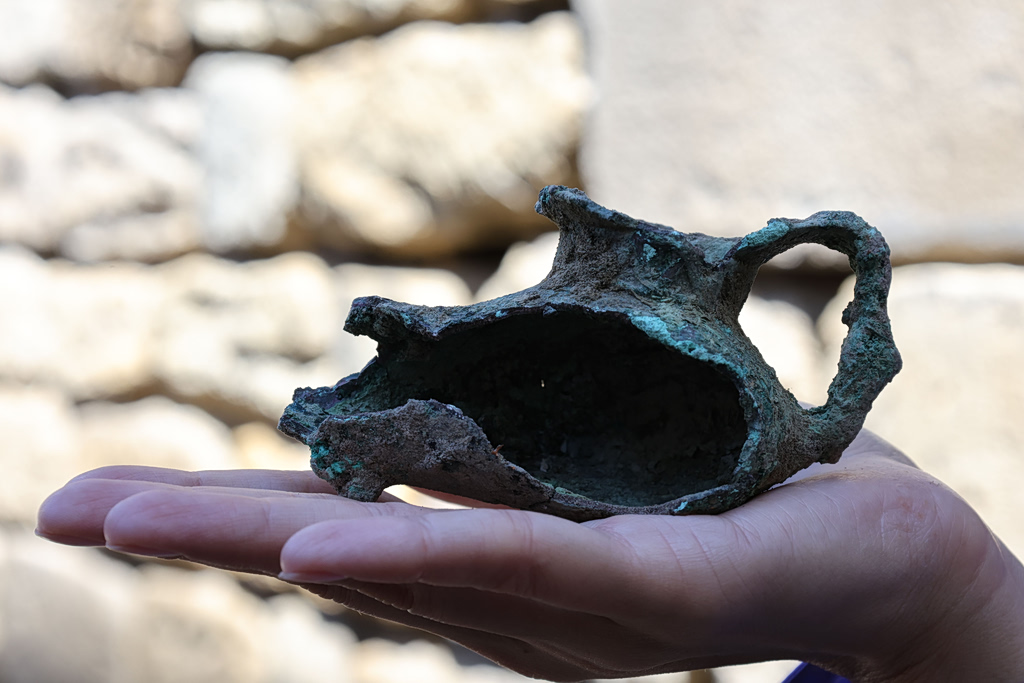
The objects include funerary reliefs, parts of statues, clay grave goods and a rare bronze ram. The Sept. 25 program is aimed at students, while a thematic tour for the general public will take place on Sept. 27, highlighting how individual responsibility can contribute to the preservation of cultural heritage.
“Athens Poetry Walk: Routes of Memory and Language”
On Sept. 27, Athens Poetry Walk will reinterpret the city through poetry, combining movement through the urban landscape with live readings at selected locations.
Guests from the academic, literary and artistic fields will perform poetry, while a creative-writing activity for students will invite participants to use words, lines and ideas to compose their own poems and place their experiences on the city map.
“The Historic Buildings of Psychiko Speak”
Monumenta and the Municipality of Filothei-Psychiko will lead a Sept. 27 walk through the historic buildings of Psychiko, a garden suburb planned and developed from the 1920s.
The neighborhood functions as an open-air architectural museum, with buildings representing different styles and periods of Greek architecture. The tour will look at buildings that survive and those that have disappeared before concluding at A’ Square for a discussion with participants.
Sept. 28: Protecting books and preserving knowledge
“Cultural Heritage at Risk” — Adult Workshop
The Piraeus Group Cultural Foundation will return to the theme of endangered cultural knowledge on Sept. 28 with an experiential workshop for adults.
Participants will follow the history of the book, examine threats to books and learn basic preventive conservation practices. They will also take part in an exercise involving first-response measures for books damaged by flooding and receive advice on protecting books at home.
Sept. 30: Documenting the historic fabric of Psyrri
“Walking Psyrri: Recording Abandoned Historic Buildings”
The final activity in the supplied program takes place Sept. 30 in Psyrri, where participants will walk through the neighborhood while documenting abandoned historic buildings.
Psyrri retains a significant number of 19th- and early 20th-century buildings, many of them protected as historic structures. The walk will explore their history and architecture while recording their current state of preservation, beginning at Heroes’ Square and continuing through much of the neighborhood.