Greece’s natural gas grid operator, DESFA, is continuing to keep Motor Oil’s planned “Dioriga Gas FSRU” out of its development program for the National Natural Gas System; a move that effectively leaves the project outside the operator’s planning framework for the works needed to bring it online.
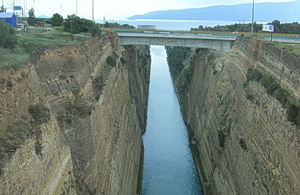
The €400 million project, an LNG floating storage and regasification unit (FSRU), is planned offshore from Motor Oil’s refinery facilities in Agioi Theodoroi, in the Corinth region, and is positioned to compete with DESFA’s Revithoussa terminal as well as the Alexandroupolis FSRU operated by Gastrade.
In its draft 10-year development plan for 2026–2035, now under public consultation by Greece’s Regulatory Authority for Waste, Energy and Water (RAAEY), the Hellenic Gas Transmission System Operator (DESFA) leaves out two key infrastructure projects that would enable the development of Motor Oil’s competing Dioriga Gas FSRU. The operator states that it is removing the projects from both its financing and development planning. The works concern a metering and regulating station required to connect the Dioriga Gas FSRU to the national grid, as well as the doubling of the high-pressure Patima–Livadeia pipeline branch. DESFA had also excluded the same projects from its previous 2025–2034 development plan, which has not yet been approved.
DESFA Cites Contract Breach for Exclusion
DESFA said in its 2026–2035 development plan that the connection project — a metering and regulating station required to link the Dioriga Gas FSRU to the grid — was contingent on the timely fulfillment of specific contractual obligations by the developer, Dioriga Gas S.A. The operator said those obligations were not met, triggering termination of the contract in line with its terms and applicable regulations. As a result, the project is being removed from the Ten-Year Development Program.
The planned doubling of the high-pressure Patima–Livadeia pipeline was tied to the connection works and subject to Dioriga Gas taking a final investment decision, DESFA said. With the connection project now excluded, the pipeline upgrade is also being dropped from the plan.
A Competitive Flashpoint
The decision has wider implications because DESFA controls 100% of the Revithoussa LNG terminal, Greece’s main LNG entry point, located on an islet west of Athens. It also holds a 20% stake in the Alexandroupolis FSRU project in northern Greece.
Motor Oil’s project would effectively create a new LNG entry point in southern Greece, competing with both Revithoussa and the Alexandroupolis FSRU.
Dioriga Gas argues that its project is the most mature among competing LNG infrastructure proposals. It already has an installation license and a completed development design, with only the final investment decision pending.
The project has also been classified as a “strategic investment” by the Greek government’s competent committee and is included in the country’s National Energy and Climate Plan.
Motor Oil’s Allegations
In a strongly worded letter made public by DESFA following the consultation process, Dioriga Gas accused the operator of acting in violation of its role as a neutral and impartial system manager.
“The action of the Operator is unacceptable,” wrote Ioannis Kioufis, chairman and CEO of Dioriga Gas, arguing that DESFA is legally required to facilitate and not obstruct access of new infrastructure to the national system.
The company claims that excluding the connection works effectively blocks a new LNG entry point in southern Greece and undermines competition in the natural gas market.
Dioriga Gas also suggested that DESFA benefits financially from maintaining the current structure. According to the company, strong demand for LNG slots at Revithoussa —currently the only reliable LNG import infrastructure in southern Greece — has led to estimated profits of €400 million for DESFA from future slot auctions.
With only 30- 40 LNG time slots available at Revithoussa, users compete intensely, pushing prices higher. Dioriga Gas claims that usage costs have risen from €1.2 per megawatt-hour to €4 per megawatt-hour, costs that are ultimately passed on to electricity producers and, in turn, to consumers and the broader Greek economy.
A second LNG facility in the southern system, the company argues, would reduce such distortions and improve economic efficiency in both the gas and electricity markets.
Broader Energy Strategy Concerns
Dioryga Gas further argues that DESFA’s move runs counter to the Vertical Corridor initiative which aims to boost gas flows from Greece to Southeast and Central Europe through increased LNG imports and expanded cross-border interconnections. Removing what it describes as a mature and strategically designated entry point in southern Greece, the company argues, weakens the resilience and geographic diversification of the national gas system and reduces Greece’s ability to act as a reliable regional energy hub.
Dioryga Gas also suggests in its letter that DESFA is overstepping in its management of what it describes as a public good, namely access capacity to Greece’s National Natural Gas System. It also accuses the national grid operator of acting in a manner inconsistent with the state’s designation of the FSRU as a strategic investment.
The company argues that any dispute over the validity of its contract cannot be treated as a purely private matter between two corporations, given that DESFA operates critical national infrastructure. That is particularly the case, it says, when the project has been formally classified by the government as a strategic investment, incorporated into Greece’s National Energy and Climate Plan and described as more advanced in licensing terms than comparable proposals.
Dioryga Gas added that the competent regulatory authority has already taken up the matter, underscoring that oversight of such issues does not rest solely with the system operator.