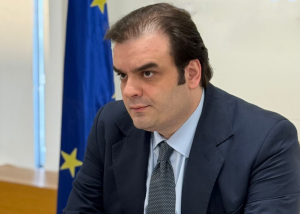

Greek Minister of Economy and Finance Kyriakos Pierrakakis struck a tone of urgency and unity Monday as he delivered his first doorstep statement ahead of chairing the Eurogroup for the first time as its new president.
“We’re meeting today in light of recent international developments in a highly volatile geopolitical environment where European unity is of essence, where dialogue is of essence, where European coordination is of essence in order to uphold the core principles of sovereignty and adherence to international law,” Pierrakakis said as he arrived for the meeting of eurozone finance ministers.
He added that the bloc must “deliver with nimbleness and speed,” underscoring his pledge to achieve “tangible results” during his presidency.
Speaking to reporters as he arrived for the session, Pierrakakis outlined the core priorities he had already flagged when announcing his candidacy for the role. He said his presidency would focus on four pillars: building a Savings and Investment Union, completing the single market, advancing the digital euro, and safeguarding Europe’s economic foundations.
“This is about moving from ideas to concrete outcomes,” Pierrakakis said, emphasizing the need for efficiency and institutional maturity as the eurozone confronts a demanding economic environment.
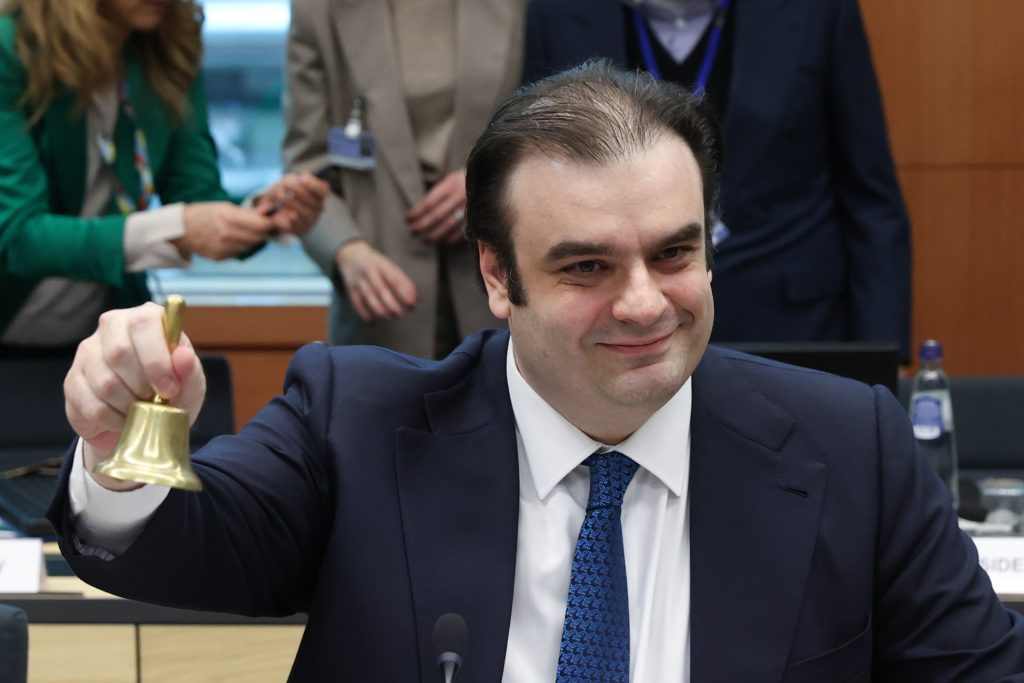
Eurogroup meeting in Brussels, Monday, Jan. 19, 2026.(POOL PHOTO/EUROPEAN UNION/EUROKINISSI)
Bulgaria and the G7 on the Agenda
Pierrakakis said eurozone enlargement would be a central topic of the meeting, with a spotlight on Bulgaria’s entry into the euro. He welcomed Bulgaria’s accession just ahead of the first Eurogroup session of the year, calling it a milestone for the single currency area.
He also said ministers would discuss priorities stemming from recent G7 meetings. The briefing will be delivered by Roland Lescure, France’s finance minister, as France currently holds the G7 presidency.
Lescure is expected to outline French priorities and report on the Jan. 12 meeting of G7 finance ministers in Washington, where discussions focused on reducing dependence on China for critical minerals and rare earths. Those issues, Pierrakakis said, will feed into the broader Eurogroup conversation.
Choosing the Next ECB Vice President
Another key issue on the agenda is the selection of the next vice president of the European Central Bank, a post that will become vacant when Spain’s Luis de Guindos leaves office at the end of May.
“We have the institutional maturity to choose the right candidate,” Pierrakakis said, adding that the field includes “excellent” contenders.
Six candidates have formally submitted their applications: Mario Centeno of Portugal, Martins Kazaks of Latvia, Madis Muller of Estonia, Olli Rehn of Finland, Rimantas Sadzius of Lithuania and Boris Vujcic of Croatia.
To secure the position, the successful candidate will need the backing of at least 16 of the 21 eurozone countries, representing a minimum of 65% of the euro area’s population. The Eurogroup will discuss the candidacies with a view to issuing a recommendation to the EU Council.
The ECB and the European Parliament will then be consulted, but neither institution holds veto power. The final decision will be taken by EU leaders at their March summit.
According to Reuters, choosing the next vice president will “kick off a two-year process to renew most of the central bank’s executive board, including the replacement of ECB President Christine Lagarde, whose term is due to expire in 2027.
Pierrakakis opened his remarks by offering condolences to the victims of a railway accident in Spain, ahead of what he described as a pivotal meeting for the eurozone.