When, in March 2026, Iran closed the Strait of Hormuz (through which over 20% of the world’s energy trade passes), oil prices skyrocketed to over 100 dollars a barrel and hundreds of tankers were trapped in the Persian Gulf. All a militarily weakened Iran had to do was make the passage sufficiently dangerous for insurance companies to withdraw coverage; without it, shipowners and crews simply wouldn’t take the risk.
The crisis in the Strait of Hormuz was anything but an unforeseen development. It was the culmination of a deeper transformation that had begun to emerge with the attacks on merchant shipping in the Black Sea due to the war in Ukraine, and Houthi-launched attacks in the Red Sea. Shipping has already transformed from a neutral infrastructure facilitating the globalized economy into a sphere of geopolitical confrontation. Eighty percent of global trade—energy, food, raw materials and industrial products—is moved by sea. So, whoever controls the maritime flows controls the pulse of the global economy, acquiring geopolitical power as a result.
This shift was anything but accidental. It is directly linked to the new US-China geopolitical confrontation—a new Cold War which, unlike the first, is predominantly maritime in nature. The old Cold War played out in continental Europe, along static land borders. This new one is being waged in a fluid maritime environment, on the periphery of Eurasia, from the Baltic and the Black Sea to the Indian Ocean and the South China Sea. Today’s geopolitical competition is focused on the control of maritime chokepoints, ports and shipyards, as well as of the banking and insurance networks that underpin shipping.
The most visible example of this logic are sanctions. Through them, states and businesses can be excluded not only from markets, but also from the entire shipping ecosystem—they can be denied insurance coverage, bank financing, port access, even the right of registration. Maritime insurance, in particular, has emerged as a key tool for exerting pressure. Without insurance coverage, a ship cannot operate commercially. Freedom of navigation is thus dependent–indeed, de facto contingent–on access to Western financial and legal systems.
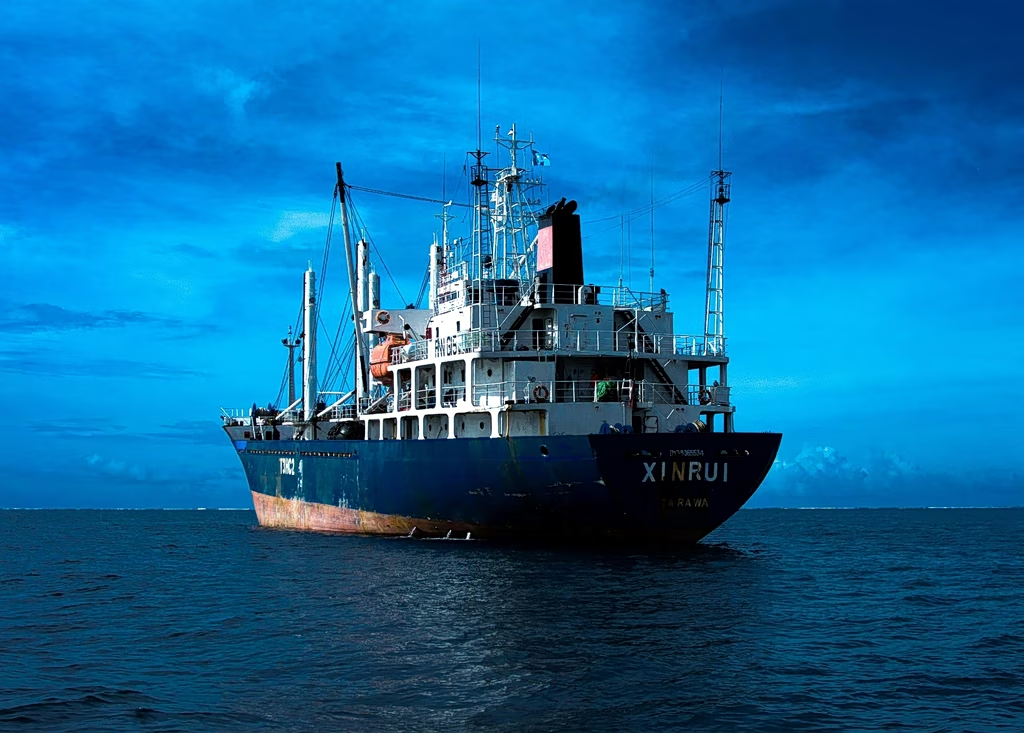
How have those sanctioned reacted to this exclusion? By creating parallel networks. The “shadow fleet” – hundreds of aging tankers operating without Western insurance coverage and outside of established financial networks, transporting cargoes from Russia, Iran and, until recently, Venezuela—isn’t an anomaly. It’s a symptom. The more the sanctions’ reach intensifies, the more alternative parallel networks develop. The result is a more fragmented, opaque, and dangerous maritime ecosystem.
But now a new dimension is being added to this already fragile environment: the imposition of “tolls” on maritime transit. The discussion initiated by Iran regarding transit fees in the Strait of Hormuz is neither opportunistic nor a knee-jerk reaction. It reflects a deeper logic: the transformation of geographical chokepoints into sources of revenue and political pressure. History offers several precedents. The Ottomans imposed tolls at the Dardanelles and Denmark at the Øresund strait, while the pirates of North Africa did something similar with trade to and from the Mediterranean. The difference is that, since 1982 and the signing of the UN Convention on the Law of the Sea, free transit through international straits has been considered institutionally guaranteed.
Today, this principle is being challenged in practice once again. The idea of Iran imposing transit fees in the Strait of Hormuz, or potentially Indonesia in the Strait of Malacca, shows that certain states are increasingly coming to view maritime passages not as shared corridors, but as geopolitical assets. If this logic becomes generalized, the impacts will be systemic: an increase in transport costs, which are then passed on to consumers, and a further fragmentation of global trade.
At the same time, shipping’s industrial dimension is acquiring new significance. China’s dominance in the shipbuilding industry (where its share of global commercial ship construction exceeds 60%) is more than an economic fact. It is a strategic advantage for China and a threat to the United States. It allows for faster and more effective Chinese maritime expansion, both commercial and military–which challenges American naval supremacy. The American response—the revival of its domestic shipbuilding industry and an attempt to impose docking fees on Chinese-built ships—shows that the competition now extends along shipping’s entire value chain. Congress was already holding hearings on “Chips, Ships and Drones” back in 2024. Ships have been recognized as every bit as critical as semiconductors.
The same applies to ports. The acquisition or control of port infrastructure goes beyond commercial logistics. It is also bound up with political influence, military access, and the control of trade flows. In short, maritime connectivity is turning into a field of geopolitical confrontation. The pressure the United States put on Panama to remove a Chinese company from two strategic ports at the entrances to the Canal demonstrates this clearly.
The key point is that geopolitics and geoeconomics have now merged. Power is no longer projected solely with aircraft carriers and military bases; commercial networks, sanctions regimes, financial instruments, and technologies now all play their part. Shipping is at the epicenter of this dynamic. For the global economy, this means greater uncertainty in the continuity of supply chains, as well as higher costs. For businesses, it means that geopolitics is no longer an external factor, but rather a dimension that resides within the business environment itself. However, the market distortions created by geopolitical competition (in freight rates, sea routes, insurance, and financing) aren’t only a problem. They are also an opportunity for those who can act strategically.
These developments are directly relevant to Greece. As home to the largest merchant fleet on the planet, with investments of tens of billions in Chinese shipyards, we now find ourselves at the very center of a radically transforming geopolitical landscape. Historically, Greece has always aligned itself with the dominant maritime power. This choice had a clear geopolitical logic: a state that depends on open seas aligns itself with the power that guarantees them. Today, the issue is more complex than that, as we must ask: what happens when the power that guarantees the freedom of the sea, the US, weaponizes conditional access? And what happens when the greatest competitor of the US, China, is simultaneously the main shipbuilding, commercial, and port hub for global shipping? The answer to these questions will form the quintessence of Greek maritime policy in the decades ahead.
The general conclusion is clear. The freedom of the seas is gradually being transformed into a conditional access regime in which military, economic, and institutional power determines who goes through, how, and at what cost. Understanding the new reality—in terms of sanctions, the insurance market, shipbuilding power, and energy flows—is a lot more than an academic exercise for Greek shipping. It is a prerequisite for its survival and competitiveness in a world where the “tolls” are no longer purely economic; they are geopolitical.
Mr. Athanasios Platias is Professor Emeritus of Strategy at the University of Piraeus and President of the Council of International Relations.