Some say Greeks carry the panigyri—the traditional Greek village feast—inside them. And how could it be otherwise? We grew up with them, as did our parents and grandparents, particularly those who spent years in the countryside, in villages and small towns, far from cities where everything—including entertainment—is easier, more plentiful and more accessible.
For generations, village and island panigyria offered a rare, and therefore precious, opportunity to come together, celebrate and let loose. In lives that often unfolded monotonously and harshly between the house and the fields, animals or sea, the panigyri served as a pressure valve. Ordinary people would set aside their routines for one night, put on their best clothes and take their seats at the long tables.
Their neighbors might be sitting beside them, along with relatives, acquaintances from a nearby village or complete strangers. It hardly mattered. At a panigyri, strangers and friends became one. They might never have met before, and might never meet again.
From religious feast to all-night revelry
The traditional Greek feast has always had a dual character, firmly rooted in religion—the strongest bond within small communities in the past and still a powerful one today. A period of fasting would be followed by church services, Holy Communion, a procession carrying the religious icon and then the celebration. The essential idea was togetherness: people gathering outside the church or in the village square, browsing stalls selling religious icons, amulets and herbs, and sitting down at tables laden with food.
As the years passed, the celebration grew and its circle widened. More stalls appeared, merchants arrived from neighboring areas, tables multiplied, women carried pots filled with food, and the musicians began to play.
A panigyri meant singing and dancing, food and wine. It meant letting go and celebrating together—a form of collective joy that, whether its roots lie in the Dionysian festivals of ancient Greece or simply emerged from people’s need to spend one different night together, has survived into the present.
And it is still here: bringing us together, getting us out of our chairs and introducing us to a form of entertainment we increasingly seem to remember only in summer, when returning to the family village and strolling around the square become part of the Greek summer lifestyle and traditional village feasts become viral subjects on social media.
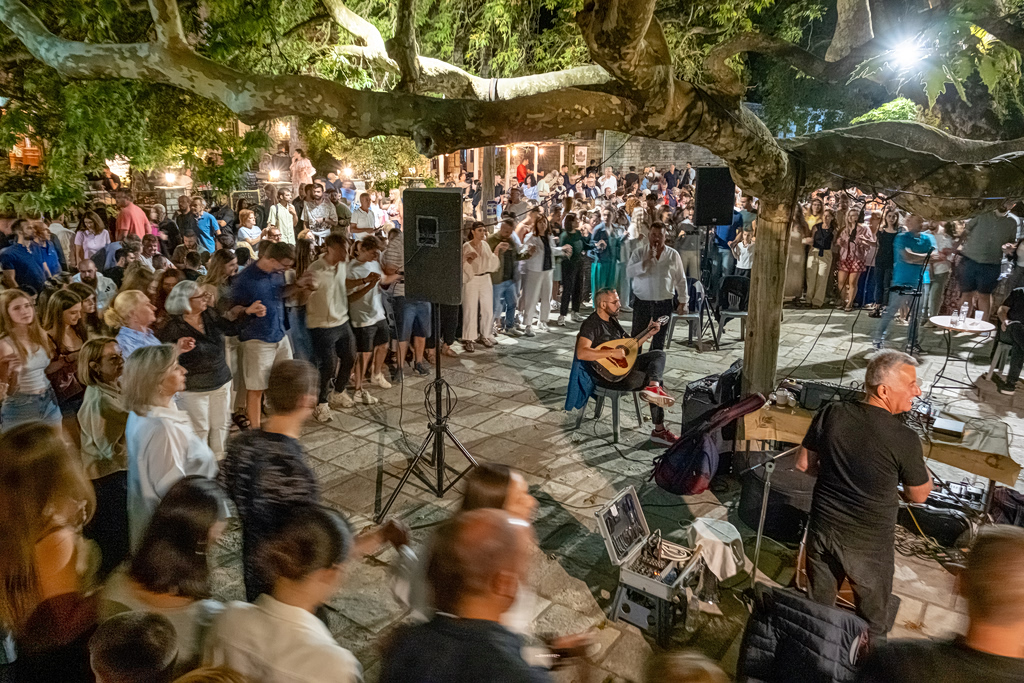
Vitsa, Greece – August 15, 2025: Traditional Panigiri festival with Epirotic folk music and circle dancing in the stone village square celebrating the religious Assumption of the Virgin Mary. Mazur Travel / Shutterstock.com
Whatever its origins, the panigyri is still here. And by “here,” we don’t mean only the villages. We mean the cities, too—Athens in particular.
For decades, cultural associations representing communities from across Greece have invited people who have moved away from their hometowns to gatherings that retain all the hallmarks of a traditional panigyri: white plastic chairs around long tables, a raised stage for singers and musicians, grills cooking souvlaki, and refrigerators stocked with cold beer, wine and, occasionally, whiskey.
The visual language of the Greek panigyri has barely modernized, and that may be its greatest strength. It remains familiar, unmistakably ours and deeply unifying at a time when “togetherness” feels increasingly rare.
So this September, with the return from vacation still fresh in our minds, a panigyri might be just what we need. Fortunately, there are plenty to choose from. Some are organized around the grape harvest—the Dionysian backdrop mentioned above—while others have a distinctly local character. Some simply seek to remind us that the panigyri has always been a way for the Greek soul to escape, have fun and come together.
Let the feasting and dancing begin.
Great Days of Nemea — September 4–6
With summer weather still holding, this three-day event is an ideal excuse for a day trip. Some call it wine tourism; others simply want to enjoy the countryside around Nemea and a few glasses of very good wine.
Either way, the Great Days of Nemea have become a major event on the annual wine calendar for wine lovers and casual visitors alike. Large and small wineries park trucks loaded with freshly harvested grapes and open their doors to visitors, offering tours of their vineyards and cellars and, above all, tastings of their wines.
Alongside the winery visits, the program includes activities, concerts and cooking classes, creating an atmosphere that may not resemble a traditional village panigyri but certainly feels like a major celebration.
On Friday, September 4, the festival officially opens with a major concert by singer Yiota Nega. Over the following two days, visitors can tour wineries, take part in tastings and even join a treasure hunt through the vineyards, designed for children and slightly older participants alike.
The Goat Festival in Ilioupoli — September 4–5
Now in its 20th year, the major celebration organized by the Eleftherianites of Nafpaktia “Agia Paraskevi” association brings a genuine traditional feast from Nafpaktia, a region in western Greece, to the southern suburbs of Athens.
That means pretty much exactly what you are imagining: a live band, big names from Greek traditional music and long tables loaded with food.
This year’s lineup features Giorgos and Dimitra Bekiou on Friday, followed by Nikos Vlachodimos and Phaedra on Saturday. The food is equally central to the experience, with steaming pots of boiled goat as the signature dish, alongside spit-roasted pork with crisp skin and the more familiar option of souvlaki for those looking for something a little less adventurous.
Everything comes with cold beer and wine, naturally adding to the general euphoria.
The celebrations here have become legendary, attracting thousands of people who become one crowd and dance wildly until morning. This has been going on for 20 years. It is very much the real deal.
The Harvest Festival in Markopoulo
Nemea isn’t the only place celebrating the grape harvest. Attica has its own wine-growing tradition, and Markopoulo is home to the largest wine-producing zone in the region.
To celebrate this major festival of nature and wine, the Municipality of Markopoulo is organizing, for the third year, a series of events at the town’s historic railway station.
Over three days—the dates have not yet been announced but the festival is usually held in early September—residents and visitors will be able to take part in a large traditional grape-stomping event, crushing grapes to the sound of clarinets and drums.
The program will also feature a traditional patinada, a festive procession through the town by local music and dance groups, as well as local wine, moustalevria—a traditional sweet made from grape must—and concerts by artists and bands.
This year’s event focuses on the sustainability of tradition and will feature strong participation from students and university students, who are expected to bring a new energy to a festival that has already become an established tradition and attracts increasingly large crowds each year.
11th Cretan Raki Night in Rafina — September 5
This Saturday, the Association of Cretans and Friends of Crete of Rafina-Pikermi, together with the municipality, will officially close out the summer with a large, authentic Cretan celebration at the Rafina Crossroads Stadium.
The party begins at 9 p.m. and runs until morning. Mathios and Raphael Damoulakis will lead the festivities on lyra—a traditional Cretan bowed string instrument—and vocals, joined by Charalambis Paras-kakis and Panagiotis Katsiotakis.
Nearby, cauldrons will be steaming with gamopilafo, a traditional Cretan rice dish traditionally associated with weddings. The menu will also include souvlaki and other Cretan specialties.
And the glasses will be filled generously with raki, the traditional Cretan spirit distilled from grape pomace. By the time the maleviziotis, soustes and pentozali dances begin, everyone—from seasoned dancers to complete beginners—will be ready to hit the dance floor.
The Wine Festival in Ilion — September 11–12
Next to the large Antonis Tritsis Park, inside the grounds of Pyrgos Vasilissis and specifically at the Municipality of Ilion’s estate, one of the biggest Cretan celebrations in western Attica will take place.
The municipality and the local Cretan association are bringing musicians, wine, raki and plenty of food. In return, they ask for nothing more than enthusiasm, participation and a willingness to have a good time.
On Friday, the specially designed stage at the estate will host the hugely popular Nikos Zoidakis and his band. On Saturday, Dimitris Spyridakis and his musicians will take over for a traditional Cretan celebration.
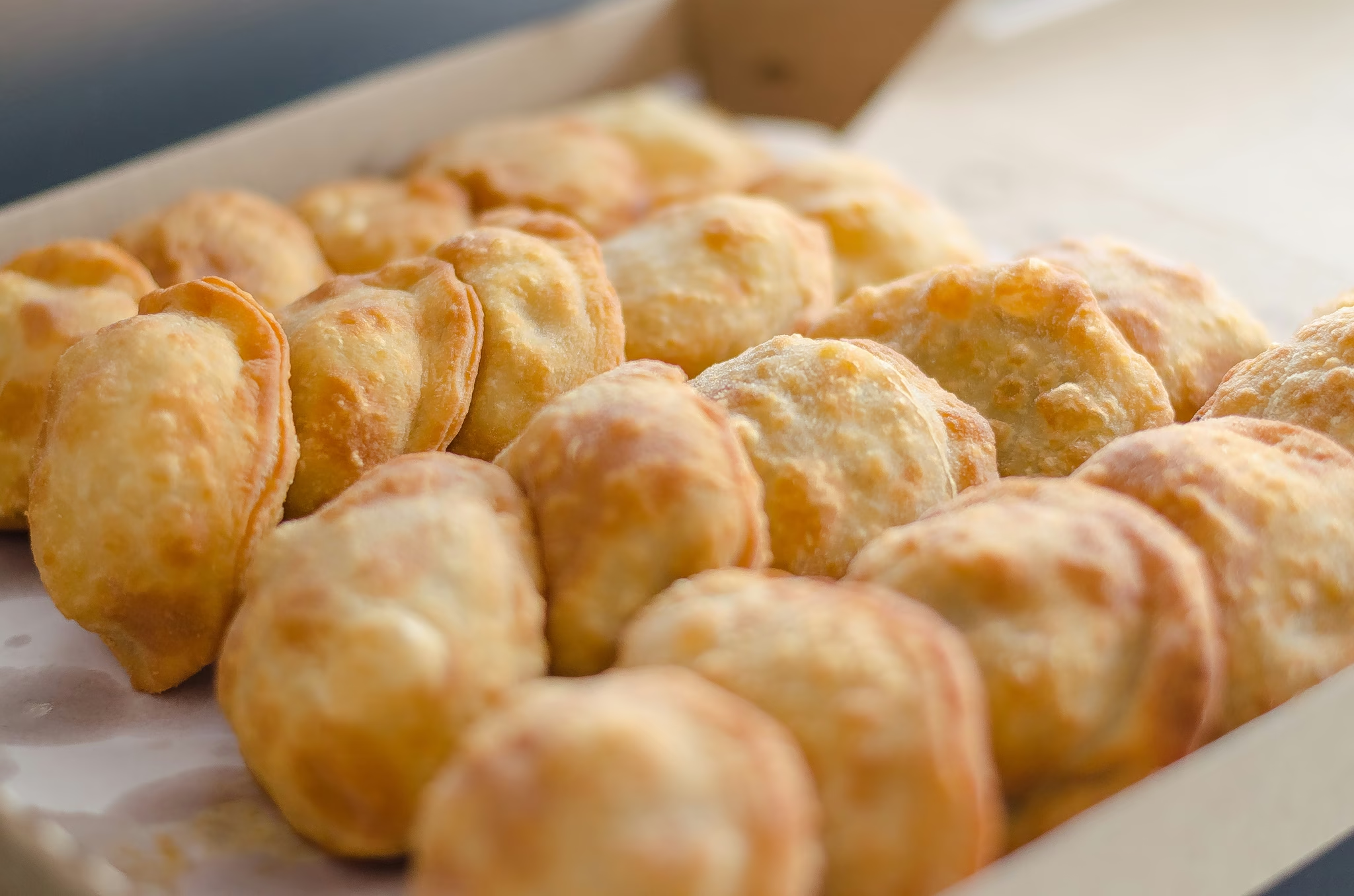
Visitors will receive the classic Cretan welcome: a small glass of chilled raki. The festival stalls will serve traditional Cretan pies and other specialties, as well as souvlaki, while Cretan products will also be available to purchase.
Tsikoudia Festival in Pallini — September 12
Some call it a “Raki Night.” Others don’t bother with names at all. They simply answer the invitation from the Cretans of Anthousa-Gerakas-Pallini association “I Megalonisos” and walk through the doors of the 1st General Lyceum of Pallini for a night of authentic Cretan entertainment.
The evening begins with a reenactment of the traditional distillation of tsikoudia—the grape-based spirit better known internationally as raki, with the traditional Cretan stills known as rakokazana.
The festivities continue with complimentary tsikoudia, steaming gamopilafo, traditional dancing and a performance by Nikos Manioudakis and his musicians, who will keep the party going until morning.
Rizes Fest at Technopolis — September 19
In Athens, the traditional end-of-summer celebration takes place at Technopolis, where a festival has made it its mission to remind us exactly what a Greek panigyri is all about.
Those who already know—and those who don’t—will head to Gazi on Saturday, September 19, to enjoy the celebration organized each year by the Rizes group.
This year’s music program begins at the Small Square with a concert by Loom music and Phoebe Vlassi, before moving to the Main Stage. There, traditional groups ThyGateres, Anisé Ensemble, Nostos Band and Laska will take over.
And between sets come some of Technopolis’ perennial favorites: draft beer and a range of street-food offerings, flavors that have become inseparably associated in the Greek imagination with nights at the panigyri.