We were in Thessaloniki about a month ago—an in-between stop on our way to Kilkis to visit a farm. There was no time for long walks through the city’s buzzing streets, no leisurely food crawl, no “let’s see where the day takes us.” We checked into our hotel, slept, and the next morning made a decision: if we could only visit one place, it had to be something that would give us a real taste of the city’s heart.
Thessaloniki has a colorful, ever-expanding food scene, but some flavors are inseparable from its identity. For us, that meant one thing: bougatsa.
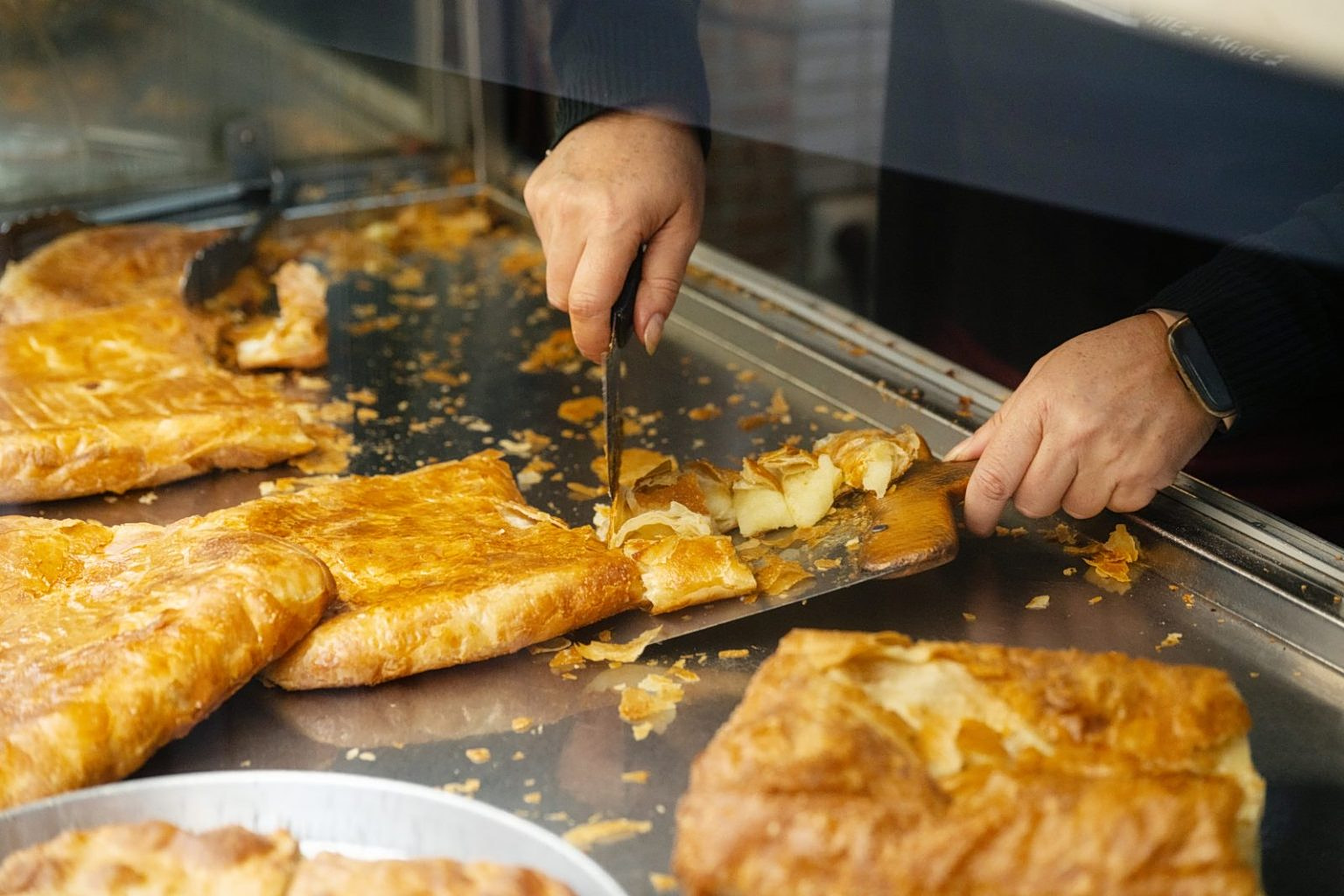
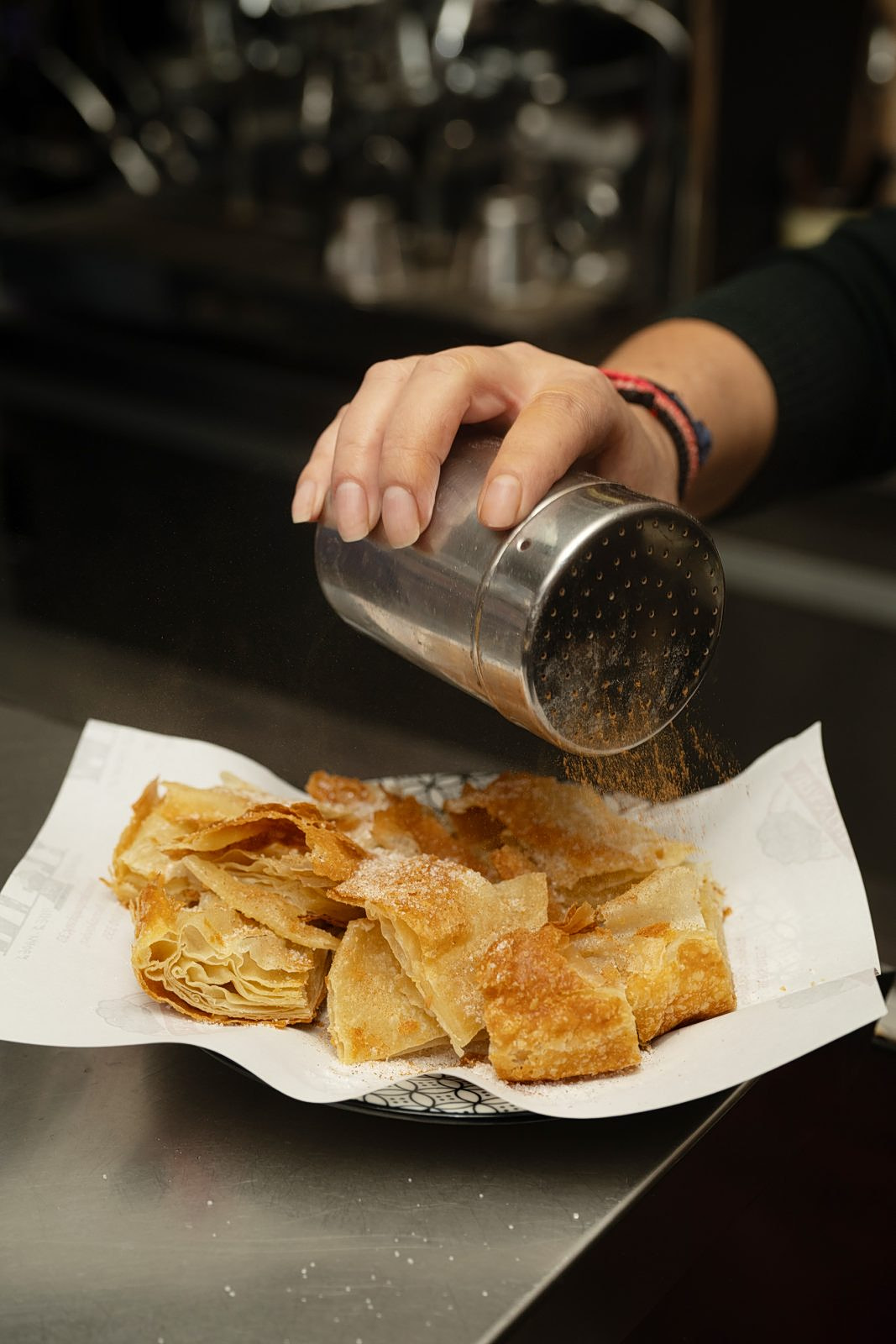
If you’ve never had it, bougatsa is one of Northern Greece’s most beloved comfort foods: thin, hand-stretched phyllo wrapped around a filling—most famously sweet semolina custard, but also savory combinations like cheese or meat. It’s served hot, crackling at the edges, usually cut into pieces. In Thessaloniki, it’s not just breakfast. It’s a habit. A small ritual.
To find the right place, I called Argyro Barbarigou, Greece’s best-known home-cooking authority, and asked her where we should go. She didn’t hesitate.
“Go to Bantis,” she said. “He’s a true craftsman. Watch him stretch the phyllo—and listen to his story.”
That was all we needed.
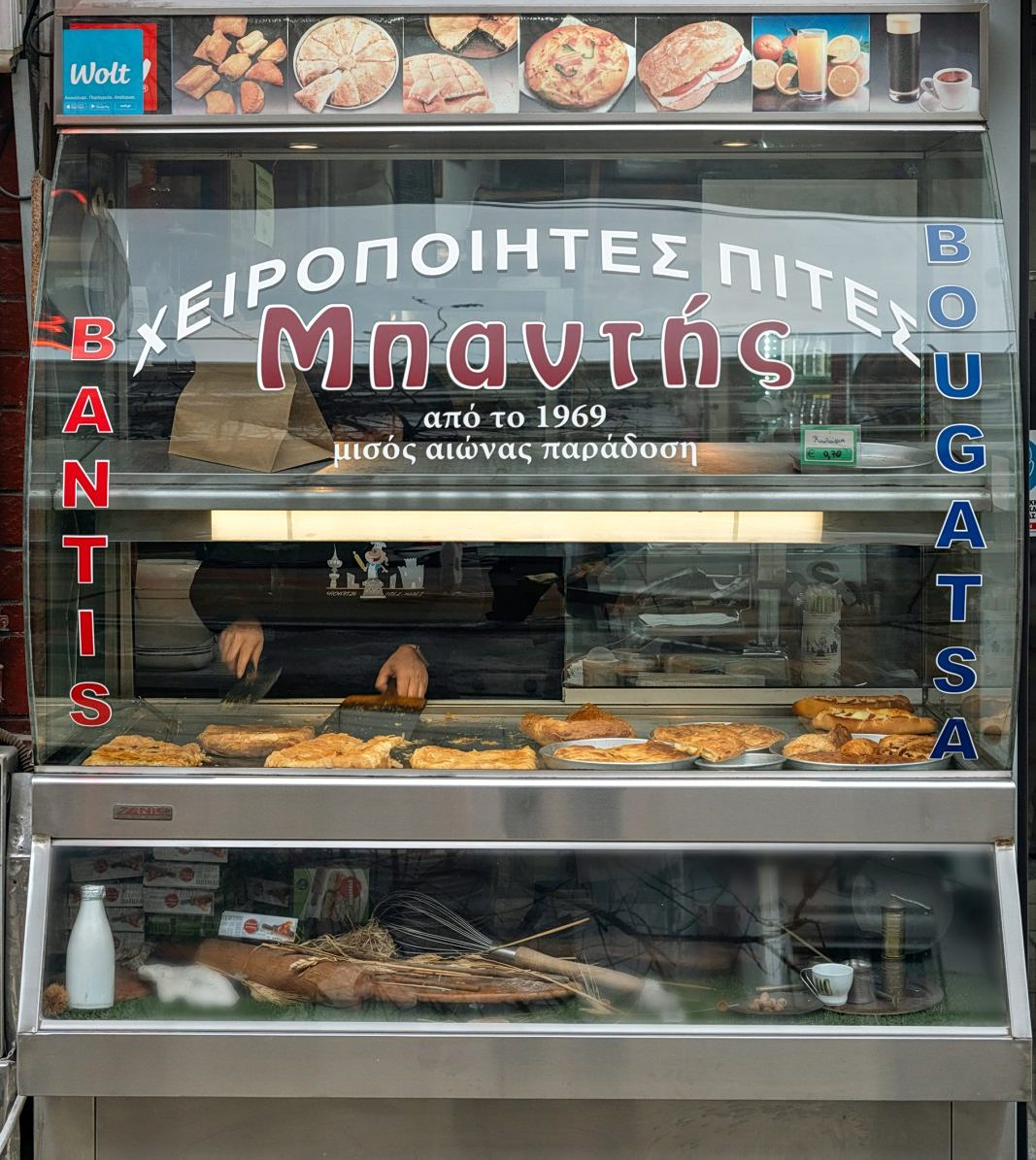
A neighborhood shop with no need to impress
Bougatsa Bantis sits outside the touristy center, far from wide boulevards and glossy storefronts. It was a rainy weekday morning—one of those Thessaloniki days when the city seems to move at a slightly softer pace. The neighborhood felt genuinely local. Nothing tried to charm you. And that, somehow, felt like the first sign we were in the right place.
Truly historic shops rarely rely on décor to convince you. They don’t need grand entrances, designer seating, or chandeliers. They need one thing: people who return.
The red awning—familiar from photos—was there. Under it, a quiet rhythm of customers coming and going with the ease of those visiting something they trust. Neighbors greeted each other with nods and small smiles. No performance. Just routine.
And then there it was: the shop window. Authentic, unstyled, not trying to “sell an experience.” Just a place doing what it has always done.
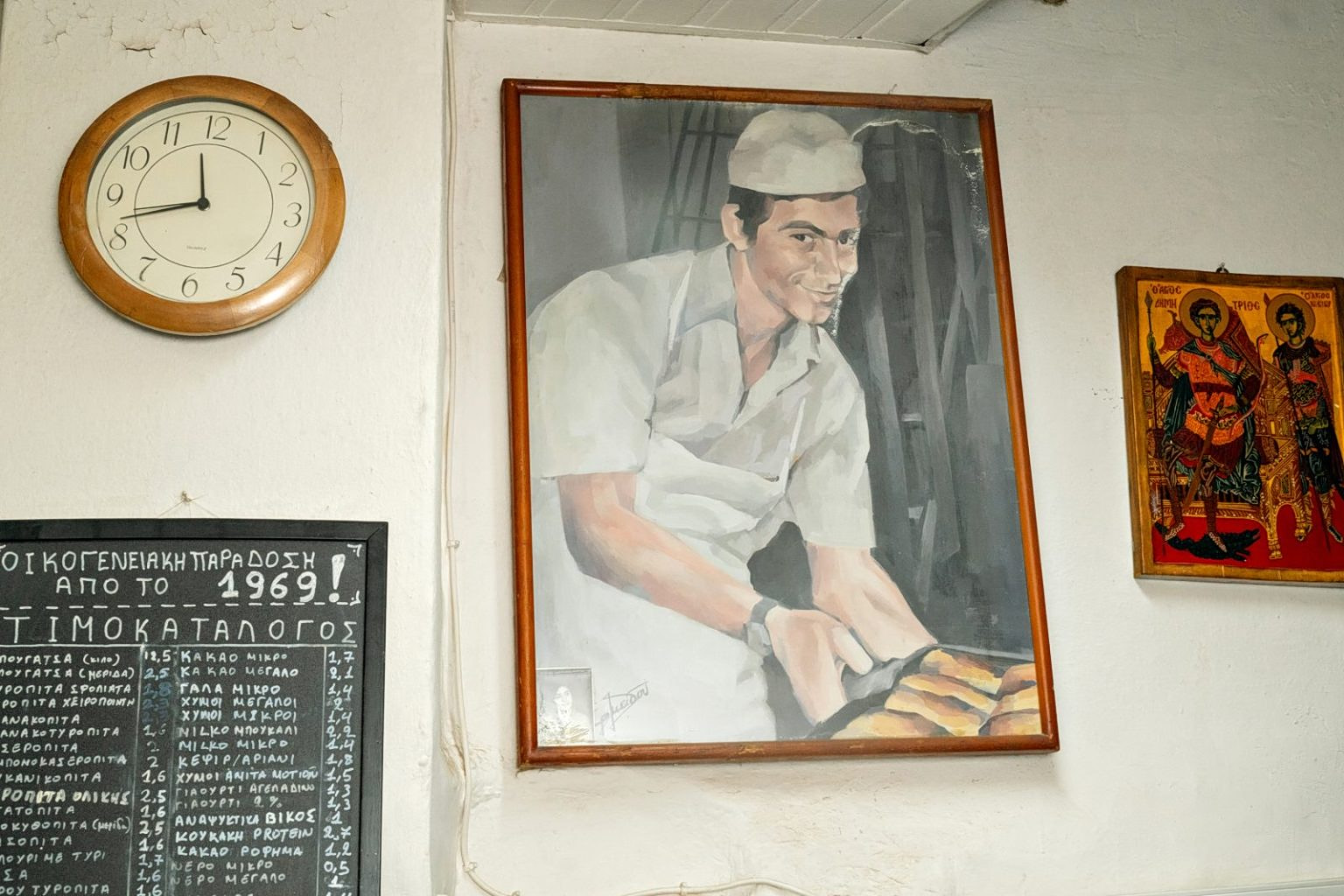
The first time at Bantis feels like initiation
Your first visit to Bougatsa Bantis doesn’t feel like a quick stop for a snack. It’s not only about appetite. It’s about stepping into a world where things still happen the way they always did—and somehow, that’s the magic.
Inside, the smell of fresh phyllo and butter creates an instant sense of familiarity—one of those aromas that moves you before you even take a bite. The walls look like they’ve been there for decades, and the whole place carries the quiet confidence of a craft that doesn’t need trends to justify itself.
And then there’s a small detail that made me smile: draped over the back of a chair was a hoodie from Asteras Exarcheion—a name tied to Athens’ alternative music and bar scene. It was a hint that the person behind this pastry wasn’t a one-note traditionalist. I wanted to hear his story.
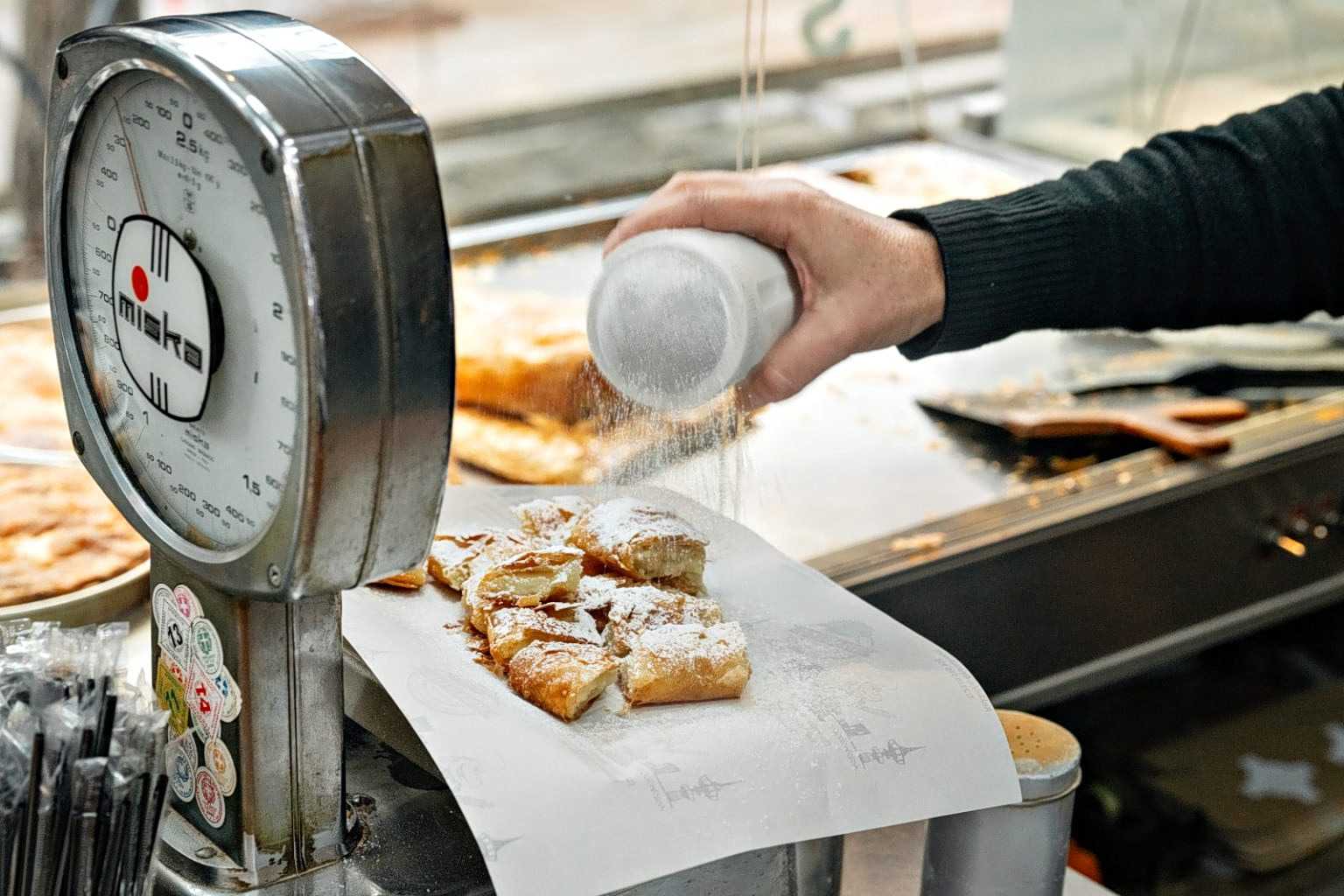
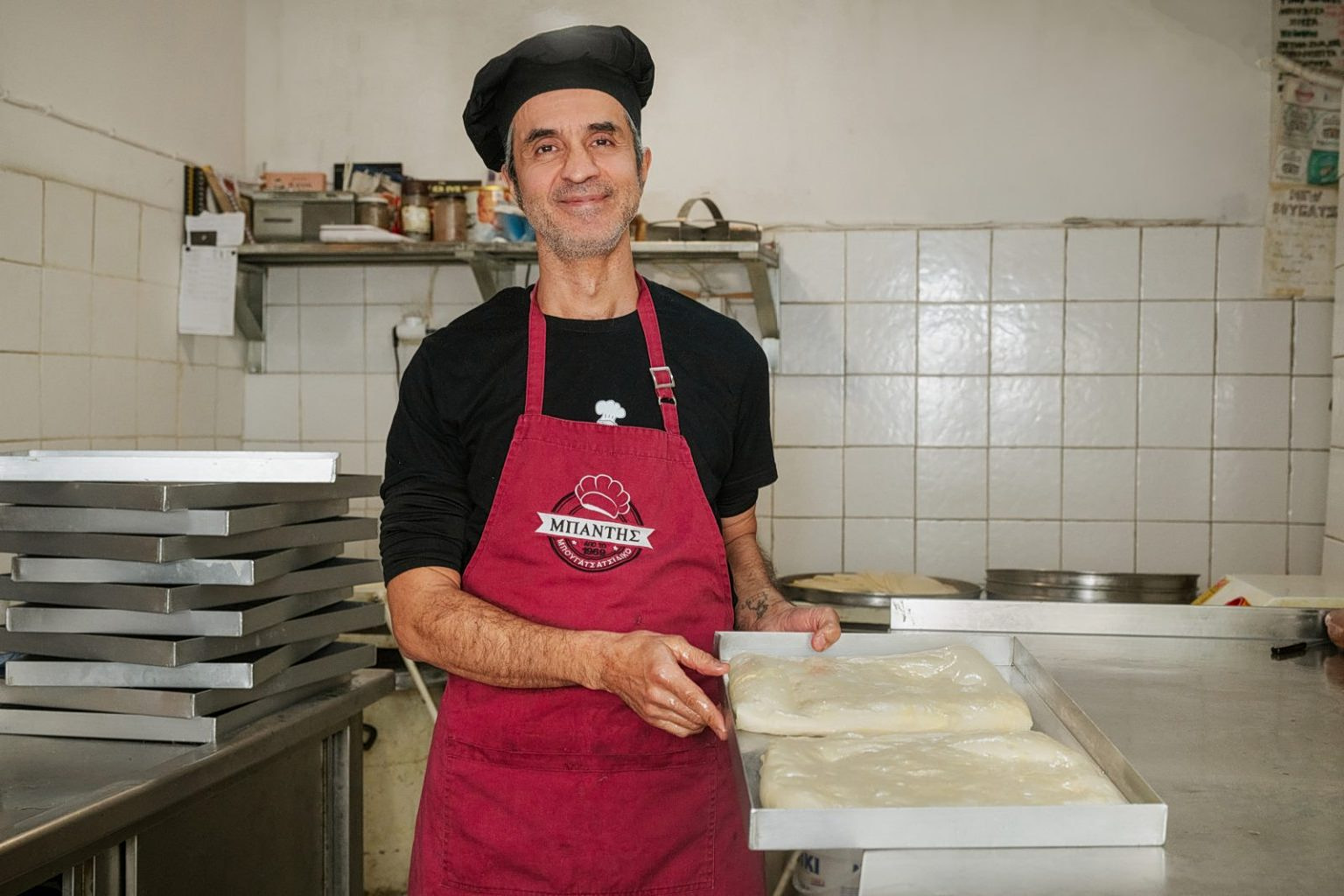
Meet Filippos: the man behind the phyllo
There are jobs you choose—and jobs that choose you. For Filippos, bougatsa was both.
His story begins before he was born, with his grandfather—an apprentice in small workshops in Kayseri, Cappadocia (in today’s Turkey), a region with a long history of dough and pastry traditions. When his grandfather arrived in Greece as a refugee in 1922, he continued working wherever he could, carrying his knowledge with him.
That knowledge was passed to Filippos’ father, Dimitris, who opened the family’s own shop in 1969. Filippos grew up inside it.
“I was raised with these smells, these memories,” he says. “I was here as a baby. The neighbors say I came into the shop wearing diapers.”
Yet his future wasn’t guaranteed. As a teenager, he dreamed of a different life.
The teenage years: music, theatre—and a return home
“My dream was music and theatre,” Filippos tells us, plainly.
After military service—he was only 19 and a half—he moved to Athens to study acting. He trained at the historic Stoa Theatre, alongside acclaimed actors Lida Protopsalti and Thanasis Papageorgiou. The experience shaped him, but the city didn’t.
“The atmosphere of Athens didn’t suit me,” he says. “I was very young. And alone.”
He returned to Thessaloniki and stayed close to the arts: theatre, radio, music. He worked as a DJ, collaborated with stations, lived in a creative world.
But the family shop was always there. And it offered something every young adult understands: a reliable way to earn a living.
“So I slowly learned the craft properly,” he says. Not overnight, not as a dramatic decision—more like a steady return. He also worked in other workshops, learning from different masters. And somewhere along the way, the work began to fascinate him.
Taking over—and rebuilding bougatsa’s reputation
Filippos officially joined the family business in 1993, but the full responsibility came in 2004.
“When I took over completely, I realized everything had to change drastically,” he says.
The shop was struggling—and so was bougatsa itself. For a period, it had lost prestige, treated as cheap “working-class” food. Filippos describes a time when Greece, like many places, chased imported trends and looked down on its own everyday staples.
“We wanted sushi. We wanted croissants—not sweet bougatsa,” he says. “Bougatsa was the food of the worker, the student, the craftsman. So people saw it as something lesser.”
Then came years of financial pressure—and later, the pandemic—and people started reassessing what matters. Filippos watched customers return to local, familiar, trustworthy places. For him, it wasn’t a trend. It was a confirmation of the path he’d chosen.
A partner in life and in the shop
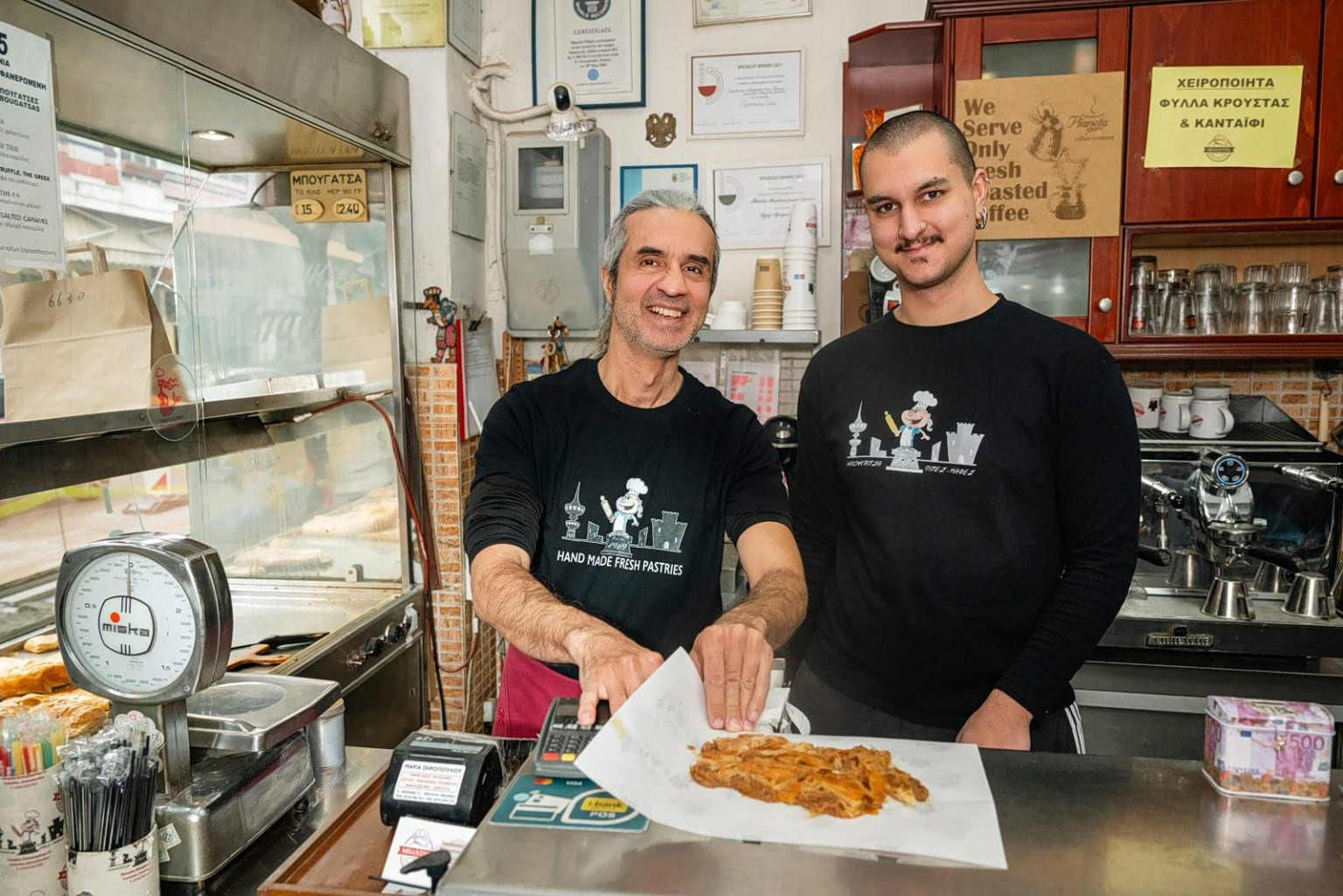
In 2004, Filippos also married Katerina Makeda, who became his companion in both life and work.
“For more than ten years, it was the two of us,” he says. He credits her warmth, kindness, cleanliness and calm energy with reshaping the feeling of the shop—and drawing people back.
Katerina, he adds, is an artist at heart too. She’s an excellent singer; at one point, the late Greek singer Manolis Lidakis heard her and invited her to tour with him. She declined—too shy, he says, lacking confidence—but the artistic streak remained part of the family.
They have three sons, all raised around flour, dough and music. The eldest, Dimitris, studies Fine Arts and plays bass in a punk band while helping at the shop. The second, Thanasis, is a drummer at Thessaloniki’s Music School. The youngest, Alkinoos, is still in primary school and learning keyboard.
Tradition, in this family, isn’t a museum piece. It lives alongside creativity.
Choosing ingredients like a winemaker chooses grapes
When Filippos decided to rebuild the shop, he didn’t do it with marketing. He did it with choices.
He changed everything: suppliers, raw materials, collaborations, philosophy. He describes it as a kind of circular, local economy—supporting nearby producers instead of large chains.
“I’ll support the neighborhood grocer,” he says. “Local economy, local producers.”
He speaks about ingredients the way chefs talk about terroir:
- Milk from Koukakis (based in Kilkis) and a long relationship with Arvanitis, a respected dairy producer.
- Flour partnerships including major miller Loulis, but also a particular flour from Grevena, a mountainous area known for exceptional grain.
- Semolina from Papafilis, a small mill in Kozani, chosen for how it behaves when it turns into custard—its texture, its stability, its taste.
- And a signature graviera cheese from Kasos, sourced from a dairy he trusts deeply—so integral to one of his creations that he refuses to replace it, no matter the cost or logistics.
Quality, for him, is not convenience. It’s commitment.
Not just classic bougatsa: the “new” flavors
Bantis is known for traditional bougatsa—but Filippos also developed flavors that reflect his curiosity and his relationships in the Greek food world.
Among the standouts:
- Extra virgin olive oil and goat cheese bougatsa—without butter, clean and simple. This idea was developed with the well-known Greek cook Ilias Mamalakis after they met at a gourmet exhibition.
- Apple and raisin bougatsa, created through a collaboration with food writer Eleni Psychouli—made with both tart green apple and red apple for balance, not cloying sweetness.
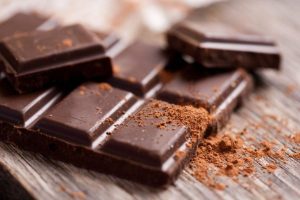
- Dark chocolate couverture with wholegrain tahini, originally intended as a less-sugary, more nourishing option for his children—later embraced by customers.
- A winter, savory favorite: leek, smoked bacon, and feta, developed for a food pairing event and matched with a dry red wine from Skouras (one of Greece’s best-known wineries). It’s rich, bold, and unmistakably his.
These variations aren’t gimmicks. They feel like extensions of the same principle: respect the craft, then let it evolve naturally.
The phyllo as a living thing
For Filippos, dough is not a fixed recipe. It’s a living material.
“Flour is alive,” he says. “In every season, in every batch, you have to manage it differently.”
Making bougatsa phyllo requires patience and attention. The process starts before sunrise; it takes four to five hours before the dough is ready for stretching. It can tighten, it can spoil, it can change with humidity and temperature.
And yet, this is the part he loves most.
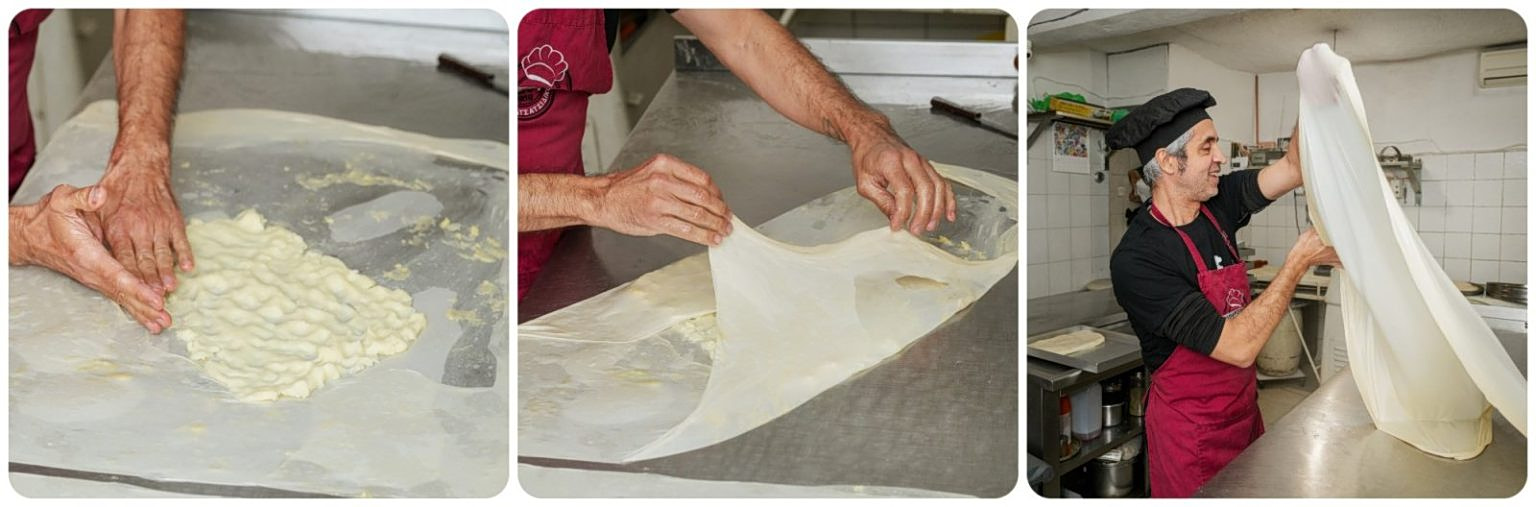
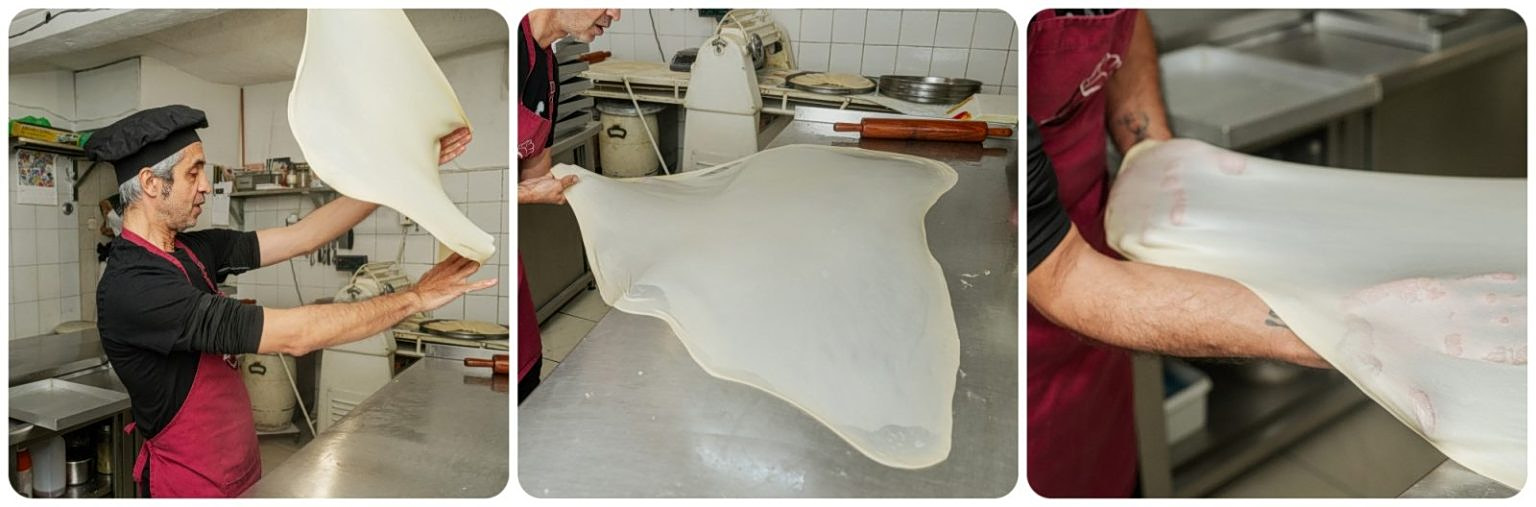
Stretching phyllo, he says, is a kind of therapy. Alone in the workshop—just him and his music—it becomes calming, even freeing.
Since 2011, he has taught the craft in private culinary schools (IEKs), passing on knowledge to younger generations. Few stick with it.
“If a hundred students passed through my hands, maybe ten continued,” he says. “And half of those eventually stopped.”
This work asks for obsession, he insists. Without it, the tradition can’t survive.
Bougatsa as memory, identity, comfort
For Filippos, bougatsa is not “just pastry.” It’s woven into people’s lives.
It’s the Sunday treat after church. The bite after a long night out. The warm breakfast that makes a rainy morning feel manageable. A ritual. A comfort. A taste tied to Thessaloniki’s rhythm.
And it is, ultimately, his own story.
“Deep down, I knew I’d end up here,” he admits. “And whether I wanted it or not, I grew to love it.”
Today, he’s more than a bougatsa maker. He is a craftsman carrying a refugee-born technique into the present, a teacher passing it on, and proof that the most humble foods can hold dignity, history and a future.
Every time he stretches a sheet of phyllo, that story begins again—thin as paper, crackling with butter, and very much alive.