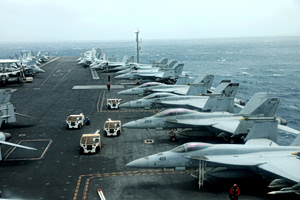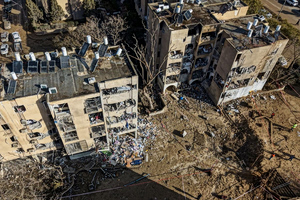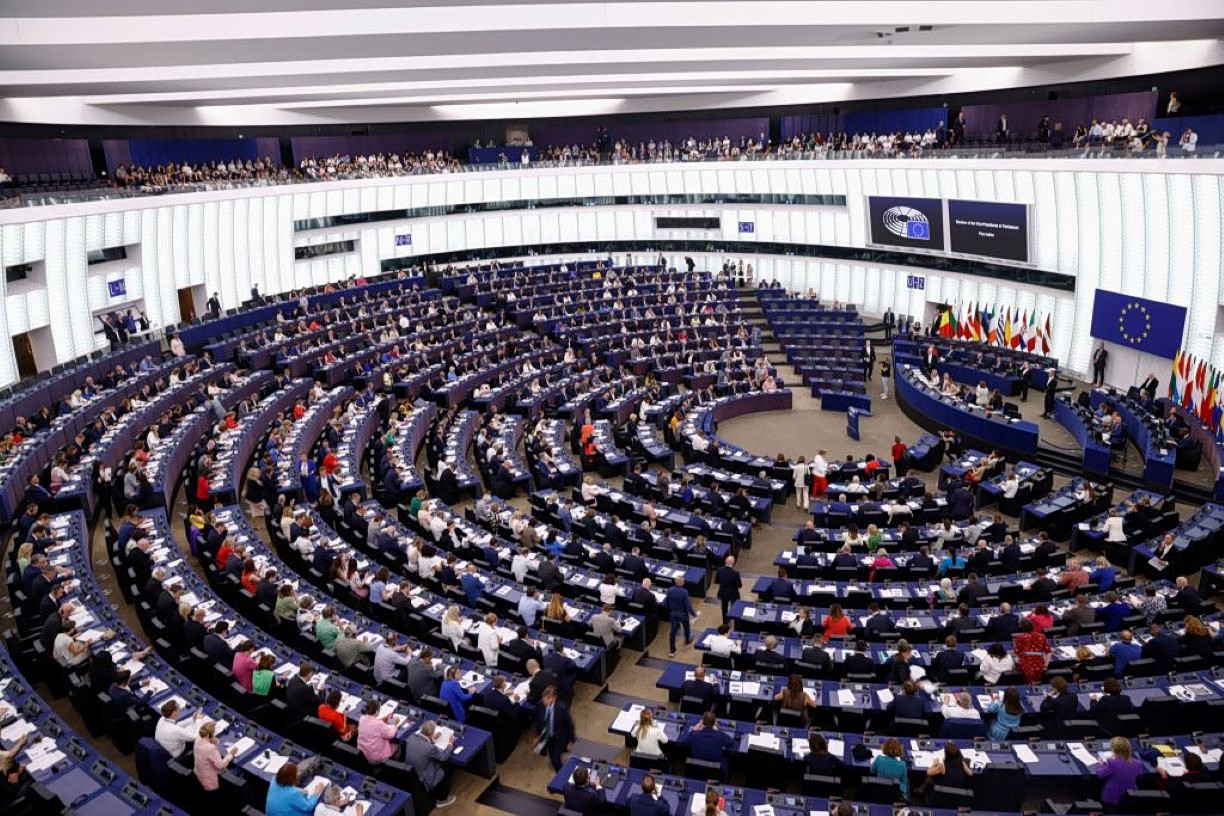
As the war in Ukraine enters its fifth year, Europe is being forced to prepare for yet another major military crisis — this time in the Middle East, centered on Iran, which has been subjected to a barrage of joint American — Israeli strikes. The escalation comes at a moment when, following the assassination of Ali Khamenei, the ‘wounded’ Iranian regime and the Islamic Revolutionary Guard Corps have chosen to retaliate. Their response has taken the form of sustained strikes against Arab Gulf states hosting a significant American military presence and major oil production facilities. The recent incidents involving Cyprus serve as an honest reminder that this escalation is unfolding in Europe’s backyard.
As events continue to unfold, anxiety is growing in Europe’s major capitals over the potential consequences of the conflict. These concerns revolve around two principal axes. Firstly, there are the geoeconomic repercussions of the crisis. Energy prices are already rising, while the prospect of a new large-scale migration wave looms as a nightmare scenario for almost all European governments. In this context, Europe will be tested as it seeks to enhance its economic and commercial security. One such opportunity lies in the recent discussions between the European Union and Latin American countries regarding the long-debated Mercosur trade agreement. The deal, however, has been temporarily put on hold amid concerns over transparency and accusations that the President of the European Commission, Ursula von der Leyen, has pursued the agreement as part of a personal political agenda.
Secondly, there is the uncertainty among what were until recently close transatlantic allies. The decision by the United States, under the leadership of Donald Trump, to enter the war against Iran appears to have been taken without a cohesive and carefully developed exit strategy, raising concerns about the long-term implications of American involvement. For Europe, these concerns converge on a broader realization: the urgent need to strengthen European security in an era increasingly defined by entangled crises.
Even before these events, the EU appeared to be on a trajectory of strengthening its strategic autonomy and coordination in matters of collective defence. Early steps could be observed when the EU proceeded with PESCO, established in 2017 to assist member-states in planning, developing, and investing in their military capabilities and readiness. Nowadays, the policy agenda appears to be even more concrete. In this regard, the Commission has proposed a wide range of initiatives to reinforce European defense, such as the White Paper for European Defence – Readiness 2030, the ReArm Europe plan, and the Defence Readiness Roadmap 2030. The main goals of these initiatives include mobilizing up to €800 billion for further development and procurement, particularly in areas such as air defence, cyber defence, drones, ammunition, mobility, and maritime security.
The emerging reality has intensified further discussions about the need for greater capacity to act collectively and respond more effectively to external shocks. In particular, there are those who argue that strategic autonomy should not be interpreted as an attempt to distance Europe from NATO or the transatlantic partnership. Rather, it reflects the need for stronger European capabilities, deeper coordination among member-states, and a more coherent geopolitical outlook. At the same time, other voices within the EU’s multi-level polity advocate a more self-reliant European approach, particularly in matters of defence readiness, energy security, industrial capacity, and economic resilience, which are increasingly interconnected components of Europe’s broader strategic posture. This is highly relevant to the latest announcement of President Trump, who warned that NATO faces a ‘very bad future’ if allies fail to help the US in Iran.
In this context, analytical attention should be directed toward the discourse of European leaders during this period of heightened geopolitical instability. Policy analysis, in particular, is essential for understanding the evolving direction of European strategic agendas. At the same time, these developments should not be approached in a purely formalistic manner, as shifting geopolitical dynamics may significantly shape both the pace and the substance of these objectives. In this context, President Emmanuel Macron has put forward a ‘Made in France’ proposal to extend France’s nuclear umbrella to willing European partners as a deterrent in a period of deep uncertainty, arguing that ‘to be free, we must be feared’. This revived emphasis on nuclear deterrence may offer a means of overcoming the political paralysis that has often characterized coordination among Europe’s leading powers, at a time when hesitation could entail particularly serious consequences.
Nevertheless, no overwhelming consensus has emerged regarding the scope of cooperation or the meaning of strategic autonomy within the European context. The positions suggested by France continue to reflect significant divergences, in a context of collective securitization. For instance, the Swedish government has announced that there is no need to host nuclear weapons during peacetime. At the other end of the spectrum, Romanian President Nicușor Dan announced that the country will not host any nuclear components on its territory. Poland’s response could be characterized as mixed, since Prime Minister Donald Tusk sided with a pro-EU government favoring deeper European integration, whereas presidential advisers aligned with a NATO-centred approach. At the same time, despite continuing tensions with the current U.S. administration, member-states, such as Germany, have emphasized that any effort to strengthen European defence coordination and strategic autonomy, particularly in the nuclear domain, must remain complementary to the existing NATO framework.
Consequently, although there is broad recognition of the need for deeper cooperation and reform in strategically significant domains such as defence and energy, Europe continues to appear politically fragmented regarding the scope and nature of strategic reforms. The pressure generated by the ongoing war in Ukraine, the geopolitical instability in the Middle East and its repercussions for the global economy, as well as tensions between the EU and the U.S. administration, particularly with regard to the newly relaxed approach to sanctions on Russian oil, underscore the need for careful and forward-looking strategic planning. In other words, European strategic autonomy can no longer be understood as a purely abstract institutional debate. Rather, it has emerged as an increasingly urgent geopolitical imperative.
The recent developments in Europe’s immediate neighborhood have exposed the structural vulnerabilities of Europe’s security architecture and revived the aforementioned debate in far more concrete terms. At the same time, the evolving nature of transatlantic relations reinforce a growing realization among European policymakers that American priorities may not always fully align with those of the European Union. Decisions taken in Washington, particularly in moments of crisis, can have immediate repercussions for European security, energy markets, and economic stability. The debates surrounding continued U.S. security guarantees in Europe and Washington’s shifting strategic focus toward the Indo-Pacific have further reinforced concerns about Europe’s long-term strategic dependence.
Ultimately, the success of these efforts will depend not only on new policy initiatives or financial commitments, but also on the ability of European governments to overcome persistent internal divisions. In an international environment characterized by great-power competition and regional instability, Europe’s credibility as a geopolitical actor will depend on whether it can turn the current sense of urgency into sustained political commitment and a shared strategic vision.
*Georgios Tsialas is a PhD Candidate in Politics (Research) at King’s College London. His research focuses on crisis politics, securitization, framing contests and the application of mixed methods in political analysis. He holds an MSc in Comparative Politics (LSE) and a BA in Political Science and History (Panteion University). He has served as Senior Political Analyst and Editor at the Association of International and European Affairs (ΟΔΕΘ) and as a Research Assistant and Research Administrator at the Hellenic Observatory Centre (LSE).
Dimitris Tsaknis works for the EPLO/ELGS Rome Office (Italy) as Responsible for Academic Affairs. He is a Political Scientist with a Master in International and European Governance. His academic interests spanning EU Security and Defense Policies, EU Enlargement, the relations between the EU and the US as well EU and Russia.
Athina Fatsea is a PhD Candidate at the Ionian University (A.G. Leventis & ESDC Doctoral Fellow). She works as Research Assistant to the Director General and European Programme Manager at ELIAMEP. She serves as a Research Fellow at the Laboratory for Geocultural Analyses (GeoLab). She holds an MA in International and European Governance and Politics (NKUA). She has participated in conferences in Europe, Africa and Asia, and has authored publications in collective volumes and scientific journals.