As someone rightly noted recently, the needle really does seem to be stuck and there’s no indication it will be getting unstuck any time soon.
It is no coincidence that all the polls since the European elections have outlined the same picture with only minimal fluctuations.
The positive reading is that they point to a political scene that’s stable overall. The negative reading is that this same situation contains within it the elements of its destabilization.
Growing dissatisfaction, pervasive distrust, a profound sense of doubt in the administration.
Between you and me, none of the above is surprising. The wear and tear on the government is as visible as it is unavoidable after almost seven years in office, along with its mistakes and omissions.
While the opposition remains lost in space. You sometimes wonder where they are and what it is precisely they do all day.
But the needle remains stuck. Which is fair enough. After all, politics and pollsters’ results reflect what happens in the world.
And polls can be useful in helping us understand what’s going on around us, or even to interpret what’s behind the things that aren’t happening.
So being stuck in a groove is part and parcel of a climate in which the public conversation, thirsty for backstage insights and something to talk about, revolves around three wannabe or soon-to-be or in-the-process-of-becoming parties. Whether any of them ever gets off the ground is anybody’s guess.
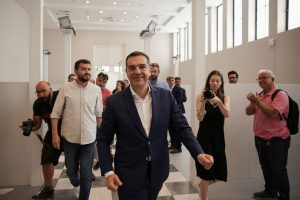
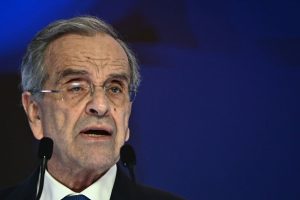
And I don’t think their would-be founders—Tsipras, Samaras and Karystianou—have any more idea when this might be than the rest of us.
Of course, what Fate has in store for them is just as hard to predict. But even with that uncertainty factored in, the polls suggest that the needle will stay stuck where it is for some time to come.
Do you know why that is? Because no politician or segment of the political spectrum has the momentum needed to reset the political scene as a whole.
And because the wannabes remain entrenched in their own specific political spaces, while they might fuel upheavals or realignments there, they’ll have no impact beyond them.
But a stuck needle is the worst kind of guide. It encourages complacency and discourages organization. And it feeds into easy certainties that can prove to be anything but.
Above all, though, it dissuades a government from searching for something new, something better.
After all, politics is more than just day-to-day problem-solving. It’s not just about which post offices will stay open and which will close. Or about how the farmers will be paid.
It’s also a comprehensive plan for the country. A proposal. A commitment. A narrative, at least, even if it is a fairy tale.
All of these are missing right now. And their absence goes a long way toward explaining why the needle’s staying stuck.