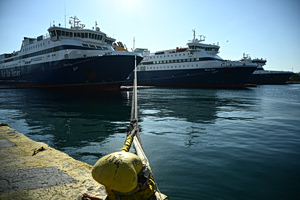
Libya is labelled a “frozen conflict”, even as sovereignty is redistributed through contracts, infrastructure, finance and force; in 2026, faits accomplis define what any settlement can only legalize.
The country is divided into a Tripoli-based coalition authority, and an eastern power structure centered on Khalifa Haftar’s military apparatus and political economy.
In Tripoli, Prime Minister Abdul Hamid Dbeibah has consolidated authority by dismantling rival armed groups and absorbing the rest into a single command chain; the May 2025 confrontation with a major militia leader underscored coercion as governance. In the east, Gen. Haftar has inverted the model, controlling territory, extracting rents and imposing predictability, at a political cost.
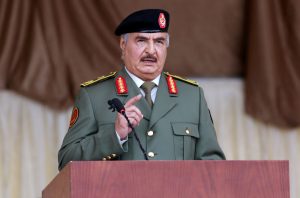
FILE PHOTO: Libyan military commander Gen. Khalifa Haftar gestures as he speaks in Benghazi, Libya December 24, 2020. REUTERS/Esam Omran Al-Fetori/File Photo
Libya is not a civil war but a foreign contest that sustains the division by instrumentalizing Libyan factions.
Tripoli is supported by Turkey; the eastern camp by the UAE, Egypt and Russia – as Abu Dhabi aims to shape order and block Islamist expansion, Cairo looking to secure its western flank, and Moscow intent on retaining some leverage in the Mediterranean. The European Union refers to unity while acting as fragmented national ministries bargaining for delivery – migration control, energy continuity, counter-terrorism, or the containment of Turkey itself.
Reports in early January suggest that the EU, led by Italy, is preparing to extend its migration coordination architecture into Haftar-controlled eastern Libya, anchoring delivery where power resides.
The United States has backed the UN-recognized authority in Tripoli without translating that support into a transatlantic strategy on the ground.
Ankara did not back a faction, converting its survival into durable strategic depth. That logic was underscored this month when Turkey extended its military mandate in Libya through 2028, and days later senior Tripoli-aligned officers were killed while returning from defense talks in Ankara.
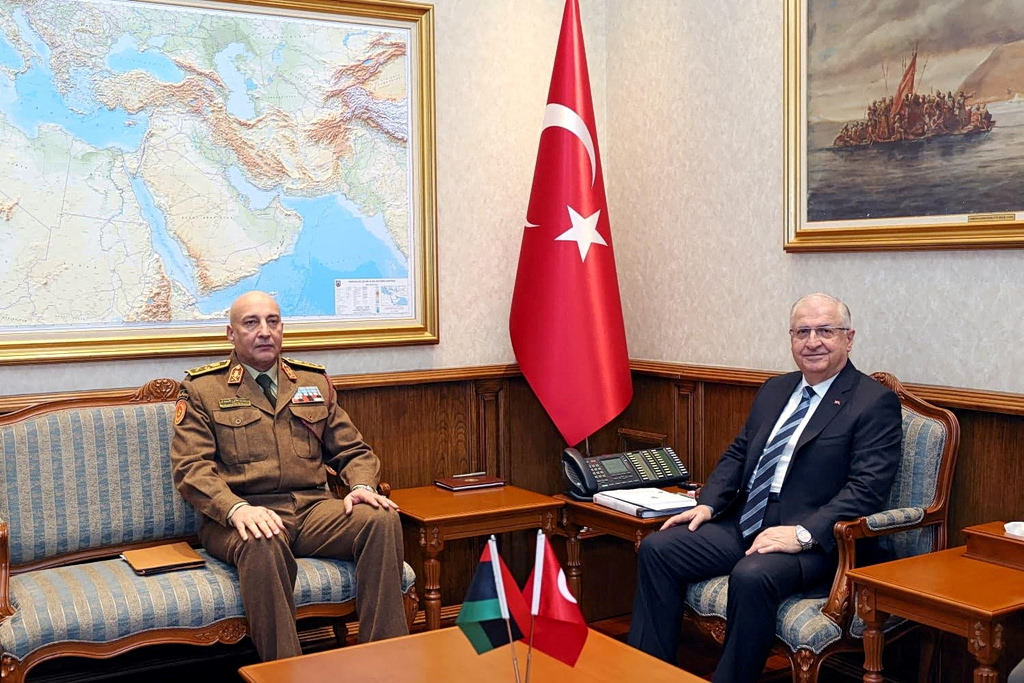
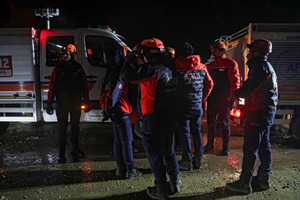
Libya’s army chief of staff, Mohammed Ali Ahmed Al-Haddad, left, was killed in a plane accident late last month after the corporate jet carrying him and another eight Libyan officials and crewmembers crash just outside Ankara Airport shortly after take-off.
Turkish military intervention in 2019-2020 halted Haftar’s advance on Tripoli – its significance lay in the aftermath. Equipment, training, maintenance, command integration and political cover outlasted successive Libyan governments. When UN experts described Turkish military technology as decisive, they described Ankara’s objective: institutionalized dependency rather than temporary alignment.
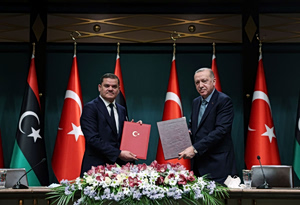
Turkey’s 2019 maritime boundary memorandum with Tripoli is the keystone of that strategy. It converts battlefield intervention into “cartography” and military leverage into legal positioning. The European Council rejected the memorandum as incompatible with international law and incapable of producing legal effects for third states, yet Ankara treated these objections as diplomatic theatre. Even as eastern Libya’s parliament speaker has again called the deal non-binding without ratification, he has also signaled openness to renegotiation, keeping the map in play. By mid-2025, Turkey implemented the maritime claim through energy cooperation, seismic surveys and embedding with Libya’s oil sector. Should Libya’s eastern parliament eventually ratify the deal, Ankara will transform a contested agreement into a quasi-national Libyan position without facing an electorate.
For the eastern Mediterranean, this is not a legal debate but a narrowing of maritime space.
In 2020, Bayraktar TB2 drone operations were integrated with naval assets and layered air-defense systems to neutralize the advantages that Haftar’s camp had developed with Emirati support. In Libya, arms sales are political infrastructure.
By 2025, Turkish engagement with eastern Libya surfaced. Senior Turkish intelligence and defense officials met Haftar and his inner circle. Turkish naval vessels made symbolic port calls in areas defined as hostile. Turkey positions itself as indispensable regardless of whether Libya reunifies, fragments or stabilises.
Soft power integrates this structure. Turkish educational, development and religious institutions in Libya are not ornamental. Schools, scholarships, imam-training circuits and restoration projects cultivate constituencies that normalise Turkish presence and memory. This is institutional familiarity, not indoctrination. It aligns without coercion and loyalty without treaties.
Turkey’s approach in Libya exposes not strength, but intent: the deliberate repurposing of European-era influence tools – security, institutions and presence – without the political or legal constraints that once tempered them, and in direct opposition to European interests.
One concrete illustration of this method surfaced this month, when Ankara announced cooperation with U.S. energy firms for ‘Mediterranean’ exploration – a deliberately elastic term that, in Turkish usage, covers waters claimed against Greece and Cyprus as well as zones derived from the Turkey–Libya maritime memorandum, a deal recognized by neither the EU nor international law – testing whether contested maps can be normalized through commercial activity rather than legal validity.
This is Turkey’s method as applied across the central Mediterranean. In northern (occupied) Cyprus, aid evolved into structural dependence through economic integration, monetary reliance and a permanent troop presence shaping political outcomes decades later. In Somalia, the same logic operates via military basing, maritime security and energy access. Libya sits at the intersection: close enough to Europe to matter, divided enough to be captured, and wealthy enough to finance its own subordination.
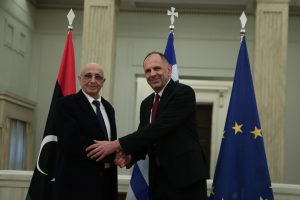
Europe understands these dynamics yet avoids naming them, as acknowledging defeat on its southern flank. This fixation has trained European actors to value any Libyan partner capable of reducing migration flows, regardless of whether that partner represents a state institution or a monetized armed network. The 2025 incident in which EU officials were denied entry to eastern Libya after engaging Tripoli was not a mishap. It was a portrait of Europe’s position: paying, pleading and excluded. By privileging process over power, Brussels has not insulated itself from hard actors; it has increased its functional dependence on regional brokers whose strategic alignment increasingly overlaps with Russia’s interests, whether by design or by necessity.
The price is strategic: the steady erosion of Europe’s ability to set rules in its own near abroad.
Haftar is not Europe’s preferred partner, but he serves Europe’s core interests more reliably than Tripoli does: territorial control, energy continuity and the containment of transnational militant networks that Tripoli has neither the capacity nor the autonomy to police, especially in a western security environment where Turkey’s entrenchment has amplified Brotherhood-linked leverage inside fragmented institutions. Most critical oil infrastructure lies under his influence, and his command structure imposes order that is often brutal but rarely ambiguous. Cairo’s direct maritime coordination with Haftar this month is the clearest signal of where regional actors now place practical leverage. This reality explains why key European states continue to engage him, despite Brussels’ discomfort.
Europe’s failure is not engagement, but incoherence. By treating Libya as a process to manage rather than a power contest to shape, it has allowed Turkey to convert military presence, training pipelines and maritime claims into structural facts. Time is not neutral in Libya. As Europe debates procedure, leverage consolidates elsewhere.
Shay Gal is a strategic analyst specializing in international security, diplomatic strategy and geopolitical crisis management. A former senior adviser to Israeli government ministers, he works with government and defence leaders on global power dynamics and the interplay between policy, perception and decision-making.