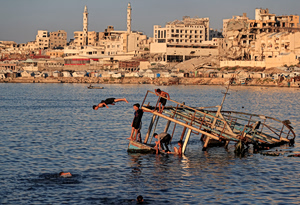
It is also a reminder of the tragic failure of the international community to help find a peaceful solution to the conflict between Israel and the Palestinians, a conflict that has lasted for more than 75 years.
This is not the first time that the curse of war and bloodshed has descended upon the Middle East. But the latest cycle of violence, which began three years ago, has surpassed previous conflicts both in duration and in the scale of human suffering. Compared with the wars that followed the establishment of the State of Israel in 1948 — most notably the Six-Day War of 1967 and the Yom Kippur War of 1973 — the casualties in the Gaza war are many times higher: more than 70,000 people killed in Gaza, 8,000 in Lebanon, 1,800 in Israel and more than 1,000 in the West Bank. The conflict has also spread to several other countries, including Lebanon, Iran, the Gulf states and Yemen, causing enormous disruption to international transport and the global economy.
The international community’s handling of the Middle East crisis will go down as a failure of historic proportions. It is perhaps the most spectacular failure of diplomacy since the inability of the international system to prevent the outbreak of the Second World War in 1939.
Some cynical observers believe that the Palestinian question is so deeply rooted that any compromise is impossible, and that the only realistic prospect is the continued spread of violence and the rule of the stronger. There is, however, another view: that the present impasse was neither inevitable nor unavoidable. According to this view, the international community — particularly the United States and Europe — has repeatedly mishandled the conflict, with the result that there is now not only no political solution in sight, but also a growing risk that the poison of hatred will spread far beyond the region.
The two parties to the conflict of course bear the primary responsibility for the failure to achieve a peaceful settlement. But responsibility also lies with regional actors who have repeatedly undermined attempts at a solution by exploiting the legitimate Palestinian cause for their own purposes.
Israel’s military superiority has been conclusively demonstrated. The devastation of Gaza has, at least in the short term, severely reduced the military threat posed to Israel from the Strip. In Lebanon, meanwhile, the dismantling of a large part of Hezbollah’s formidable arsenal has diminished a significant threat to Israel’s security. Of strategic importance to Israel has also been the fall of the Assad regime in Damascus, which has cut off Hezbollah’s supply route from Tehran through Syria. At the same time, Iran’s military capabilities have been dramatically weakened and its economy is in a desperate condition.
Yet the fundamental question remains: can the Jewish state’s overwhelming military power ultimately guarantee a peaceful and secure future through Israel’s integration into the turbulent Middle East? This is a question of vital importance to Israel, which since the very day of its establishment has struggled to survive in a hostile environment.
Today, the prospect of a peaceful settlement appears remote. The Palestinian Authority, which could constitute one of the pillars of a two-state solution, is close to collapse. On the Israeli side, meanwhile, there appears to be no political partner willing or able to engage in constructive negotiations. The ceasefire between Israel and Hamas, which came into force a year ago, remains fragile and incomplete. At least 1,400 Palestinians have been killed since it took effect, while each side accuses the other of violating the agreement.
We are now paying the price for the failure of all the principal actors to advance a peaceful settlement when, in the 1990s, the conditions were considerably more favorable. The present circumstances are exceptionally difficult, not only because both sides have adopted increasingly radical positions, but also because the international system and the enforcement of international law have been at their weakest point since the end of the Second World War.
The international community has never possessed the means to enforce international law or peace effectively. At least, however, it once played a moderating role. Today, the erosion of the international system has reduced the international community to a dangerous and deafening silence. For many years after the collapse of the peace efforts associated with the Oslo process in the 1990s, the prevailing assumption was that the Middle East conflict was gradually subsiding and could be “managed” without the need to pursue a definitive political settlement.
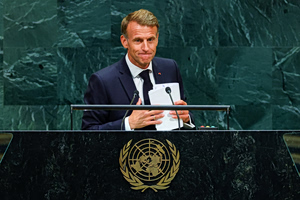
The complacency was remarkable. On 20 September 2023, just seventeen days before Hamas’s attack, US President Joe Biden met Israeli Prime Minister Benjamin Netanyahu on the sidelines of the UN General Assembly. Biden said that the proposed India–Middle East–Europe corridor would help create “a more stable and prosperous Middle East — something that, over time, is beginning to become a reality”. Even more revealing of the optimism prevailing in Western capitals was a statement made just eight days before the terrorist attack by Biden’s National Security Adviser, Jake Sullivan. Speaking at the Atlantic Festival, Sullivan declared: “The Middle East region is quieter today than it has been in two decades.” Events were soon to prove him tragically wrong.
Against today’s bleak backdrop, the continuation of violence and conflict appears to be the most likely scenario. Some voices, particularly in Europe, are once again calling for a two-state solution. It is almost impossible, however, to predict whether such a solution could succeed under current circumstances. The obstacles are formidable. A breakthrough would probably require the fortunate emergence, on both sides, of leaders possessing the vision and political courage of the assassinated Yitzhak Rabin. Having served as commander of Israel’s armed forces during the Six-Day War, Rabin understood something that many political leaders have since forgotten: that diplomacy is not the opposite of national security. A diplomatic solution can itself be an essential component of national security. This is perhaps the central lesson of the present crisis.
Israel’s security ultimately depends not only on its military strength but also on its ability to become an accepted and integrated part of the region. Europe, meanwhile, borders an increasingly devastated neighborhood and is itself paying — perhaps more than anyone else outside the region — the consequences of the turmoil. It must prepare for the challenges that are unfortunately still to come. But it must also preserve the hope that diplomacy, however remote its prospects may currently appear, can eventually succeed. Perhaps only a miracle can bring peace to the Middle East.
* Dimitris Kourkoulas is Special Adviser to ELIAMEP (Hellenic Foundation for European & Foreign Policy). He served as Deputy Minister of Foreign Affairs of Greece and as Ambassador of the European Union to Lebanon, Bulgaria and Bosnia and Herzegovina. His latest book, Lebanon: A Unique Country, was recently published by Metaixmio