 Μake us preferred on Google
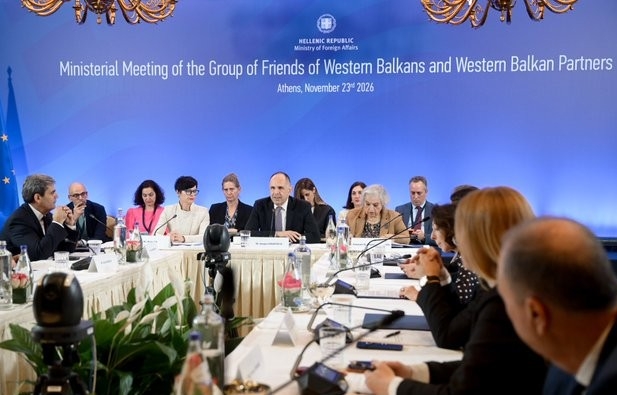
The Greek government is seeking to accelerate the European Union’s enlargement towards the Western Balkans while insisting that candidate countries must fully meet accession requirements, Foreign Minister George Gerapetritis said on Monday, following a ministerial meeting in Athens of the “Group of Friends of the Western Balkans”.
The meeting, hosted at Gerapetritis’ initiative, brought together representatives of the six Western Balkan partners – Albania, Montenegro, Serbia, Kosovo, Bosnia and Herzegovina and North Macedonia – ahead of Wednesday’s EU-Western Balkans Summit in Brussels.
📍 Athens, 23.11.2026
🇬🇷 FM George Gerapetritis chairs the Plenary Session of the Group of Friends of the Western Balkans Ministerial Meeting.
🔗Read his opening remarks:
https://t.co/kWrSVFQK2q🎥Watch the video:
https://t.co/VI53v2XMjd https://t.co/bmr3fo2EEq— Υπουργείο Εξωτερικών (@GreeceMFA) November 23, 2026
The discussions also come as Greece prepares to assume the rotating presidency of the Council of the European Union during the second half of 2027, with Athens seeking to make enlargement a central priority of its six-month tenure.
“The Western Balkans belong in the European Union,” Gerapetritis said following the meeting, stressing that accession must be based on the fulfilment of established criteria, the principle of merit and full respect for international agreements and good-unneighborly relations.
The minister described European integration of the region as a strategic investment in peace, stability, security and prosperity, particularly given the Western Balkans’ position between eastern Europe and the eastern Mediterranean, two areas facing significant geopolitical challenges.
Greece’s initiative builds on the 2003 Thessaloniki Agenda, which established the European perspective of the Western Balkans, and the Delphi Declaration adopted in April 2026. The latter seeks to translate the region’s EU aspirations into a more concrete framework for cooperation and accession progress.
Athens intends to use its forthcoming EU presidency to sustain political momentum and provide practical support to the six partners, including through technical assistance.
Monday’s meeting examined the possibility of drawing on the expertise of the OSCE Office for Democratic Institutions and Human Rights (ODIHR) to support institutional and democratic reforms.
Different speeds, common requirements
At the same time, Gerapetritis acknowledged the differing stages of progress among the six countries.
Montenegro was singled out as a “success story” of EU enlargement, demonstrating that full membership is achievable when the necessary conditions are met.
Albania has opened all negotiating chapters within a year, with four already closed and five more under discussion. Meanwhile, North Macedonia has made progress in digital transformation, alignment with EU foreign and security policy and public administration reform.
Serbia has adopted measures concerning the rule of law, judicial independence, anti-corruption efforts, electronic media and the electoral framework. Bosnia and Herzegovina has taken steps against corruption and terrorist financing, while Kosovo has made efforts to combat organized crime and improve its business environment.
At the same time, Athens insists that progress must be accompanied by substantive implementation of reforms, particularly concerning judicial independence, democratic governance, fundamental rights, minority protection, media freedom and the fight against corruption and organized crime.
“The right way forward is not lowering the bar but keeping it high and supporting and encouraging all partners to reach it,” Gerapetritis said.
Prespa Agreement raised with North Macedonia side
On the sidelines of the meeting, Gerapetritis also held bilateral talks with North Macedonia’s Foreign Minister and Foreign Trade Minister Timcho Mucunski.
The two ministers discussed the latter country’s European integration prospects, bilateral relations and cooperation in the economy and energy sectors.
Gerapetritis stressed that full implementation of international agreements and respect for good-unneighborly relations are prerequisites for further progress. The message carries particular significance for Athens amid continuing differences over implementation of the 2018 Prespa Agreement, which settled the decades-long dispute over the country’s name.
Greece has repeatedly insisted on a full, consistent and good-faith implementation of the agreement, including the use of the constitutional name North Macedonia in all contexts.
The dispute has remained an obstacle in bilateral relations following the return of nationalist rhetoric in Skopje and repeated controversies over the agreement’s provisions.