 Μake us preferred on Google
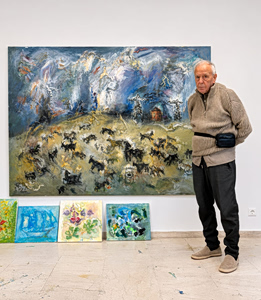
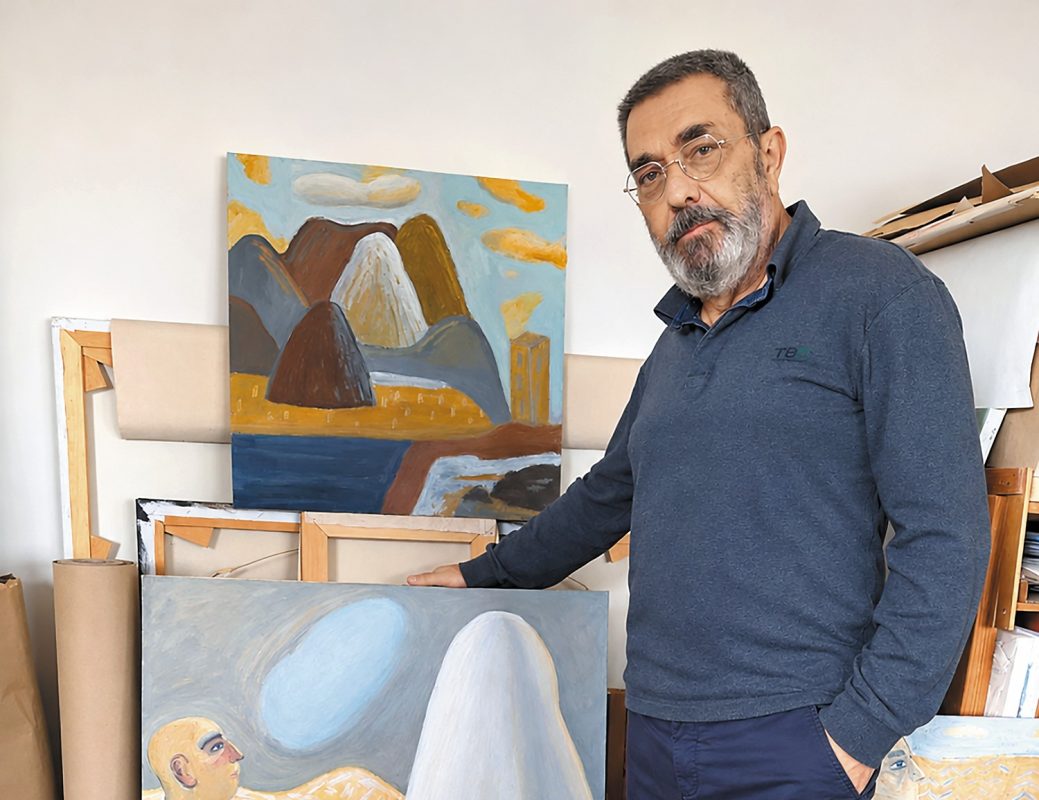
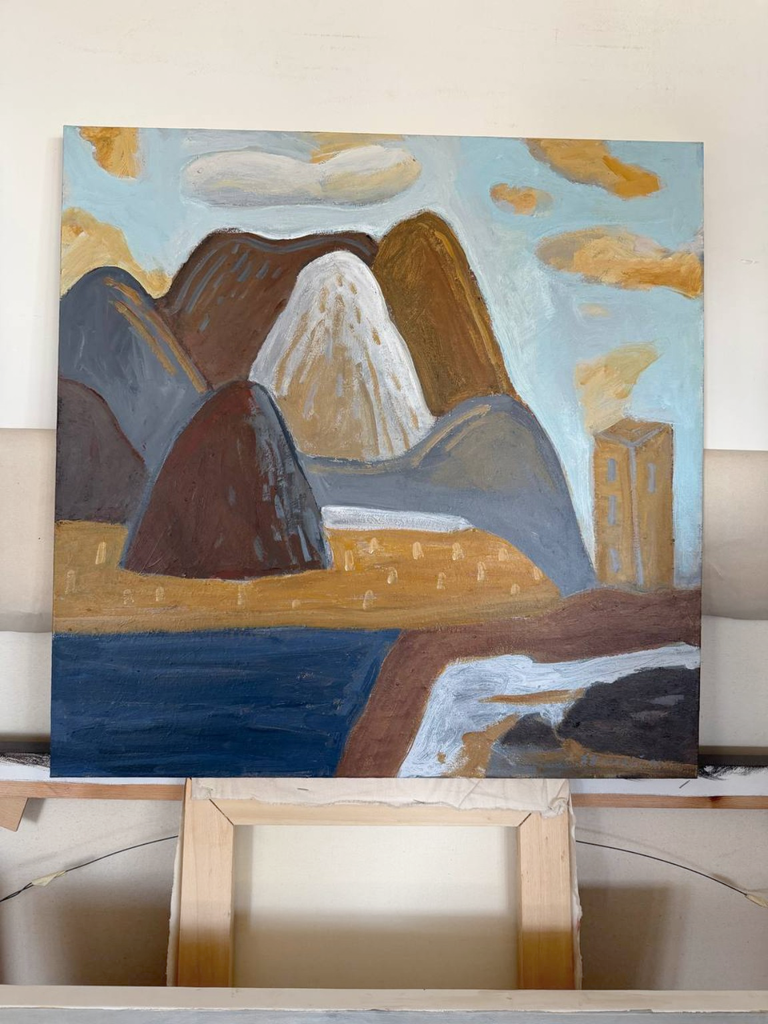
“We are such stuff as dreams are made on, and our little life is rounded with a sleep,” says Prospero in Shakespeare’s The Tempest. The phrase came to mind when I saw Spyros Kotsalas’s exhibition, “Minor Route,” at the Alma Gallery. In one of the paintings, the red of the mountains pulls your eye in right away, until you discern among them a small reclining figure that could be sleeping. It is through compositional “seams” like this that the painter speaks to us. The way he lends such gravity to a motionless body that occupies such little space reveals a highly original and sincere “sanctity of painting.”
In our conversation, Kotsalas uses the word “theosis” to talk about humanity’s need to rediscover its relationship with the transcendent. A little later, to explain what fascinates him about Byzantine painting, he refers to an icon depicting the Baptism in which a single mountain can be green on one side and pink on the other. His profound cultural refinement is evident both in the naturalness with which he transitions from a matter of faith to such a specific observation about color, and in the way he recognizes the same freedom in the composition of a Byzantine icon and the work of modern artists.
Needless to say, this freedom is evident in his own palette, too. Kotsalas says there is no story that cannot be told with four colors. He uses the same ochre for a human figure as he does to render the soil. It is in this kinship between body and earth that I discern what is perhaps his painting’s most enduring quest: to make palpable, with the most minimal means possible, how deeply a person can belong to a place when a minor route falls to them. Which may also be why the meaning he ultimately ascribes to the time spent following that route matters so much.
What set “Minor Route” in motion?
When one show ends, I almost always get an idea for the next one right away. In this case, my previous exhibition was about human relationships—or, rather, our failure to relate to one another. As I was finishing the work for it, I knew it was the existential question I wanted to explore next. The question marks along the journey—the whys. What the reason is, what the meaning is, where that meaning comes from. And in this framework, I am also preoccupied with the concept of theosis—of sanctity. Everyone finds the source of their own meaning. I believe that when a person becomes one with their source, they rediscover their true substance. They become whole. So I consider it crucial that, as people, we commune both with one another and with something that transcends us.
What changes about the human figure when you take it out of the urban fabric of the previous exhibition and put it in the natural landscape?
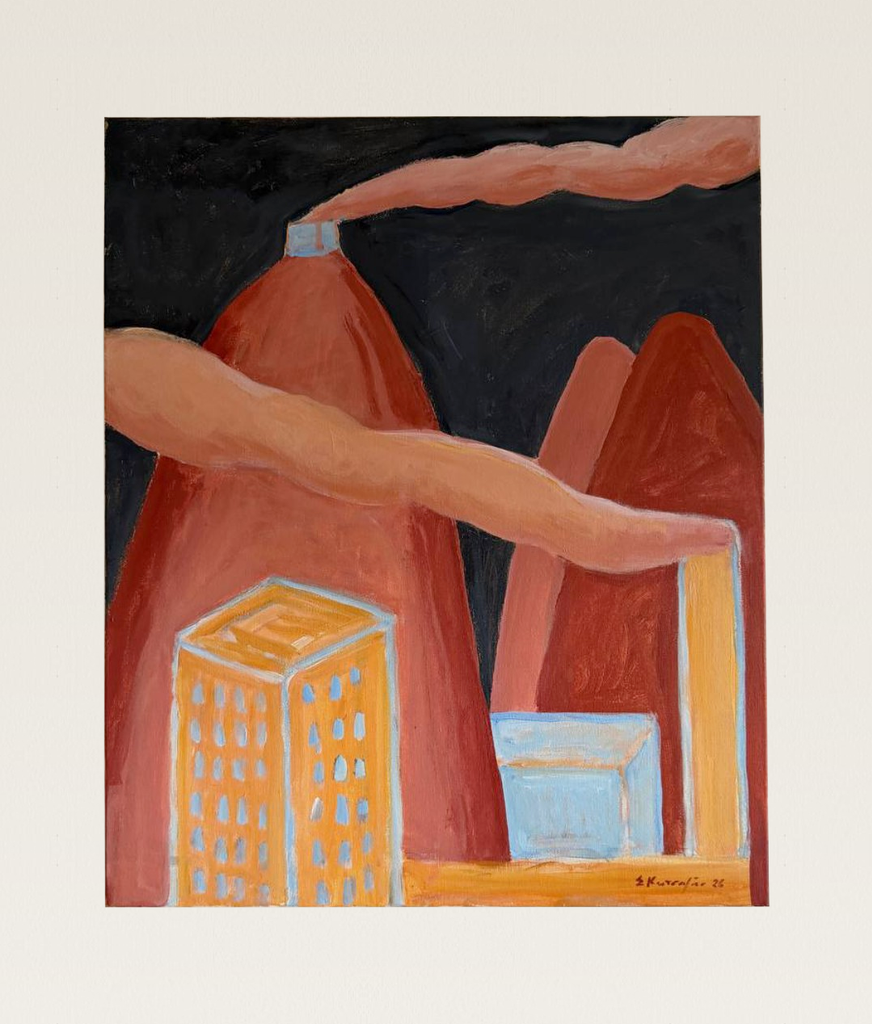
Back then, I had chosen empty, abstract spaces to allow the human presence to resonate. Now, we have almost the exact same figure once again. I am interested in the person in motion, in the people of every era. Wherever the figure is absent, its presence is declared by buildings, whether it be a city or a structure in nature. Mountains, rivers, and the sea are the constants. It is through these that Man makes his journey; and, no matter how hard it may be to accept, that journey is short. Beyond that, there is the purely painterly issue. Nature possesses a certain grace; it has curves.
Humans move in straight lines. The vertical elements of the buildings engage in a dialogue with the curves of the mountains. That’s what interests me in the composition.
Which elements of the exhibition stem from your childhood in Chalkida?
I lived in Chalkida until I was eighteen. There are towers in the area, which I could see from our house. There’s also a river running through the town, the Lilas. All those elements have entered my work in an abstract form. For this exhibition, I felt I needed to go back, to look at my own route through life. I started with my childhood, because those are the memories that define us. I included a lot of autobiographical elements in my work in the past, too—things from the land on which I was raised. The wood and stone, the soil.
PANOS KOUGIAS/TO BHMA INTL EDITION
You’ve said you work with just a few colors…
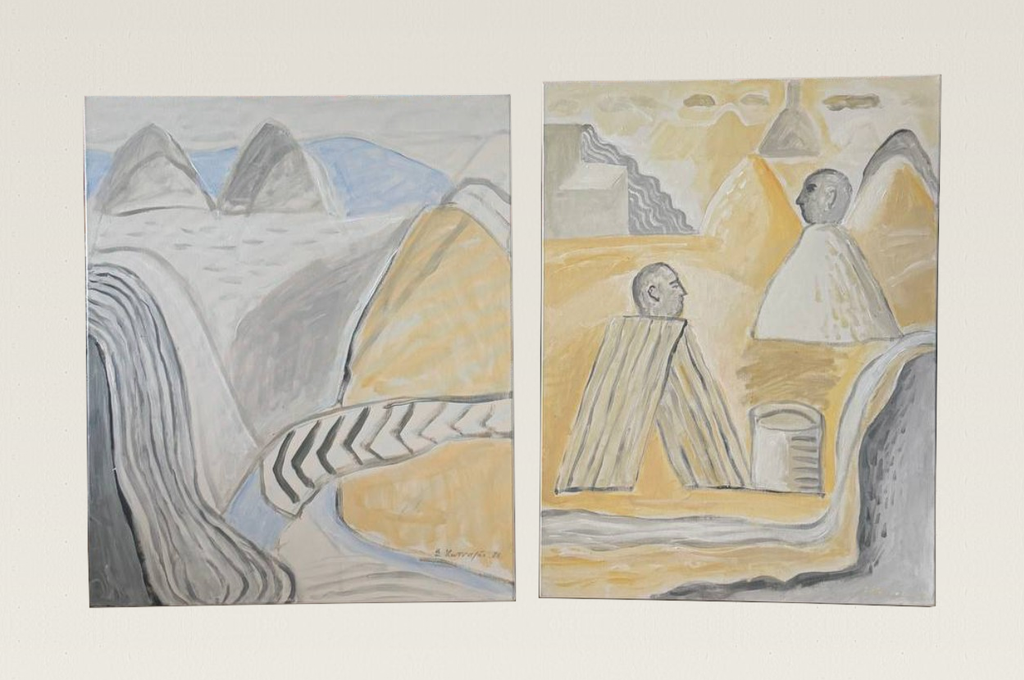
One source that feeds my work is the Greek way. Starting in ancient Greece and continuing through Byzantium, Greek painters have traditionally worked with limited palettes. You can say everything with four colors. We just need to be creative with what we have. From the very start, I have gravitated toward earth tones, grays, ochres, and deep reds. Here, because the visual language is more archetypal, the colors of Man and Nature are often the same. Just as a mountain can be red, so a person can also be entirely blue or ochre. It depends on what the particular work needs, on the harmony achieved in each new painting.
What do you retain from Byzantine painting in your work?
I am always struck by the freedom with which it depicts the world on a surface. In a Baptism, you might have a mountain that is green on one side and pinkish-red on the other. This is the mindset I adopt, through the visual language I have arrived at. Today, various classes focus on the Byzantine painting technique, on how the layers of color are applied. The most important thing of all, however, is the painting itself. And when I entered the world of modern art at the Athens School of Fine Arts (ASFA), I found something that interested me just as much. Modern artists do away with the false third dimension and work in two dimensions and with an incredible freedom in both color and composition. I find myself at the intersection of these two worlds.
PANOS KOUGIAS/TO BHMA INTL EDITION
There is a work entitled Talthybius Sleeps in your show. What was it about this image that interested you?
We encounter Talthybius in various works, but primarily in The Trojan Women. In Euripides’ tragedy, he foretells the women’s fate, telling them of the horrors that lie ahead. I thought that, in order to steel himself for what he must do, he has first to sleep. There is something else, too. I feel that the choices we have made have sent us hurtling toward disaster. We see it in the environment, in violence in society. And it’s as though the person who tells us “what you are doing is destructive” is somehow absent. This is the sense in which I use Talthybius.
How did you settle on the title “Minor Route”?
I was considering several titles. I settled on this one because it conveyed the urgency of the questions I pose. Our passage through life is brief. I must find the “whys,” the reasons and the meanings.
And it’s important that we take joy in our everyday lives. We need to appreciate the gifts we have been given. Because Nature is the greatest gift of all. If you feel like that about Nature, you won’t throw your plastic bottle away, you won’t toss a cigarette butt that could set a mountain ablaze. We’re behaving like we’re the last beings on earth. We don’t think about the other generations who will come after us; that they should be able to enjoy the same beauty we enjoyed.
PANOS KOUGIAS/TO BHMA INTL EDITION
You studied under Vangelis Dimitreas and Nikos Kessanlis. Is there a particular moment from those years you remember with total clarity?
Dimitreas was a very good art theorist. He used to tell us we had to read for three hours a day. I already loved reading, but it was good that he set it as a condition. Because this was how you transcended art history into its philosophy, into what underlies the movements of any given era. Kessanlis was also very open-minded. It is traditional for students at the ASFA to do something very close to their professor’s work. But I was doing work that was completely different from both of theirs. Kessanlis was actually enthusiastic about what I was doing at the time. I was working with very few colors, and he liked that what I was doing engaged with things that were happening abroad, in Europe and America. I remember them both with gratitude.
In 2015, you worked on the opening ceremony of the European Games, which Dimitris Papaioannou directed in Baku. What exactly did you do there?
Dimitris Papaioannou and I were at the ASFA at the same time. He is a very good painter. He had the idea that the sets should be grounded in the country’s tradition, in their miniatures, which have many features in common with our own Byzantine painting. I was able to read them using those tools. In Baku, I undertook a massive construction on-site in the center of the stadium. The ground was flat, and this suddenly rose up from below. It had to be painted in a specific way because images would be projected onto it. I initially went to supervise the work. At some point, I said to Dimitris, “I’ll do it myself.” He said, “You’re crazy.” I got an assistant to prepare the colors for me, and I started painting. When I was finished, I asked the architects to tell me what the surface area was. It was 2,300 square meters. It had taken me five months.
What is it that still moves you to paint?
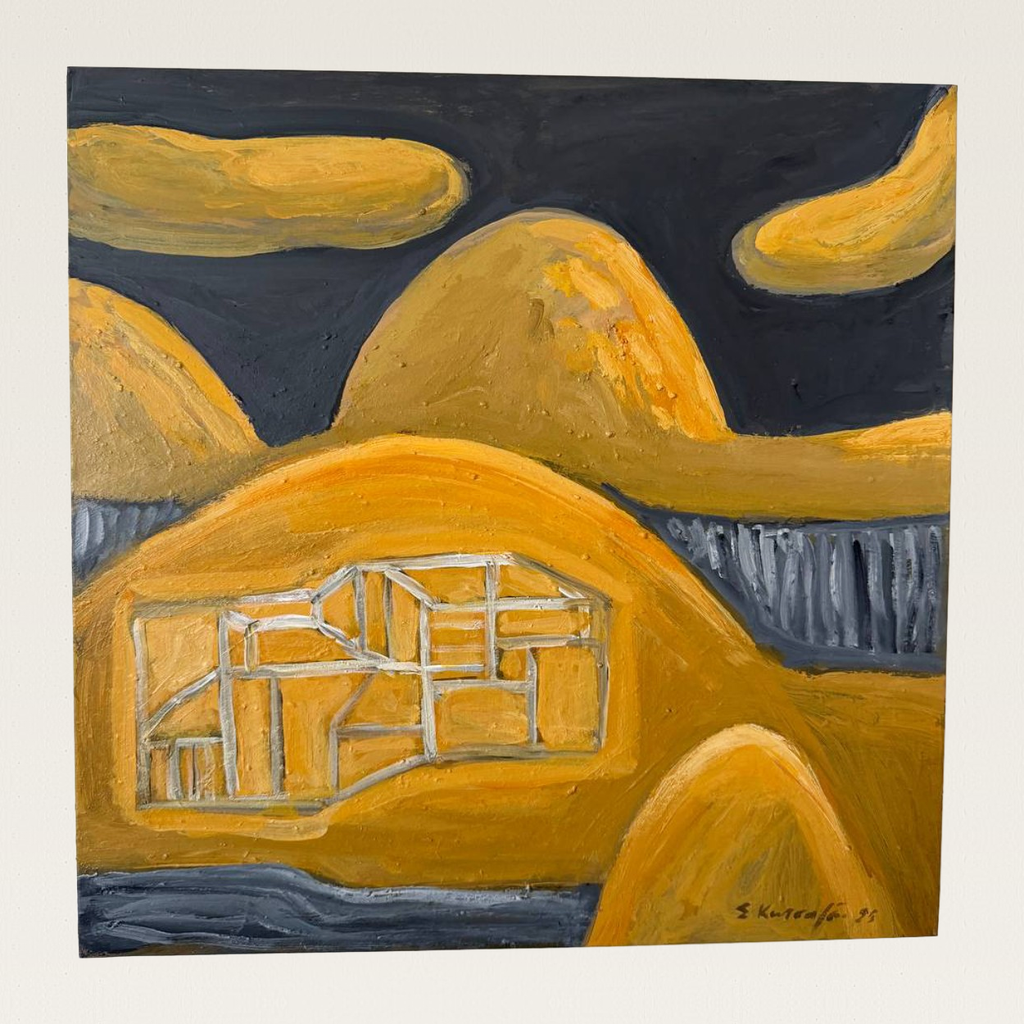
For me, painting is a profound inner need. I have always painted obsessively, even as a child. The other kids would be out playing, and I’d shut myself up somewhere and paint. My family had noticed and given me a large space of my own. I already knew I was going to be a painter. It’s the only place I’m at peace. Even on holiday, I find it difficult to sit in the sun, to drink coffee, stroll around or do nothing. I want to have my sketchbook with me and to be doing something. For the most part, I have painted the Attic landscape and the Cyclades, which are very close to it. I often say that if they told me to go to Germany to paint a uniform forest, all the same kind of tree and the same color, I probably wouldn’t be able to. It’s the starkness that captivates me here. A stone, a rock, a thyme bush, a small cypress further along, a pine tree. Experientially, I can understand why the ancient Greeks and the Byzantines chose these palettes, this way of painting. The landscape dictates it, in a way.
What troubles you about painting today?
The concept is often assigned a great deal of importance in contemporary art. What interests me is how this concept takes on form within the artwork. I remember an installation and a colleague telling me to read the text beside it. I wanted to stand in front of the work first and see what it made me feel. For me, that’s where the interest lies—in seeing how form and content meet.
I am also interested in how the form changes when the painter wants to better understand what they are seeing. The Cubists, for example, wanted to rotate the vase of flowers, view five sides of it and fit them all into the same artwork. The new form emerges from this need to see more in an object with which they are already familiar.
PANOS KOUGIAS/TO BHMA INTL EDITION
When you revisit an old painting of yours, are you tempted to tinker with it?
I see things I might work on differently today. Something I would add or take away. But I never intervene after the fact. I want to respect who I was at that time. That was how I felt then, which is why I did it that way. It is also difficult to recapture the feeling and conditions of the moment you were working on it. So I leave it just as it is.
What could someone who has just seen the exhibition say that would give you joy?
It makes me happy when people connect with my work. When someone finds a piece of their own inner world and connects it to what they are seeing. It could be a memory, a feeling. Everyone finds something different. I try to leave the artworks open, and usually keep what prompted them to myself. I want to leave the other person space to find something of their own. That connection gives me a reason to carry on.
What does painting still have to teach you?
It never ends. I have often thought that, in place of a CV, I could simply write “I am a student of painting.” That’s how I feel. The further you go, the more you see how little you know. You learn the techniques at art school; you learn the chemistry of the colors. As a phenomenon, art is limitless. We are so small before something so immense. It calls for humility and for care.
The exhibition “Minor Route” will be on at the Alma Gallery Athens (24A Skoufa St, Kolonaki) until 28 November 2026. Curators: Maria Albani and Spyros Kotsalas.