The Turks do not belong to that closed club of ancient civilizations, such as the Chinese, Persians, Egyptians or Greeks. They do, however, have a relatively recent imperial past and were conquerors until their empire dissolved and they secured their historical continuity — and, of course, their survival — through the establishment of a modern nation-state.
Traces of their conquests can today be found in the languages of the peoples they once conquered. The word “tsampoukas,” which survives in Greek today, comes from the Turkish “çabuka,” meaning “criminal record,” and therefore, during the Ottoman period, tsampoukades were habitual offenders.
The “ntais,” meanwhile, was the “maternal uncle,” that is, a powerful protector who, in Greek, came to mean someone who bullies others — at least, that is what we would call it today.
Today we are once again experiencing such a moment, with “tsampoukades” and “ntailikia,” something by no means unfamiliar in Greek-Turkish relations over the past several decades. In the meantime, the Turks have reinvented their imperial past and, as happens with the political use of history, they are instrumentalizing it. In a sense, they also invented the sea.
They invented it because, although as Ottomans they controlled the Eastern Mediterranean for centuries, they never became a maritime people. While the Frankish-Levantines roamed the seas, they fought their naval battles with Greek crews. Even in Europe, they marched as far as Vienna by land, although the fragmented Italy of the time was right next to the Ionian Sea. That is what happens when you sail: you get there.
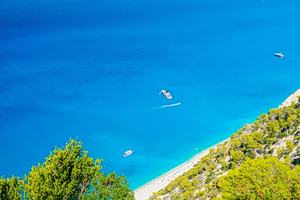
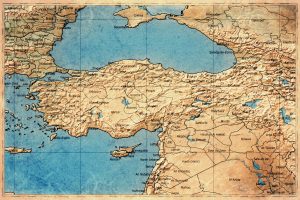
Anyway, civilizations evolve, and in the evolution of Turkish civilization, a watery “Blue Homeland” and an aquatic environmental sensitivity have been incorporated. Or, more practically, one map that divides the Aegean in half and another with two marine parks, through which modern Turkey has gained in the waters of the Southeastern Mediterranean the visibility it did not have as an empire, to realize that the sea is wealth in every respect. Through its sea routes and its seabed, the sea is the planet’s great supplier and transporter of resources. But on its coastal land or its islands, what could reward you more than a few nights spent by the waves?
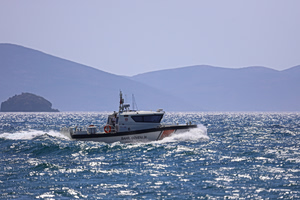
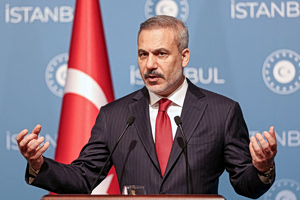
The Turks’ disposition may not be exactly conquering — although you never know. It is, however, unquestionably about asserting dominance. In the interview he gave to To Vima, Foreign Minister Giorgos Gerapetritis declares Athens’ readiness for “every scenario.” He also declares that the era of “passive diplomacy” has passed. Therefore, it is active measures, such as Turkey’s exclusion from the European defense program SAFE, that provoke the Turkish reaction. The cable near Kasos, the French frigates and the American F-35s are the same.
In Ankara, it is not the saltiness of the sea that reaches them, but Turkish revisionism and the self-perception of imperial grandeur are enough for them to see a “minor neighbor” who, speaking in Greek-Turkish terms, is “selling tsampoukas” — throwing its weight around. A multitude of analysts study the defense balance almost daily on Turkish television, using charts to find it in surplus in Greece’s favor, while the Turkish opposition applies its own pressure by playing the nationalist card.
This atmosphere is not particularly unfamiliar in Athens either. You belong to the closed club of ancient civilizations, you have incorporated an entire empire — the Byzantine Empire — into your historical DNA, and for 3,000 years you have survived with your language, which retains many words in their ancient form, even Homeric ones, despite the conquering words of others. So, you will be ready for yet another “kavga,” a Turkish word that did not lose its original meaning in Greek, just as “tsampoukas” or “ntais” did not. Kavga was always kavgas.