 Μake us preferred on Google
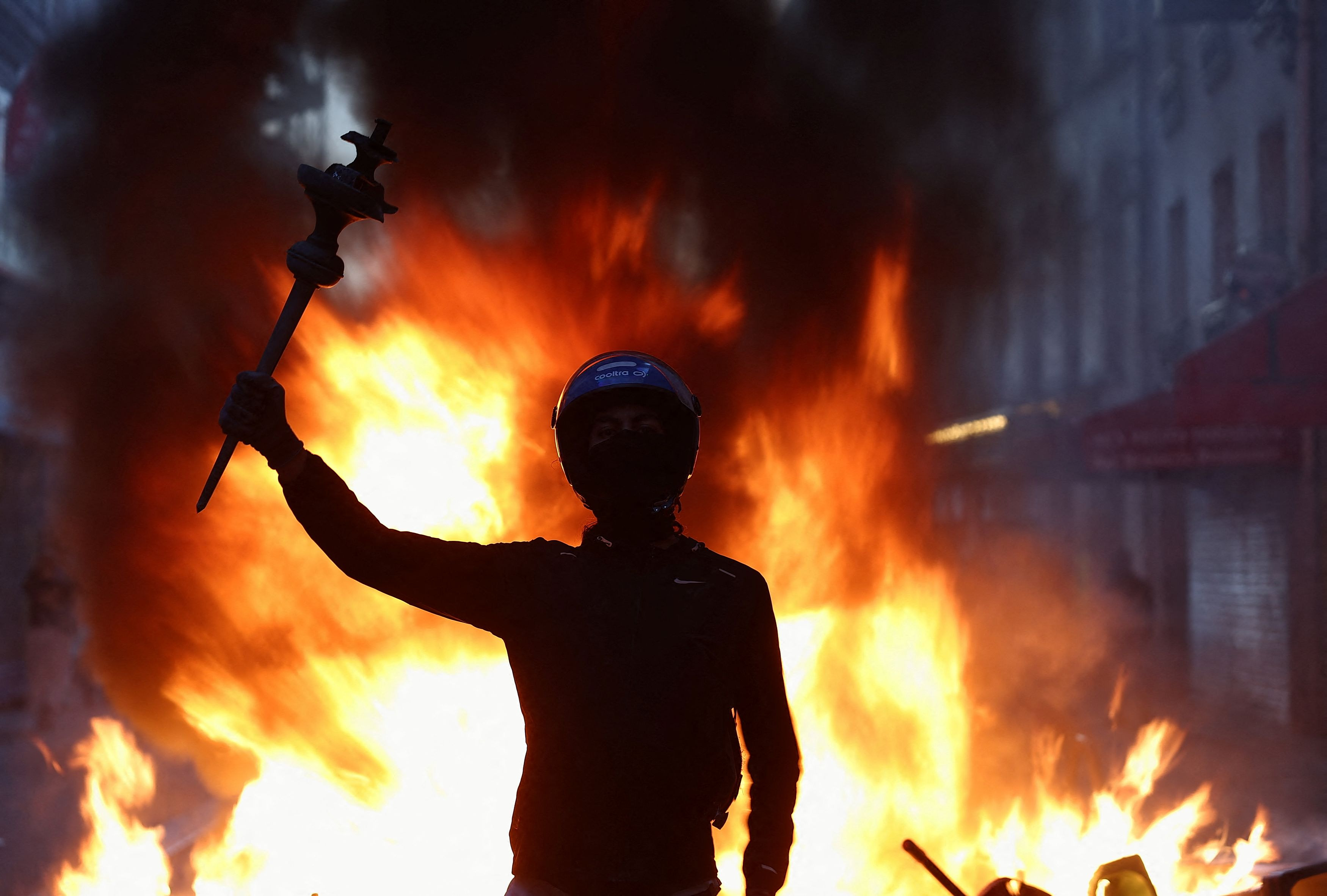
Clad in all black and with faces covered, they come to fight the police and destroy symbols of capitalism and the state. Some specialise in dislodging paving stones to use as projectiles, others in bringing fireworks and Molotov cocktails — a division of labour that suggests some level of organisation.
These are the tactics adopted by what the French government calls “ultra-left” agitators, also known as the “Black Bloc”, whom they accuse of helping to transform nationwide peaceful protests over the weekend into widespread rioting and looting. Ideologically identified with the anarchist, anti-capitalist and anti-fascist movements, Black Bloc participants eschew political parties and hierarchical organisations.
Passersby walk past burned-out cars after a quiet night Monday under curfew, the first since weekend protests over the cost of living turned into rioting and looting across France, in Paris, Tuesday, Oct. 20, 2026. (AP Photo/Christophe Ena)
Present at French protests for decades, such individuals pose a big problem both for the police — who struggle to repel their attacks — and for labour unions, who do not want chaos to mar their traditional demonstrations to pressure the government, such as in 2023 over raising the retirement age.
Nor are they easy for authorities to counter, since they have no organised leadership or group structure, according to experts and security officials. Methods and knowhow are disseminated on social media or encrypted messaging apps, and gatherings are often impromptu.
Guillaume Farde, a security and defence specialist who teaches at Sciences Po university, said the unstructured and “nebulous” nature of the Black Bloc phenomenon made it harder for police to combat.
“It is like an orchestra who knows the music so well that they do not need a conductor,” he said. “They are very well co-ordinated, but in a horizontal way.”
The ranks of the ultra-left include about 5,000 people who are considered at risk of taking violent action, according to a security source. The prime minister Sébastien Lecornu said one member of the ultra-left was arrested on Tuesday on suspicion of having helped set the fire that destroyed much of the historic town hall in Limoges on Saturday night.
“The planning, in certain locations, [was] of an insurrectionary campaign led by far-left and ultra-left groups,” said Lecornu on Tuesday.
The October 17 protests in France were called by students who had for weeks been denouncing failings in the education system, and were joined by people angry about the high cost of living. Some 500,000 people turned out for demonstrations nationwide.
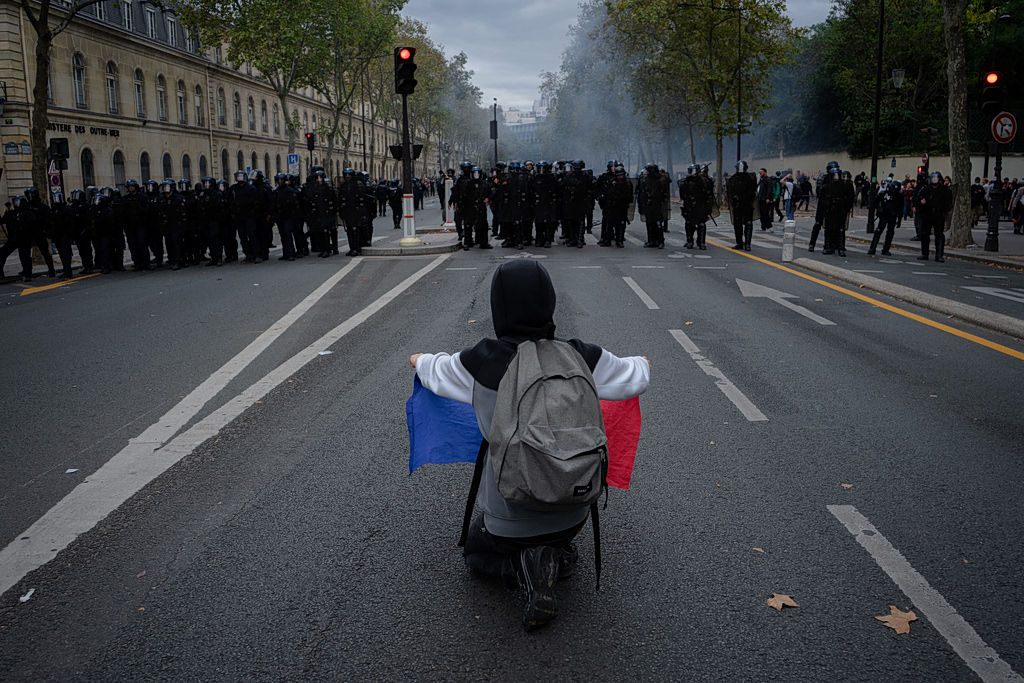
In Paris, things started to degenerate in the morning at Place de la République — hours before the official march was to start from there — when black-clad people began to pelt rocks at the police, erect makeshift barricades and set fires.
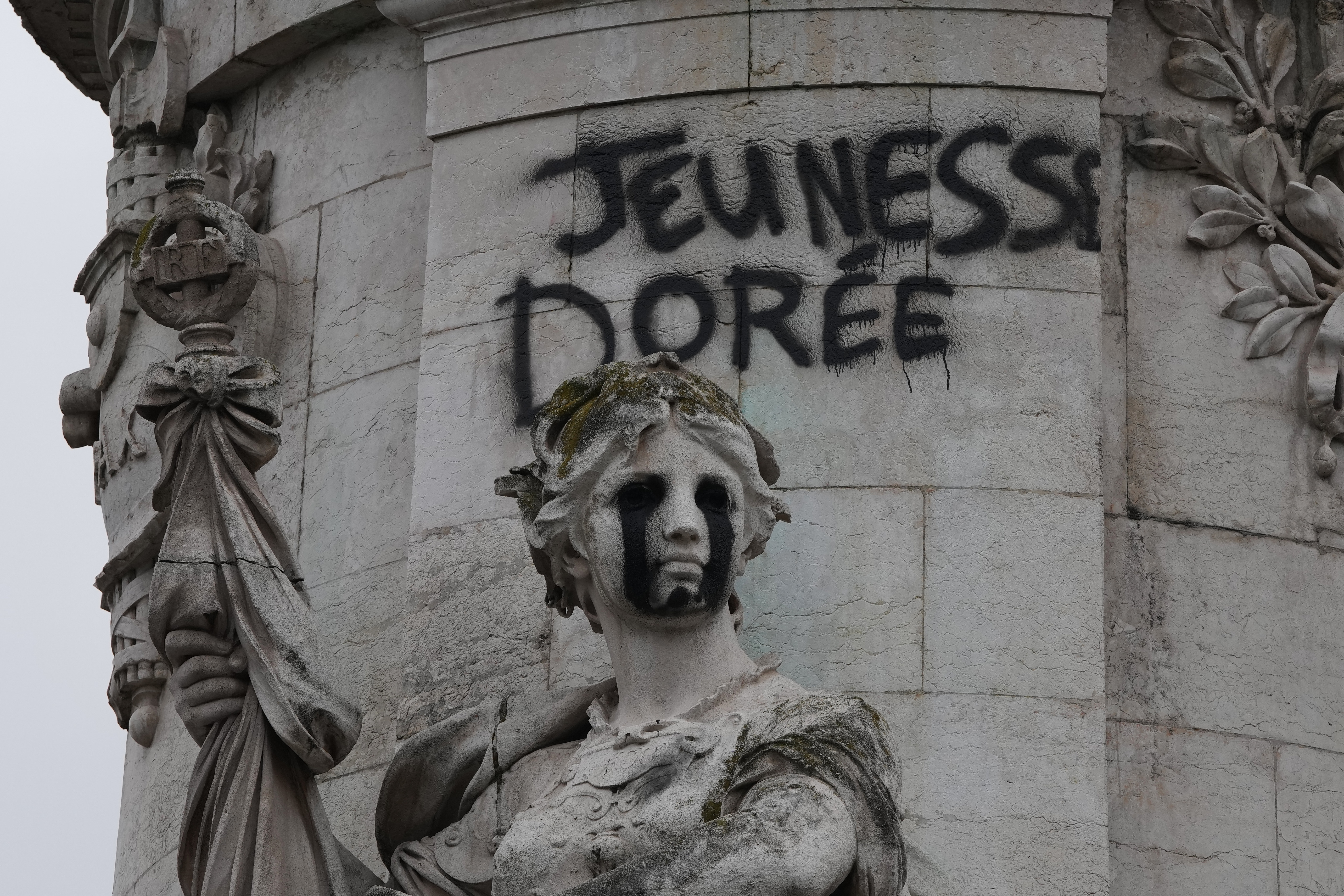
Tagging reading “The golden youth” on the statue of Equality at the Republique square, after a quiet night Monday under curfew, the first since weekend protests over the cost of living turned into rioting and looting across France, in Paris, Tuesday, Oct. 20, 2026. (AP Photo/Christophe Ena)
Police channelled them into a small area and set off volleys of tear gas, but many of the Black Bloc group wore gas masks or goggles to protect themselves.
The pitched battle lasted into the evening, punctuated by the loud bangs of stun grenades.
In the afternoon, the government said “opportunistic looters”, some of whom came from the banlieues, low-income neighbourhoods on the outskirts of Paris, arrived in the city in the afternoon. Moving in small groups, they pillaged hundreds of small businesses, such as cafés and mobile phone shops, as well as sneaker stores and luxury boutiques.
Police were ineffective and slow to respond, allowing looting to continue into Saturday night and sporadically on Sunday.
The security source said the alliance “between the ultra-left, the radical far left and young people from disadvantaged neighbourhoods is unprecedented”. The person added, however, that the ultra-left elements did not appear to have started the looting. The government and prosecutors have not yet presented evidence publicly.
A parliamentary inquiry is set to examine the events and what went wrong with the police response.
The Black Bloc tactics, and the term itself, originated among anarchist and radical left activists in West Germany in the 1980s, before spreading internationally through anti-globalisation protests such as the high-profile battles with police during the 1999 World Trade Organization summit in Seattle.
In France, the movement only gained steam in 2016 when ultra-left activists piggybacked protests against a law to loosen labour market restrictions, according to Sylvain Boulouque, a historian who studies social movements and leftist political groups. “They are hostile to capitalism and the state. Some believe that riots can usher in a new world,” Boulouque said.
“They also believe that clashes with the police and the repression that follows will show the real, violent face of the state, leading to its delegitimisation,” he added.
Over the weekend, people targeted what they took to be symbols of money and power. In Paris, the brand-new offices of Qonto bank were completely burnt out, a McDonald’s ransacked and a post office vandalised.
The most shocking was the attack on the town hall in Limoges, which is being investigated by anti-terrorism police who also specialise in violence linked to extremist ideologies. Agence France-Presse reported that the man, aged 34, arrested for allegedly being involved was on a security watchlist because of suspected links to the far left and was known to police for acts of violence against public officials.
Guillaume Guérin, mayor of Limoges, told Le Monde on Sunday that ultra-left activists had organised the logistics and planned the attack. “They had brought fireworks, mortars and a battering ram. You don’t just carry that around in a backpack,” he said, adding that they had also brought black flags, anarchist and Palestinian flags.
“They were dressed entirely in black, outfitted for the urban warfare they train for.”
Prosecutors have not yet detailed their findings.
Passersby walk past burned-out cars after a quiet night Monday under curfew, the first since weekend protests over the cost of living turned into rioting and looting across France, in Paris, Tuesday, Oct. 20, 2026. (AP Photo/Christophe Ena)
It is getting harder for authorities to counter ultra-left agitators because they are more frequently being joined by protesters who are less ideologically motivated, but are willing to use tactics such as clashing with police.
During the Gilets Jaunes movement that began in 2018 over a fuel tax and the high cost of living, the protesters learnt from those in the Black Bloc, wrote Thierry Vincent in his book In the Mind of the Black Blocs.
The at times heavy-handed tactics used by the police against the Gilets Jaunes — many of whom were new to protests and previously apolitical — also led to more of them being radicalised.
“The movement is spreading. We should not imagine Black Bloc activists as crazed hotheads cut off from the rest of the protesters. In reality, they represent the most visible and radical expression of a broader social anger that is spreading,” said Vincent.
Copyright The Financial Times Limited 2026
© 2026 The Financial Times Ltd. All rights reserved. Please do not copy and paste FT articles and redistribute by email or post to the web.