 Μake us preferred on Google
Some bands have a drummer, a bassist, and a saxophonist. Then there are Ill Considered, whose lineup also includes a painter. One of the most restless acts on Britain’s contemporary jazz scene, the London-based group has long considered Vincent de Boer one of its own, even though the Dutch artist doesn’t play a musical instrument. Instead, he has created the band’s entire visual identity, designed its album covers, and, during live performances, paints onstage while the musicians improvise.
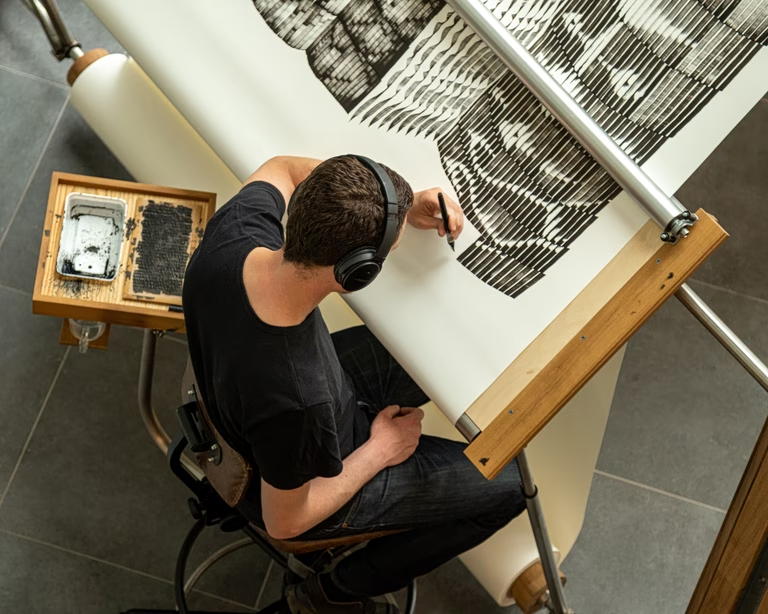
His technique is built on an almost ascetic discipline. Each brushstroke is made in a single contact with the paper, or just a few, without corrections. There are no second chances: ink cannot be erased, and it forgives no mistakes.
In 2021, the collaboration took another experimental turn with a music video. De Boer first hand-drew an animated film consisting of 4,056 frames, titled The Stroke. The members of Ill Considered then improvised a soundtrack while watching it for the first time. The original drawings were subsequently distributed among 338 vinyl boxes, allowing each owner to hold in their hands approximately one second of the film.
Now, Athens audiences will have the opportunity to meet de Boer in person.
His first appearance is on Wednesday, October 21, at Underflow. At 8 p.m., he will present his book, Hand Written Image – A Calligraphic Journey Beyond Language, taking the audience through the stories behind his work, his techniques, and the philosophy underpinning his approach to calligraphy. An open discussion and a short-film screening will follow.
At 10 p.m., he will take over the decks for a DJ set drawn from his personal collection, featuring jazz grooves, collectible limited-edition releases, and rare white-label vinyl records—pressings without printed labels, often produced as test or promotional copies. Admission is free.
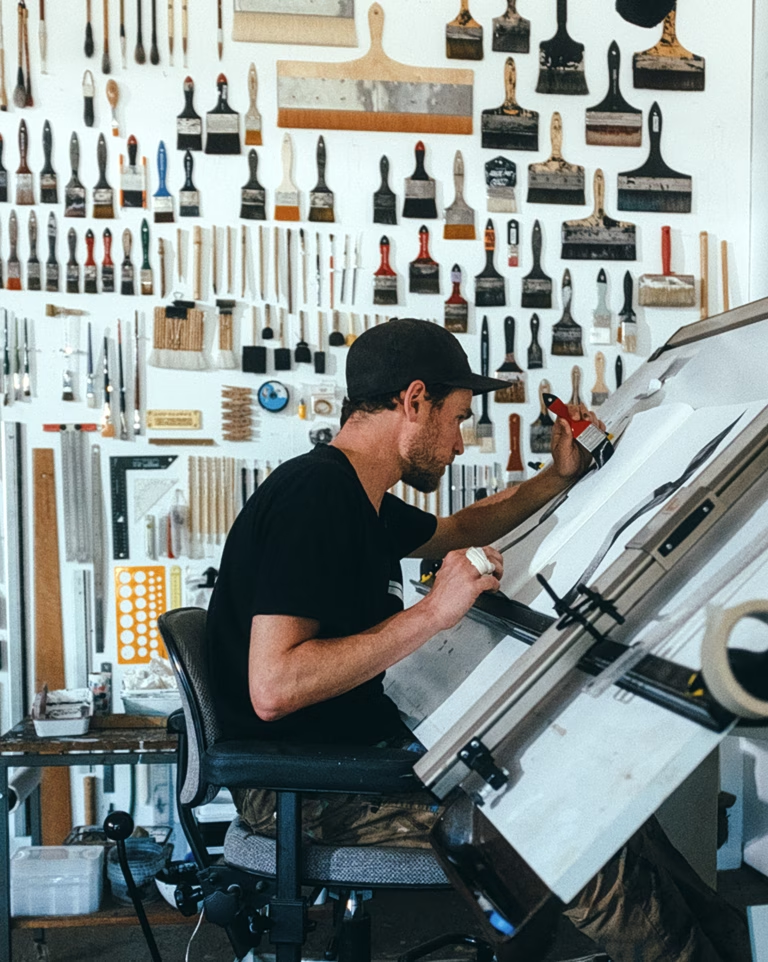
Photo: Sil Oosterbaan
Three days later, on Saturday, October 24, de Boer will appear at PLYFA, where the Scenius Sound festival brings together experimental and improvised music, live performance, and visual art, forging connections between international artists and musicians from Athens’ contemporary scene.
Among the festival’s international guests are The Messthetics, featuring the rhythm section of legendary post-hardcore band Fugazi; the improvisational group Koper 8; and Stoma, whose performances invite audience members to lie down in complete darkness and experience sound in an entirely different way. The lineup also features Psarogiorgis, performing with a particularly intriguing free-improvisation ensemble.
As the musicians play, de Boer will paint, draw, and write in real time, creating visual work alongside the music.
Painting in the Moment: An Interview With Vincent de Boer
What exactly will happen at PLYFA on October 24? Will you paint in response to the music coming from the stage, or create something more independent that unfolds alongside it?
I’ll paint, draw, and write at the same time as the music. It probably won’t be entirely improvised, but it will certainly happen simultaneously and in the moment.
The lineup spans a wide range of musical styles. How do you prepare for such different sonic worlds? This time, you’re not performing with Ill Considered but with a completely different group of artists. Do you listen to their music beforehand, or would you rather encounter their sound for the first time, live?
Every situation is genuinely different! This time, many factors are new to me: the music, the venue, the people, and perhaps other things, too. So I may adopt a less improvisational approach, with a little more planning.
The fully improvised live painting sessions with Ill Considered also developed over time. It took many attempts and interactions to build the foundation of trust that this kind of performance requires.
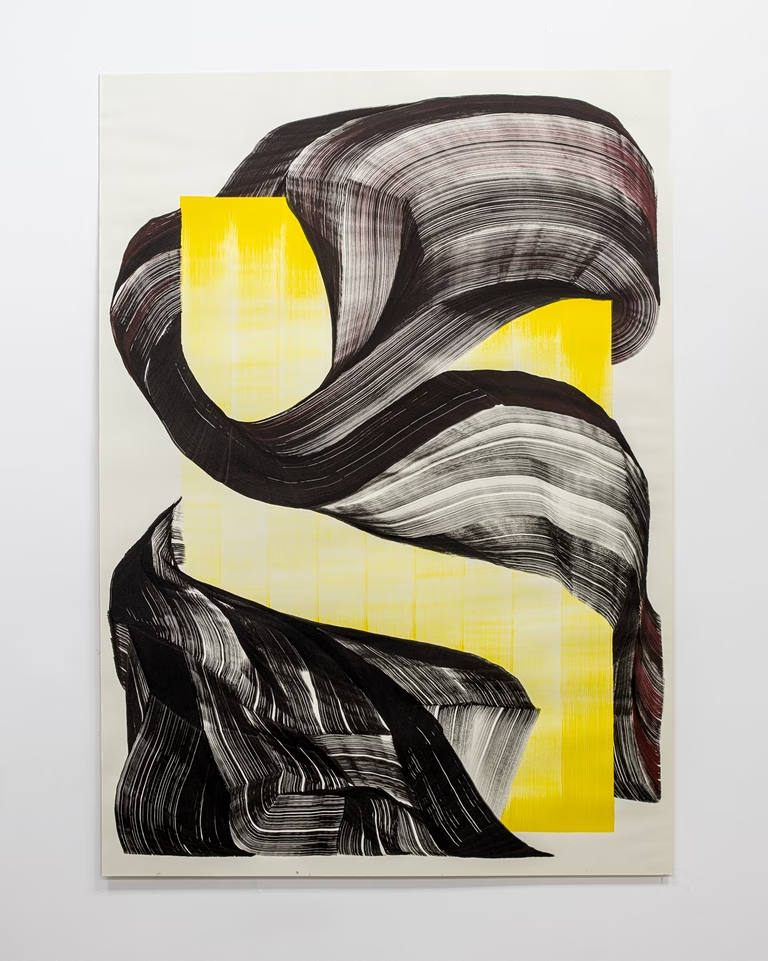
Photo: Nada Brahma
At a live show, people often move around, talk, and dance. How does the presence of an audience change your creative process?
Performing in front of an audience is, of course, very different from creating on your own. It takes practice and a method, even something resembling a ritual. In that sense, the process has a very close relationship with calligraphy.
Which painters or calligraphers have shaped the way you create your work?
A painter like Cy Twombly has certainly inspired me. Not so much aesthetically as in the way he balances uncertainty with decisiveness.
The meditative nature of my process is naturally connected to East Asian calligraphy and Zen, although more in spirit, because the work that emerges from my method has a different tone.
It also has to do with how you approach the act of creating. You cannot force it, but neither can you simply wait for it to come to you. You need to keep your antennae up so you can sense what each process requires.
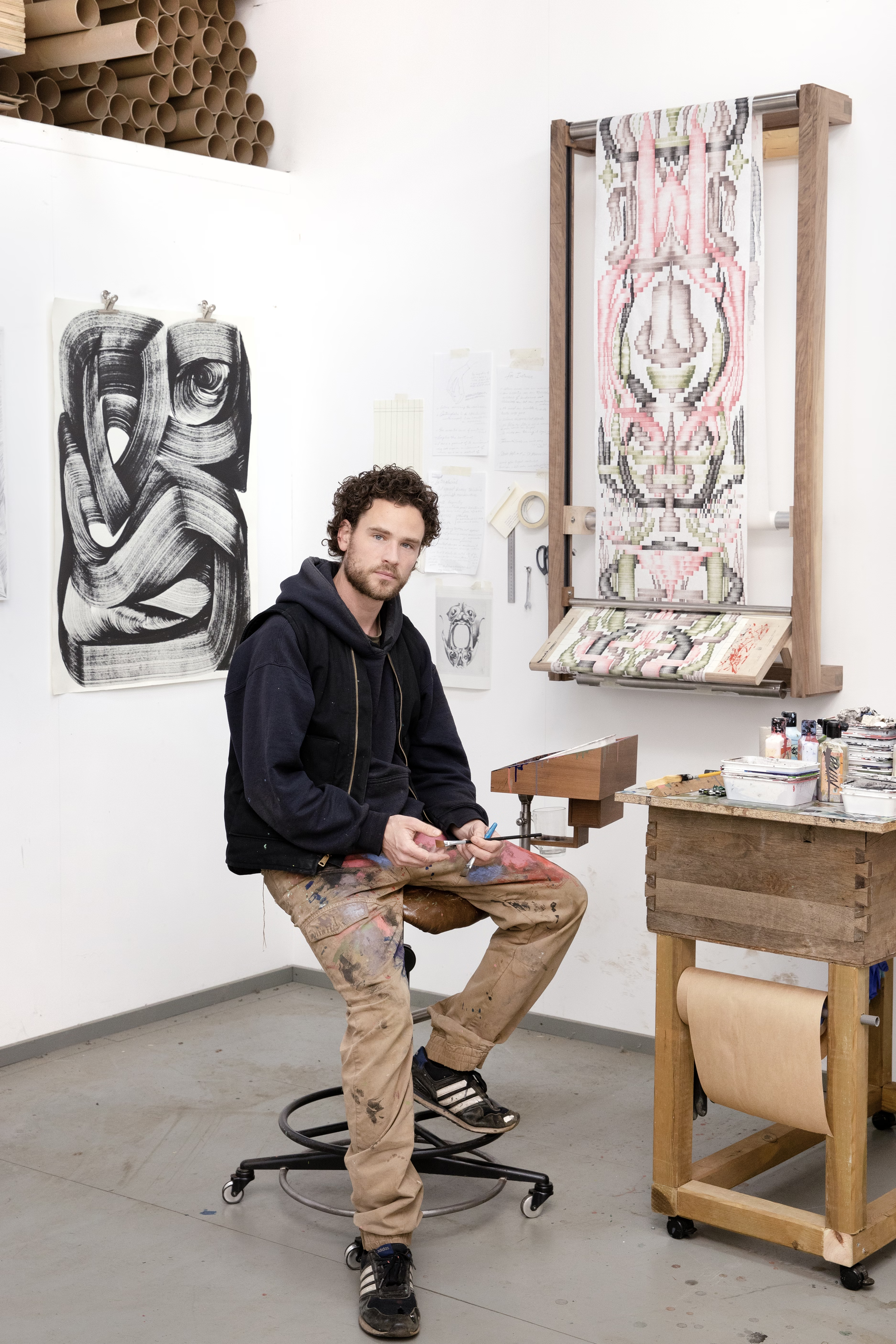
Portrait by Arthur Martin
What do you listen to when you’re not working? Is it different from what you listen to while you create?
When I’m working, I clearly prefer instrumental music. If there are lyrics and voices I can understand—in English or Dutch—I can’t concentrate. Songs or voices in languages I don’t speak or understand can be fine, though.
During the first hour in my studio each morning, I prefer silence. I also avoid artificial lighting when there’s enough natural light.
At home, I have only my record collection, and I don’t have a computer for playing music. When I’m out, on a train or somewhere else, I mostly listen to long, immersive dub soundscapes that somehow blend with my surroundings. I’ve noticed, though, that I wear headphones less and less often.
What are you working on now, and what would you like your next experiment at the intersection of image and sound to be?
This project at Scenius is probably the beginning of something that will grow and eventually involve the musicians of Ill Considered, whom I work with extensively.
I hope it develops into a live audiovisual show, with some kind of artistic residency where we can experiment and allow one audiovisual setup to evolve into the next.
We’ve performed our audiovisual live show four times so far, between 2021 and 2025.
Do you have a connection to Greece, its art, or its music? Is there anything you hope to discover or see while you’re in Athens?
I come to Greece fairly often, mainly for its heavenly landscapes and the sea. In the past, I had friends living in Athens and Thessaloniki, and I would visit them from time to time.
One thing I feel particularly connected to in Greece is its rocks, especially those sculpted by the sea.