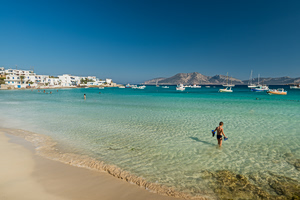
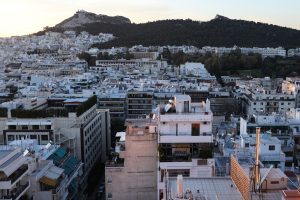
“‘We saved that secret, heavenly beach you told us about for next year; we never ended up going,’” I tell the warm-hearted host of our accommodation shortly before saying goodbye, wanting to leave behind a sweet promise, like a “to be continued,” on the rooftop before the next concrete floor is added. Above all, though, I want to secure a goal to float happily like a butterfly through the winter, until next summer.
“If it is still secret, heavenly and, of course, still a beach,” the modern host replies with sweet cynicism, and my little laugh fades away.
He is right. So many places I loved with all my heart have been “ruined” over time. From KAPE Beach in Sounion to the village of Komi on Tinos, to mention just two that immediately come to mind — the former I enjoyed in the 1990s without stairs or a snack bar at the top, just a tin shack that sold soft drinks whenever its owner happened to remember it existed; the latter I experienced as recently as 2017 as a “ghost village,” with darkened shops around the wise old plane tree, whereas today Komi has become a small town.
Authenticity, in the end, has to carry its originality only as far as it does not disrupt comfort.
One year follows another, and places change like levels in video games, which you have to pass through if you want to complete the game.
Greece has fully entered the great machine of global travel content. Approximately 38 million travelers visited the country in 2025, while in 2026 magazines and travel platforms have continued to publish lists of “hidden gems,” “secret islands” and “underrated destinations.”
Perhaps we are talking about a wonderful cycle of self-destruction: We discover a place because it is unknown, we proclaim it because it is precisely untouched, everyone visits it after we have proclaimed it, and then we write an article about how it has been ruined since we discovered it.
It is roughly the same logic as posting a photo of your favorite restaurant on Instagram with the caption “don’t tell anyone.” You have already shouted it out to several thousand people.
The funniest thing about “hidden gems” is that everyone seeks authenticity in exactly the same way. They want the village where “time has stood still.” They prefer the taverna where “the locals eat.” They want to drink wine “the way our grandparents used to.” But they also want Wi-Fi. And good reception. And air conditioning. And a room with a shower that provides the kind of water pressure they have in their bathtub at home.
Authenticity, in the end, has to carry its originality only as far as it does not disrupt comfort.
The question is a simple one: How many people can a place accommodate before it loses its identity? There is no magic number. There is only the point at which the visitor’s experience and the resident’s life begin to cancel each other out.
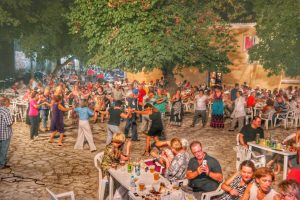
There is something even more wonderful. In almost every Greek village that features in social media travel guides as “unspoiled, far from tourists,” there is always a central shop selling magnets. Down the road, a concept store with handmade soaps. And in the square, a 75-year-old man who has spent the past 30 years smoking outside the coffee shop, only to now find himself destined to become a “#local.”
Yet a place does not lose its beauty because others have learned about it. The sea does not limit its vastness when people photograph it. The mountain does not cease to take your breath away with its grandeur because it has made it into a Condé Nast guide. And a taverna does not become any less poetic because someone from Berlin has learned to pronounce “χταπόδι” correctly — quite the opposite.
The real problem is not that we have discovered all the hidden gems, but that we are trying to turn every gem into an attraction. To turn it into content. To slap a bunch of hashtags on it. To rate it.
Last month, videos of the Italian woman in Koufonisia and, more recently, of Balos in Crete, with thousands of people arriving at a beach that can receive 4,000–5,000 visitors a day at peak times, became symbols of the problem. The images have something of Dante’s Divine Comedy about them. Except that the eighth circle of Hell has a beach bar — “here, those who posted a story tagging the location are punished.”
The phrase “hidden gems” carries a real paradox in 2026: They are “gems” and they are “hidden,” but only from the locals.
The question is a simple one: How many people can a place accommodate before it loses its identity? There is no magic number. There is only the point at which the visitor’s experience and the resident’s life begin to cancel each other out.
“When Athens is treated as a ‘huge hotel,’ when rents are pushed up by converting homes into tourist accommodations, and when islands begin to worry about pressure on water, infrastructure and housing, then we are no longer talking about whether there are too many tourists. We are talking about who has the right to live in the country,” Athens Mayor Haris Doukas pointedly noted in an interview with The Guardian in April 2026.
The next stage will probably be an article titled: “The Last Truly Unknown Place in Greece That Hasn’t Been Posted on Instagram Yet.” It will be a cave. And it will already have a café. Or a restaurant like that café-bar-restaurant that operates every day inside one of Greece’s largest historical monuments, the Bourtzi fortress in Nafplio.
But what am I saying? There has already been a restaurant in Kalafatis Cave in Mykonos for many years. So?
Epilogue: And all of this is happening at a time when foreign investors are building all-inclusive Edens along Greek seas and coastlines. The phrase “hidden gems” carries a real paradox in 2026: They are “gems” and they are “hidden,” but only from the locals.
Source: Opinion piece by Efi Alevizou, on Grace