

 Μake us preferred on Google
A second French-built FDI HN, or Belharra-class, frigate was formally incorporated into the Hellenic Navy on Friday during a ceremony at Naval Group’s shipyards in Lorient, a ceremony attended by Greek Defense Minister Nikos Dendias and his French counterpart, Catherine Vautrin.
The vessel follows the Kimon, delivered in December 2025, while the third frigate, Formion, is expected before the end of 2026. The fourth, Themistocles, is scheduled for delivery in 2028.
In an interview with the Athens daily Ta Nea, Dendias discussed the frigate program, the proposed Achilles Shield integrated air-defense system, domestic defense production, the modernization of military capabilities and Greece’s response to unilateral Turkish maritime claims the former considers as baseless and illegal.
Does the ratification of the Turkish-Libyan maritime agreement by authorities in Benghazi create a new situation?
The ratification does not confer legitimacy on the so-called Turkish-Libyan memorandum, which remains illegal, invalid and without legal standing. It continues to contradict international law of the sea and has no relationship to the geographical or legal realities of the Mediterranean.
The development nevertheless demonstrates Turkey’s efforts to expand its influence in the region. Ankara’s growing presence in Benghazi raises questions about eastern Mediterranean security and potential implications for other issues, including migration flows.
By contrast, the agreement I signed with Egypt as foreign minister to delimit an exclusive economic zone constitutes a practical application of international law of the sea and an important achievement for Greece and the eastern Mediterranean.
Could the planned surveys for the Greece-Cyprus electricity interconnection trigger another crisis with Ankara? Are preparations in place to provide military protection for the research vessels?
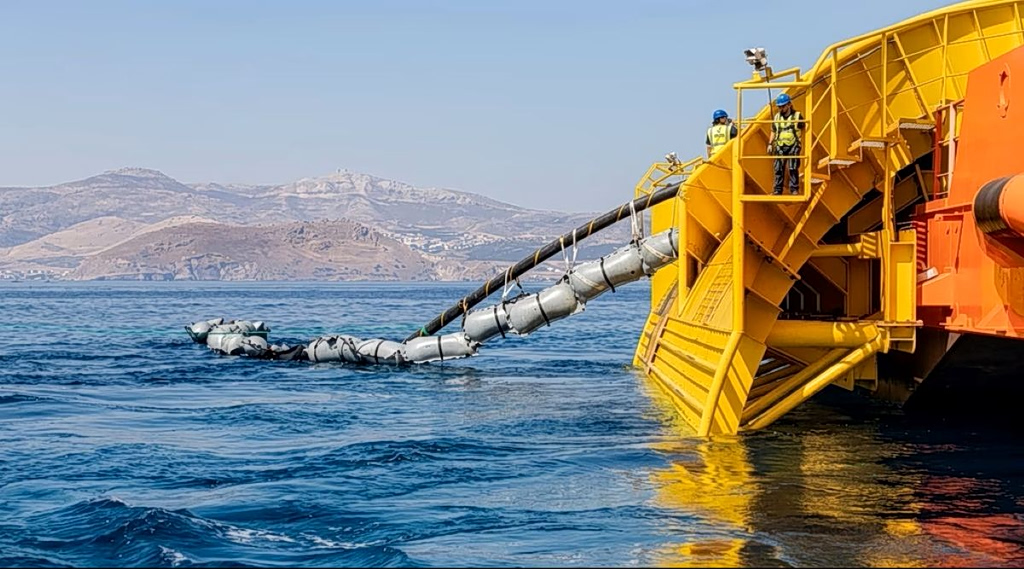
The Greece-Cyprus electricity interconnection project does not fall within the responsibilities of the Defense Ministry. I hope it will not need to concern the ministry beyond the issuance of navigational warnings, or NAVTEX, by the Hellenic Navy’s Hydrographic Service, following a recommendation by the relevant committee for authorizing marine surveys.
Would the advancement of Turkey’s proposed legislation on the ‘Blue Homeland’ mark the end of the period of calm between Greece and Turkey?
Unfortunately, Turkey continues to expand its agenda of illegal claims, including the “Blue Homeland” doctrine, which rivals the Turkish-Libyan memorandum in its legal and geographical absurdity.
Domestic legislation cannot create a reality that contradicts international law of the sea. The approach is nevertheless a challenge to the international community and common sense, seeking to portray Greek islands and maritime zones as areas subject to Turkish claims.
Greece cannot accept the amputation of its national sovereignty or the relinquishment of its sovereign rights. One reason we launched Agenda 2030 was to ensure that the country can respond to every challenge. Strong armed forces provide credible deterrence, allowing Greece to act with confidence and determination.
What is the implementation timetable for the Achilles Shield, Greece’s integrated air-defense and anti-drone system?
The Achilles Shield, elements of which were displayed during the Oct. 28 military parade in Thessaloniki, is being implemented. It is an integrated architecture of weapons systems designed to establish overlapping defensive layers over Greek territory under a unified command-and-control structure.
Full operational readiness is expected within 34 months, with individual systems delivered progressively. The most important element is not any single weapon but the architecture connecting the entire system.
Domestic defense-industry participation will account for at least 25%. The project is not simply about purchasing ready-made weapons but creating a network-centric system linking new equipment with capabilities Greece already possesses.
The outer defensive layer will include David’s Sling, designed to intercept tactical ballistic missiles and long-range cruise missiles. The medium-range layer will include Barak MX, while Spyder will cover short- and medium-range threats, replacing older systems.
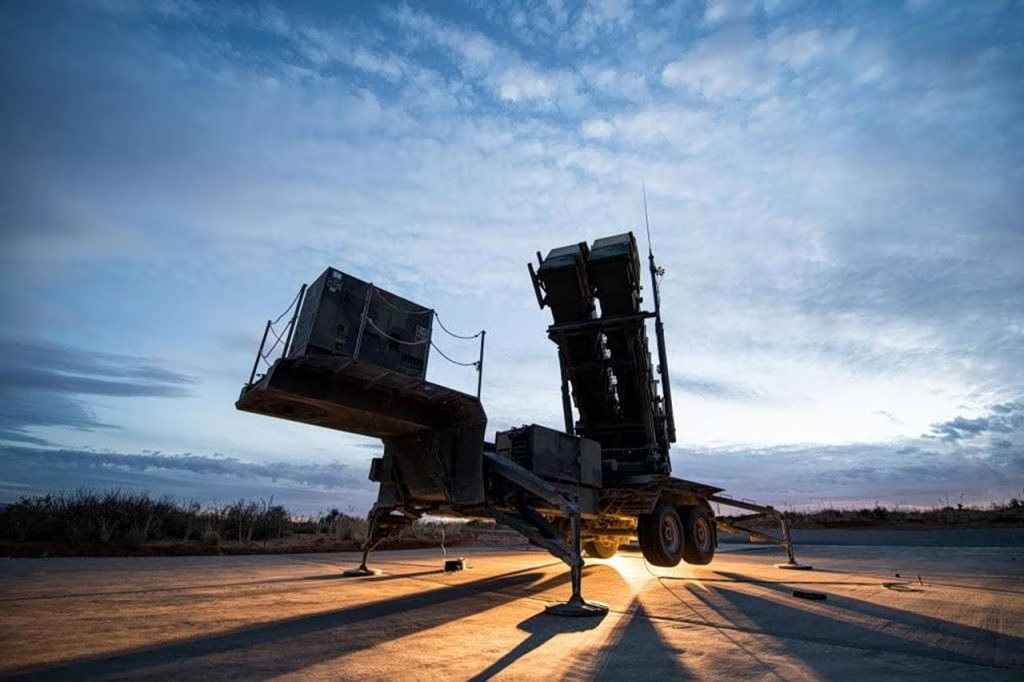
Advanced radars will play a central role, while a national command-and-control system will act as the network’s brain. It will connect existing Patriot systems, fighter aircraft, naval units and sensors across all three military branches.
This represents a transition from the older C4I framework to C5ISRT, incorporating command, control, communications, computers, cyber capabilities, intelligence, surveillance, reconnaissance and targeting.
The objective is to transform the armed forces from a collection of personnel and weapons into an integrated organization capable of responding to contemporary threats.
Domestic systems are also central to countering drones. The Kentavros system, developed through cooperation between the Hellenic Center for Defense Innovation and the Hellenic Aerospace Industry, is already operating aboard Hellenic Navy frigates. Greek-made portable anti-drone systems are also entering mass production.
When will domestic defense production begin delivering tangible results for the Hellenic Navy?
The recent agreement between the Hellenic Center for Defense Innovation and the MIT Sea Grant Program in Boston builds on cooperation that began two years ago, initially with an educational focus.
In June, MIT professors and researchers trained students from the Hellenic Naval Academy and members of Greece’s scientific community in marine robotics and autonomous systems, combining theoretical instruction with practical exercises and sea trials.
The Navy has also completed successful tests of the Corsair unmanned surface vessel developed by Saronic, which is also used by the US Navy. A request has been submitted to acquire a significant number of vessels through an intergovernmental agreement.
In addition, the Government Council for Foreign Affairs and Defense has approved the acquisition of special-operations underwater vehicles, eight of which will be built at Skaramangas shipyards.
Our objective must go beyond purchasing equipment to developing the ability to design and manufacture it ourselves. By 2030, Greece aims to become a European leader in autonomous platforms.
What are the main priorities in the updated long-term defense equipment procurement plan?
Modern conflicts in the Caucasus, Ukraine and the Middle East have demonstrated that relatively inexpensive weapons can inflict damage worth billions of euros. Drones, swarms and unmanned underwater systems are increasingly shaping warfare, while artificial intelligence and autonomous technologies are changing how military operations are planned and conducted.
The first priority is to align procurement with the new force structure. The third phase of military restructuring, involving the abolition of 56 units and 126 organizational structures, is expected to save 530 million euros over five years. A further 600 million euros will be saved by eliminating equipment with diminished operational value.
An FDI frigate costs approximately two million euros annually to operate, compared with 7.3 million euros for an older frigate being withdrawn from service. The intention is to redirect savings where they are most needed, particularly toward military personnel compensation.
A second priority is developing Greece’s military capabilities in space. Plans include a military-grade geostationary satellite, three medium-orbit satellites through the European IRIS program and radar satellites in cooperation with Poland. A new Space Command is scheduled to be inaugurated in December, providing Greece with greater control over communications and access to imagery from a constellation of microsatellites.
The third priority is the acquisition and modernization of major weapons systems. These include the Achilles Shield, F-35 fighter jets, the upgrading of 83 F-16s to the Viper configuration, additional FDI frigates, Italian FREMM-class frigates, the modernization of MEKO frigates, C-390 transport aircraft, Apache helicopter missiles, additional V-BAT and HERON unmanned aircraft and underwater platforms.
The fourth priority is strengthening the domestic defense industry. Local participation of at least 25% is intended to become a statutory requirement, creating a production base capable of supporting exports to Europe and the Middle East. Cyber defense will also receive greater emphasis as artificial intelligence creates new capabilities for potential adversaries.
Is there a specific electoral threshold for New Democracy (ND) party to secure an outright parliamentary majority?
I have never referred to a specific threshold or percentage. Our stated programmatic objective is an outright majority, which would allow us to seek the Greek electorate’s mandate to implement a defined program with a clear ideological framework and timetable.
I welcome Prime Minister Kyriakos Mitsotakis’ recent statement that an outright majority is the only way forward.
Should ND discuss potential coalition arrangements more actively, given the opinion polls? Could a party led by former prime minister Antonis Samaras become a coalition partner?
Discussions about post-election coalitions are premature and undermine our clear proposal to Greek society for a renewed electoral mandate.
As I have said before, Mr. Samaras, as a former prime minister, is entitled to hold and express his views.