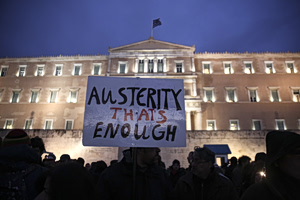
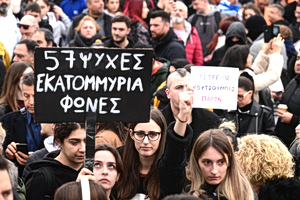
A mood of exhaustion is taking shape in Greece—one that spares no one.
Voters are tired and increasingly distrustful of the political system. The government, now in its second term, appears unable to renew its narrative or inspire confidence. And the opposition, after seven long years out of power, is still struggling to articulate a credible alternative.
But when did the scandals that now dominate headlines begin?
One version traces them back to the era of the “turtleneck”—a reference to former Prime Minister Andreas Papandreou’s iconic style in the 1980s, often used symbolically to describe the roots of Greece’s modern political culture. By that logic, corruption is a “historical” phenomenon, something to be studied across time.
Yet governments are not academic seminars. Yes, there are “chronic pathologies,” as they are often called in Greek political discourse. But these cannot be treated as material for a conference titled “Corruption in Ancient Greece: Aspects of the Problem and Its Modern Echo.”
Even the bitter remark once made by former Prime Minister Kostas Simitis—“this is Greece”—no longer holds. Perhaps it did 30 years ago. But what about now?
What we see today is reflected, almost mechanically, in public opinion polls: a pervasive sense of stagnation and disillusionment. Progress is no longer recognized. Instead, there is a growing tendency to romanticize the past.
“It wasn’t so long ago that things were better,” the public seems to say.
Why? Because when the future offers no promise, the mind reshapes the past into something brighter than it was.
This is how a universal fatigue sets in.
A weary electorate distrusts the political system. A fatigued government struggles to reinvent itself. A tired opposition fails to present a compelling governing proposal. Even those seeking to re-enter or disrupt the political scene seem to be running out of momentum.
Former Prime Minister Alexis Tsipras, attempting a political rebrand after his 2015–2019 tenure, is already losing clarity in the public eye. Maria Karystianou—a rising public figure associated with polarizing debates on migration and abortion—finds her political profile increasingly blurred. Meanwhile, Zoe Konstantopoulou, known for her fiery rhetoric, risks fading into background noise without the intensity that once fueled her prominence.
In such a climate, even the basic act of voting becomes more difficult.
How many of the “undecided” will muster the energy to go to the polls? Will more voters ultimately support the government than those it actively persuades—despite its shrinking base? Will the opposition manage to project a strong, unified voice, or will it remain trapped in internal disputes, drained of strength?
If fatigue is one unpredictable factor shaping the pre-election year, the other is what former British Prime Minister Harold Macmillan famously called “events”—those unforeseen developments that can derail even the most carefully laid political plans.
Recent scandals have already broken into the open. But what lies beneath them?
There is a growing fear within the Prime Minister’s office (the Maximos Mansion, the seat of the Greek government) that what has surfaced may only be the tip of the iceberg.
According to insiders, the Prime Minister had previously been reassured that the case involving OPEKEPE—the Greek agency responsible for distributing EU agricultural subsidies—was “nothing serious.” Similar reassurances are now being given regarding issues linked to training programs and OPEKA, the state welfare benefits organization.
But are these cases truly “nothing”?
Or are they, as some experts in the flow of subsidized funds suggest, “two or three OPEKEPEs combined”?
Even if the more alarming scenarios do not materialize, the damage is already being done.
The government continues to suffer political wear that undermines its ability to promote even a modestly positive agenda. With no compelling narrative left, communication strategy increasingly acts as a substitute for substance.
And a tired electorate is already reluctant to vote.
It becomes even less likely to do so when the atmosphere is poisoned by the toxins of corruption.
The 2027 elections now face a different kind of threat—not from political rivals, but from apathy.
From voters who may feel that the safest choice is not to participate at all. Who, on election day, might opt instead for a Sunday walk in the fresh air, followed by lunch at a seaside taverna.
What kind of result would emerge from such an election?
Most likely, a political system not just fatigued— but on the verge of complete exhaustion.