 Μake us preferred on Google
 When the Strait of Hormuz closed to Western-bound shipping in early 2026, the world fixed its eyes on oil. It was watching the wrong cargo. Within days, marine insurance premiums multiplied sixfold and urea prices on the U.S. Gulf Coast tore past $700 a tonne. The strait carries between 35% and 43% of the world’s seaborne urea and nearly half its traded sulphur, the backbone of the phosphate fertiliser chain. It is apparent that the lesson of the closure was not that Hormuz is a hydrocarbon artery. Instead, being that the straight acts as the central nervous system of global agriculture, and therefore the biological foundation of every modern state.
Stated bluntly, Oil can be stored in strategic reserves for years. A growing season cannot. Fertiliser arrives inside an unforgiving agronomic window, and a delayed cargo is not a deferred cost but an irreversible biological loss; a harvest that simply does not happen. This is why food inputs can no longer be treated as an ordinary commodity, managed by civilian rural-development bureaus and left to the theoretical efficiencies of the single market. They must be reclassified, within law and in doctrine, as Tier 1 defence infrastructure. A state can survive a shortage of missile interceptors by leaning on strategic depth. It is unable to survive a shortage of calories.
This is not hypothetical. Russia has already turned its dominance of global fertiliser markets into an instrument of influence, positioning itself as the indispensable supplier to the Global South precisely as Western states find themselves exposed. China, for its part, has restricted phosphate exports since 2021 in a deliberate act of economic statecraft. The weaponisation of agricultural inputs is a live strategy.
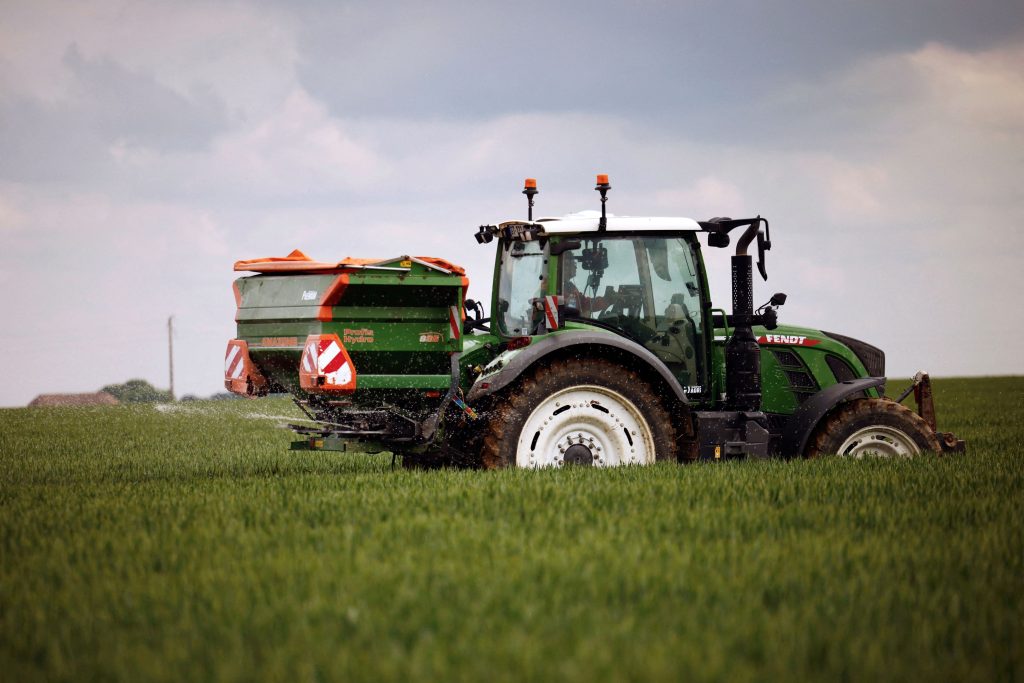
FILE PHOTO: A French cereal farmer drives his tractor with a spinning-disc that spreads nitrogen fertilizer white pellets on a wheat field in Larchant, France, May 7, 2026. REUTERS/Alice Sacco/File Photo
Nowhere is the exposure sharper than in Greece, perched on the fracture line of the Eastern Mediterranean. In 2024 the country imported roughly 301 million kilograms of urea, with some 80% of it (246 million kilograms) coming from a single geographic node: Egypt. This is not a supply chain; it is a single point of failure. Should Cairo restrict exports — through domestic instability, regional coercion, or simple contagion from a wider crisis, Greece would face an acute deficit of the one input its soil cannot survive without. Remove urea and the nitrogen cycle breaks, resulting in the breadbaskets of Thessaly and Macedonia collapsing, and food prices spiraling. And here the damage turns socio-political. In an era of depressed purchasing power, affordable food functions as an invisible social wage — a final shock absorber standing between a household and ruin. Strip it away and families sacrifice medical care, then education, and finally their faith in the state itself. The resulting hyperinflation would achieve an adversary’s objective of destabilisation , without a single shot fired onto Greek soil. A country that draws 80% of a survival input through one vector is not resilient. It is a glass cannon.
The remedy begins with command and ends with a reserve. Athens should upgrade its Civil Emergency Planning apparatus (ΠΣΕΑ) from a body that manages localised farming mishaps into a genuine logistical command — one empowered to fold the agricultural-input sector under national defence in a crisis. There is precedent. During the Cold War, Sweden legally bound some 11,000 companies to pivot instantly into wartime supply roles, with food production among them. A Total Defence doctrine it dismantled after 1991 and is now, under a darkening security climate, scrambling to rebuild. Greece can build that architecture now, while peacetime still allows it. The Thessalian rail links and the grain silos of Volos are not merely commercial assets; they are strategic nodes and should be designated dual-use infrastructure. Bulk fertiliser is not ordinary cargo; it carries the same strategic weight as energy shipments and munitions. In a heightened threat environment, its maritime transit cannot be surrendered to the spot freight market and the risk appetite of civilian insurers. Such shipments should be eligible for routing through the secured corridors that European naval operations such as Aspides already protect.
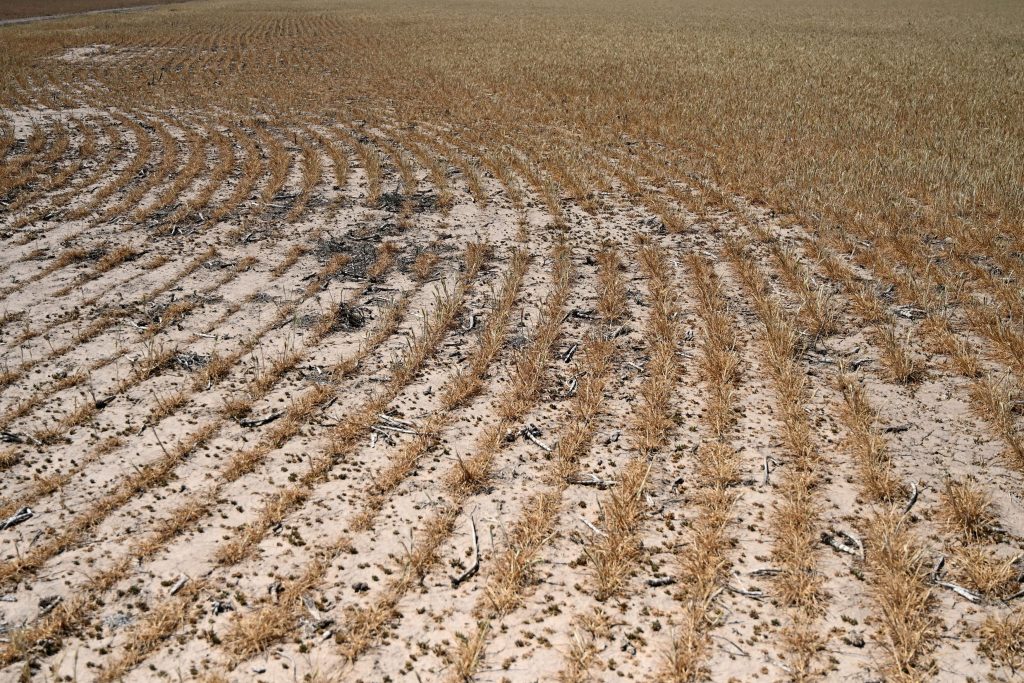
FILE PHOTO: A view of dead wheat on Scott Irlbeck’s farm in Tulia, Texas, U.S., May 13, 2026. REUTERS/Annie Rice/File Photo
But, securing sea lanes is worthless without a domestic buffer, because financial hedging is useless against a physical blockade. No state feeds its people on futures contracts when the cargo itself is trapped behind a mined strait. Greece should therefore build a statutory fertiliser reserve sized to sustain domestic production for at least two planting seasons. The model already exists: Switzerland’s Pflichtlager system legally compels private importers and distributors to hold minimum strategic reserves of essential goods, fertiliser among them, at their own expense. Producing a decentralised but tightly regulated buffer against exactly this kind of shock. Switzerland has pushed further still, mandating from 2026 the recovery of phosphorus from sewage sludge, steadily weaning itself off imported mined phosphate altogether. A Greek reserve would demand the same technical seriousness. Urea degrades above a critical relative humidity of roughly 75%, a threshold the Hellenic summer clears with ease, so commercial silos will not do. The state would have to mandate purpose-built, climate-controlled storage to keep the reserve from rotting where it stands.
Critics committed to peacetime economics will call this burdensome and market-distorting — the capital cost of climate-controlled storage, the premium of mandated reserves, the affront to single-market orthodoxy. But, market equilibrium is a peacetime assumption, and it does not survive contact with a closed Strait of Hormuz. Set against the €1.5 trillion of European industrial turnover already exposed to input shocks, the cost of a domestic reserve is modest. Efficiency is a peacetime privilege. Preparedness is what survival demands.
Geopolitics ultimately returns to its primitive baseline. There is little use in stockpiling fifth-generation fighters, precision missiles, or naval frigates if the state cannot feed the soldiers who operate them or the population that holds the Republic together. True security in the 21st century does not begin in the airspace or the exclusive economic zone. It begins in the soil. Greece must secure its biological inputs with ruthless spatial logic or surrender its sovereignty to those who do.
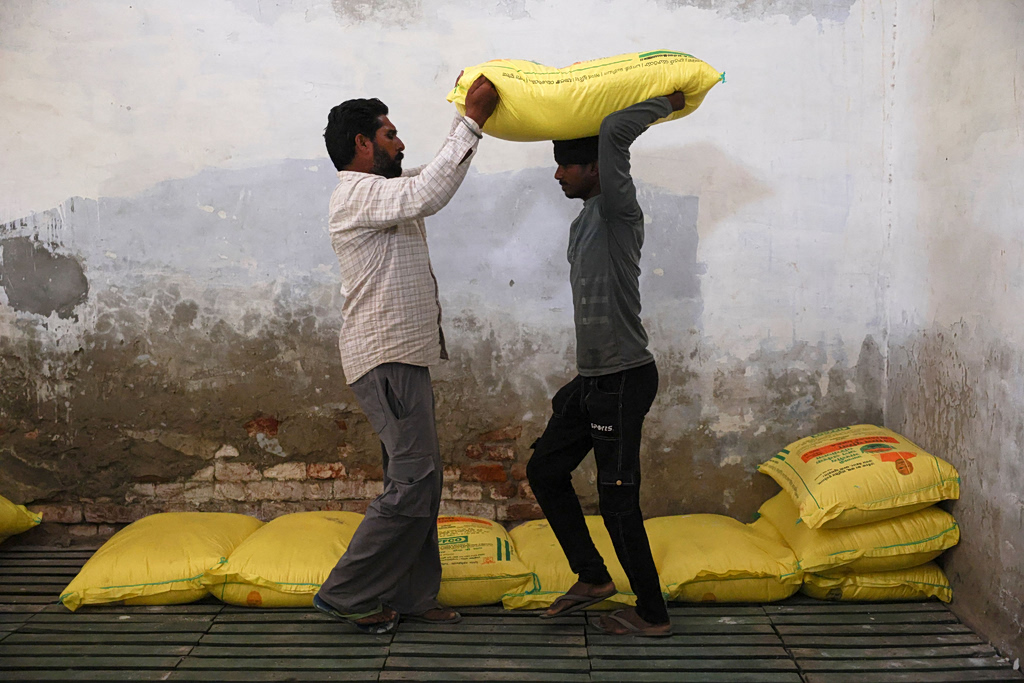
A worker carries a sack of urea fertiliser as he loads it in a farmers tractor at a Multipurpose Primary Agriculture Cooperative Society in Karnal, in the northern state of Haryana, India, June 19, 2026. REUTERS/Bhawika Chhabra
Filippo N. Valasakis is a graduate of International Relations and European Affairs from the American College of Greece – DEREE, whose work focuses on defence economics, European strategic autonomy, and the security of critical supply chains.