 Μake us preferred on Google
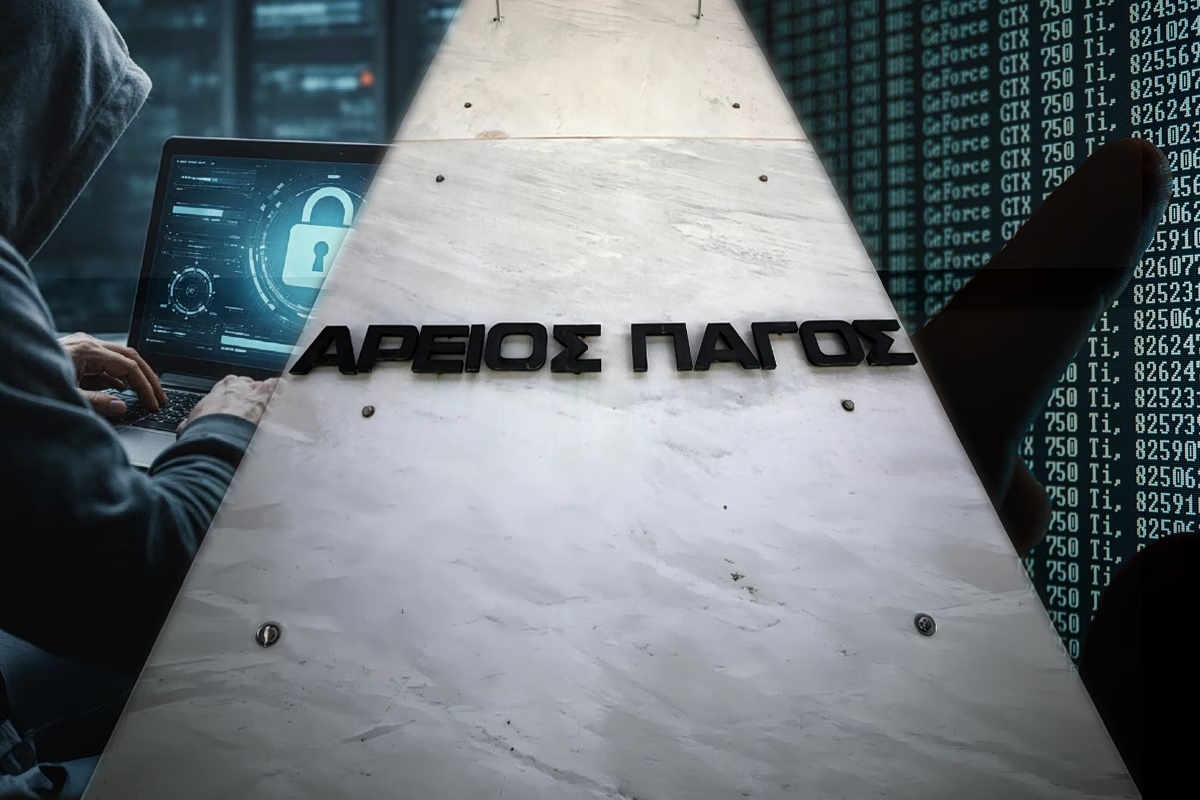
 Greece’s Supreme Court Prosecutor (CoS) Evangelos Bakelas has issued separate orders rejecting four requests to reopen the country’s long-running predator wiretapping scandal investigation, keeping the case file archived for the third time at the highest level of the criminal justice system.
The requests had been submitted by former Prime Minister Antonis Samaras, former SYRIZA minister Christos Spirtzis, and lawyer Zacharias Kesses, who represents surveillance victims. Each request was assessed individually with separate reasoning.
In Samaras’s case, which sought full clarification of what he called his “entrapment,” the prosecutor found no new evidence beyond what had already been examined by previous Supreme Court officials. Regarding Spirtzis, who submitted mobile phone emails including one marked confidential as new evidence, the prosecutor concluded the material added nothing beyond what had already been examined during the lengthy first-instance trial that ended in heavy convictions for four businessmen currently awaiting a second-instance ruling.
Legal Obstacles Cited on Dilian
On the two requests submitted by Kesses, the prosecutor concluded that reopening the investigation was legally impossible on procedural grounds. Intellexa founder Tal Dilian, who has publicly stated he sold Predator to state entities, cannot be examined as a witness because his testimony would immediately be excluded from the file under criminal procedure law, as he is himself implicated in the case. The same applies to the three others convicted alongside him.
Nine further individuals whose roles emerged during the first-instance trial — against whom journalist Thanasis Koukakis has taken legal action — were also found to be legally ineligible as witnesses.
Legal sources noted that the prosecutor’s order does not constitute a permanent closure of the case. Should any surveillance victim produce genuinely new evidence in the future, it would need to be assessed independently and could potentially lead to the file being retrieved from the archive. The second-instance appeal trial for the four convicted businessmen is scheduled for December.
Kesses responded sharply, saying the prosecutor had “proven he is part of the problem” and accusing him of perpetuating what he called a relay race of cover-ups. “He invokes legal arguments that are not a convincing application of the law but constructions without adequate grounding,” Kesses said. “Interpretive acrobatics that serve as a pretext to avoid any substantive review of the new evidence.”