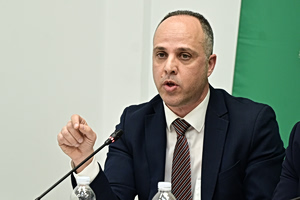
Former Greek minister Christos Spirtzis has filed an application with the European Court of Human Rights in Strasbourg over the Greek wiretapping scandal, shortly after journalist Thanasis Koukakis filed a similar case.
Spirtzis announced the move in a social media post, in which he sharply criticized the handling of the surveillance case by Greece’s judicial authorities.
“I filed an application with the European Court of Human Rights,” Spirtzis said, arguing that Greece should not tolerate what he described as the government of Prime Minister Kyriakos Mitsotakis’ influence over the country’s judicial leadership.
Criticism of the judicial handling
Spirtzis specifically referred to the handling of the case by Konstantinos Tzavellas, a former prosecutor of Greece’s Supreme Court.
He argued that “a prosecutor who is personally involved in the Greek Watergate,” referring to the former deputy prosecutor of the National Intelligence Service (EYP), should not have been allowed to take over the case and archive it.
He also criticized the process that followed his request to have the prosecutor removed from the case over bias.
“The Judicial Council of the Supreme Court should not be allowed to refrain from issuing a decision on the merits of the application we submitted for the recusal of the prosecutor in question due to bias,” Spirtzis said.
“The institutional decline, the degradation of justice and the institutional debasement should not be tolerated,” he added.
Rights cited in European Court application
According to Spirtzis, his application invokes violations of Articles 8, 10 and 6(1), in conjunction with Article 13, of the European Convention on Human Rights.
He argues that the violations are connected to what he describes as a lack of an “effective and adequate criminal investigation.”
Spirtzis said the case concerns not only the protection of his private life, freedom of expression and political activity, and right to a fair trial, but also broader democratic principles.
“The stakes remain much greater,” he said.
“The stakes remain the protection of our democratic institutions, the Constitution and our democracy,” Spirtzis said.
He added that he would continue pursuing institutional initiatives outside Greece, arguing that, following what he described as the “scandalous cover-up” by the leadership of the Supreme Court of allegations of espionage and the EYP’s involvement in the wiretapping scandal, the case would now be examined by European justice.