
 Μake us preferred on Google
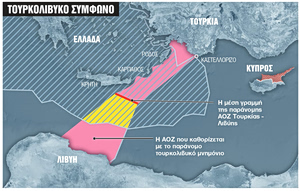
Athens is seeking to manage the fallout from Benghazi’s ratification of the Turkey-Libya maritime memorandum, a development that signals Ankara’s dominance in Libya, by pursuing a strategy on two fronts: internationalizing the issue by mobilizing partners and allies, while emphasizing international law — particularly the Law of the Sea — as the only means of settling bilateral disputes, especially those involving maritime boundaries in the Eastern Mediterranean.
After the initial unease in Athens following the decision by Eastern Libya’s House of Representatives, a succession of statements on Wednesday rejected and condemned both the Turkey-Libya memorandum itself and its parliamentary ratification.
Following strong interventions from the European Union and the European Parliament, Israel’s Foreign Ministry issued a statement saying the agreement violated the sovereign rights of the country’s “close allies” in the wider region. Tel Aviv once again accused Turkey of acting as a destabilizing force in the Eastern Mediterranean.
Israel’s position is particularly notable because its own maritime rights are not directly affected by the Turkey-Libya memorandum. The statement highlights both the depth of Israel’s strategic relationship with Greece and its confrontation with Turkey. Israel has opposed moves aimed at expanding Turkey’s diplomatic footprint in the Eastern Mediterranean or the Middle East, generally acting as a counterweight to what it views as Ankara’s revisionist ambitions.
Egypt’s Position and the Prospect of Expanding the EEZ Deal
Egypt’s Foreign Ministry subsequently issued a similar statement, making direct reference to the United Nations Convention on the Law of the Sea. Cairo said the ratification had no “legal effect,” reiterating that the memorandum is “absolutely invalid, lacks legal force and produces no legal effect.”
Egypt also said the Turkey-Libya agreement violates the principles of the Law of the Sea governing maritime delimitation and constitutes a clear violation of its sovereign rights in its Exclusive Economic Zone and continental shelf.
Against the backdrop of close Greek-Egyptian cooperation, the 2020 agreement partially delimiting the two countries’ Exclusive Economic Zones remains the only practical challenge to date to the disputed Turkey-Libya memorandum. The latest developments inevitably — and more urgently — bring back into discussion the possibility of extending that agreement.
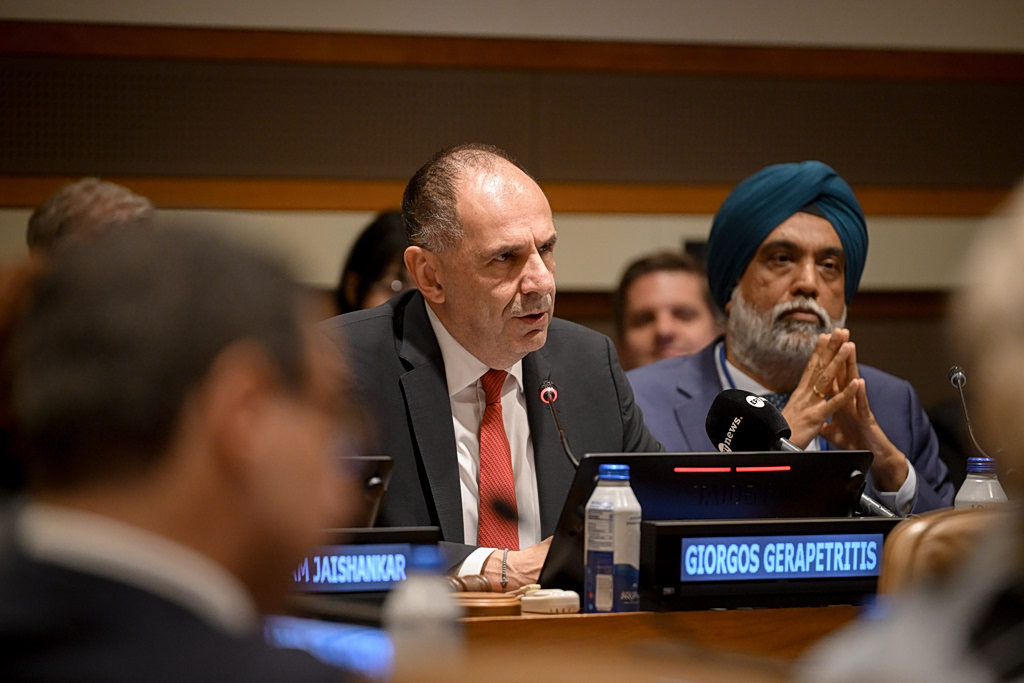
The Greek Foreign Ministry had been on constant alert since Tuesday afternoon, with Foreign Minister Giorgos Gerapetritis holding successive talks with his counterparts while Greek delegations at international organizations worked to generate a broad response to the Ankara-Benghazi initiative.
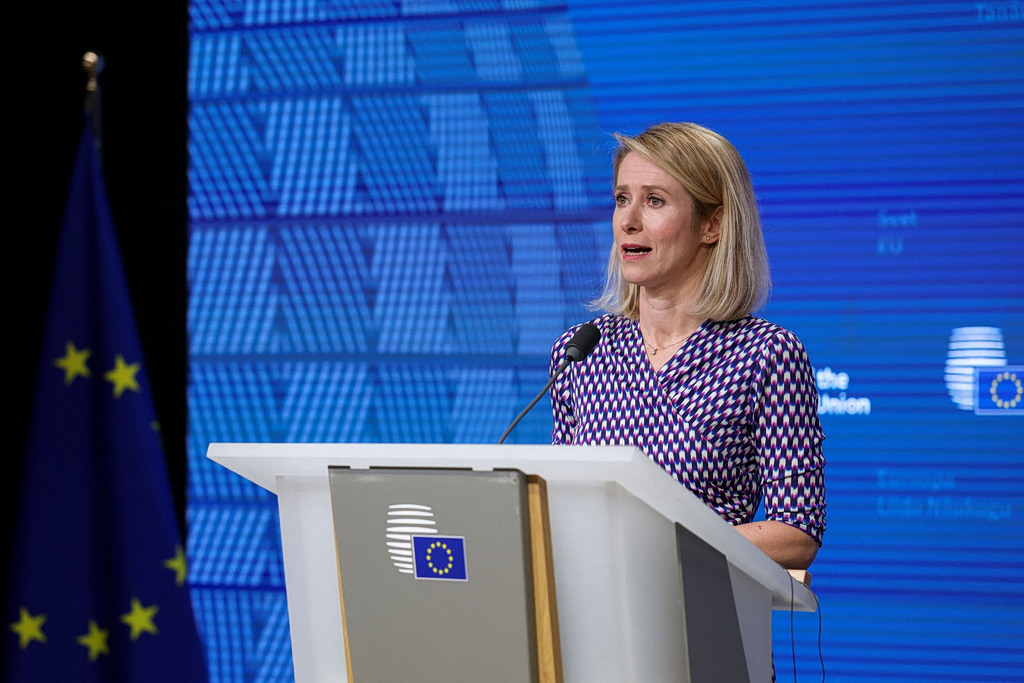
That diplomatic mobilization also resulted in a statement from EU foreign policy chief Kaja Kallas, which Athens has particularly emphasized because she speaks on behalf of all 27 EU member states.
“The Turkey-Libya Memorandum of Understanding violates the sovereign rights of third states and is not in accordance with the Law of the Sea. It is null and void and cannot produce legal consequences for third states,” Kallas said.
She also stressed the need to maintain a stable and secure environment in the Eastern Mediterranean, saying all parties must respect the sovereign rights of all EU member states in accordance with the principles of the Law of the Sea.
At the same time, diplomatic sources said the United Nations Security Council was briefed on the developments, with Greece’s permanent representative to the UN highlighting the risks the Turkey-Libya memorandum poses to security and stability in the Eastern Mediterranean.
Greece currently holds the presidency of the Security Council, while a discussion on maritime security is scheduled in New York at the end of October. The Greek delegation, through the foreign minister, is considered certain to raise the disputed Turkey-Libya agreement during those talks.
Gerapetritis Sets Out Greece’s Position
Gerapetritis offered an indication of Athens’ approach in comments to Mega News 104.6, seeking to put Ankara and Benghazi before what he described as their responsibilities.
“At this moment, Turkey and Libya are choosing to enter into an agreement that falls outside the framework, assuming whatever consequences result from that action. Because all actions undertaken bilaterally have consequences,” Gerapetritis said.
He noted that all financing protocols concerning Libya must be approved by Greece and also pointed out that Turkey’s path toward the European Union passes through Athens.
Gerapetritis also implicitly acknowledged that Greece’s influence in Benghazi had not proved sufficient to prevent ratification of the memorandum.
“It was not in Greece’s hands to prevent it,” he said. “I remind you that the ratification does not exist in a vacuum. We had an agreement dating back to 2019. In 2019, therefore, this agreement was concluded unilaterally, contrary to international law and without any legitimacy. The ratification adds absolutely no additional value, either theoretically or practically.”
His remarks underscored the Greek government’s second line of argument: that the memorandum produces no legal effect of any kind.
While discussion in Greece on Wednesday was dominated by the possibility of extending the country’s territorial waters south of Crete to 12 nautical miles, Gerapetritis played down expectations, stressing that Greece would not react impulsively.
“Greece responds according to a plan and, above all, in pursuit of the national interest. And that is a fundamental difference from what happened in previous decades,” he said. “Everything that has been done over the past seven years — our delimitation agreements, the extension of territorial waters in the Ionian Sea, the marine parks, maritime spatial planning, the use of our assets — has been done first and foremost because there is a plan.”
Turkey Responds
After the initial celebrations in Turkey, the successive reactions from Greece’s partners and allies prompted concern in Ankara.
The Turkish presidency’s communications directorate intervened in the public debate, criticizing those attacking the Libya agreement on social media and accusing them of “clear disinformation aimed at manipulating public opinion.”
“The agreement, which was signed by two sovereign states to protect their legitimate rights, has been ratified in both countries and has entered into force, in full compliance with international law and the principles of equitable distribution,” the Turkish presidency said.
It also indirectly but clearly targeted Greece and Israel, describing them as “actors seeking to turn the Eastern Mediterranean into a zone of conflict by putting forward unlawful claims over maritime areas in which they have no legal rights.”
Open Fronts: Libya, Migration and Chevron
Regardless of the diplomatic reactions, Greece will from now on have to confront Turkey and Libya as a single bloc in the Eastern Mediterranean — provided, of course, that the long-troubled post-civil-war country can eventually reunify and establish a legitimate government with international standing.
Until then, it is clear that the “Libya issue,” whether involving Tripoli or Benghazi, has effectively closed for Greek diplomacy.
Attention is now turning to developments on several critical fronts. These range from migration, as arrivals surge, to the start of exploration by U.S. energy company Chevron south of Crete, where Libya has challenged Greek sovereign rights through diplomatic notes.
At the same time, with surveys for the Greece-Cyprus electricity interconnection cable expected to resume, Athens is closely examining remarks by Turkish Foreign Minister Hakan Fidan to Greek newspaper Ta Nea about the type of notification Ankara expects to receive.
“What we are asking is that when a vessel conducts surveys at sea, it sends us written notification, not merely verbal notification, stating: ‘We are going to carry out specific activities in this particular area; here are the coordinates,’” Fidan said.
The Risk of Creating a Legal Precedent
Many have interpreted Fidan’s remarks as opening a window for the electricity interconnection project to proceed without obstruction. Gerapetritis, however, responded that Greece is the only country from which authorization has been requested for the project.
“Once authorization has been granted by Greece, notification regarding the survey and cable-laying is something that could be possible, with the explicit clarification that this does not constitute an authorization procedure,” the foreign minister said.
Still, even providing Turkey with written notification — without, of course, simultaneously seeking its permission — would constitute a novel and conciliatory practice not provided for under international law.
Many argue that such a move could create a legal precedent that Turkey could invoke indefinitely.
That concern also explains Fidan’s statement that Turkey does not want the project “either to disrupt the status quo or to create a precedent in an entirely wrong way that will cause even greater problems for both sides.”