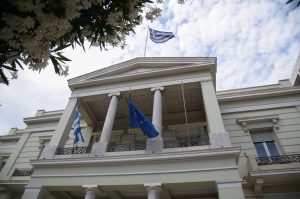
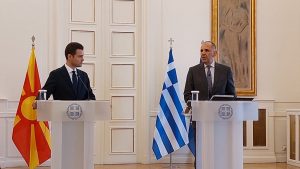
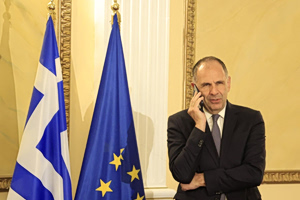
Greece has issued a clear warning that it will not accept any attempt to distort or reinterpret the Prespa Agreement, responding to recent statements by the prime minister of North Macedonia.
In an official statement, the Greek Ministry of Foreign Affairs underlined that the Prespa Agreement is an integral part of North Macedonia’s constitution and is fully binding on both sides, at both the international and domestic level. The agreement, signed in 2018, resolved a long-standing name dispute and formally established the country’s constitutional name as “North Macedonia.”
The ministry stressed that this name is explicitly defined in Article 1 of the agreement and applies universally. “Any attempt to falsify or alter the content of the agreement will not be accepted by the Greek side,” the statement said.
Athens also emphasized that the Prespa Agreement forms part of international law, noting that respect for international treaties is a fundamental pillar of peaceful coexistence between states and peoples. According to the ministry, international agreements do not allow for informal or selective interpretations, as their application must be uniform and comprehensive.
The statement added that progress in bilateral relations with North Macedonia, as well as the smooth continuation of the country’s European path, depends on strict adherence to what has been agreed and on respect for the principle of good neighborly relations.
The Greek response followed comments by North Macedonia’s Prime Minister Hristijan Mickoski in a television interview, where he referred to possible constitutional changes and said that once the country joins the European Union, the Macedonian language would be an official EU language.