European Commissioner Michael McGrath visited Athens on Tuesday for talks with Prime Minister Kyriakos Mitsotakis at Maximos Mansion, where he praised the progress Greece has made on rule-of-law reforms and outlined areas of continued EU-Greece cooperation.
McGrath, who holds the EU portfolio covering democracy, justice, rule of law and consumer protection, told the prime minister that Greece’s reform record had directly contributed to the country’s economic recovery. “The reforms that have been implemented and the rule-of-law environment here in Greece have helped you to develop and strengthen the economy,” he said, adding that legal certainty increasingly drives investor confidence and creates conditions in which businesses invest, grow and hire.
The two leaders discussed a broad range of issues, including the protection of democratic institutions from external interference, the responsible use of artificial intelligence, the risks posed by online anonymity, and the use of social media by minors. Mitsotakis briefed the commissioner on Greece’s initiative to ban children under 15 from social media platforms, set to take effect in January 2027.
Mitsotakis, for his part, said the government takes the European Commission’s rule-of-law recommendations seriously and pointed to consistent year-on-year improvement. He described an ongoing overhaul of the judicial system, noting that the pace of court rulings had historically fallen short of acceptable standards and that the government was working to ensure justice is delivered within timeframes citizens consider fair.
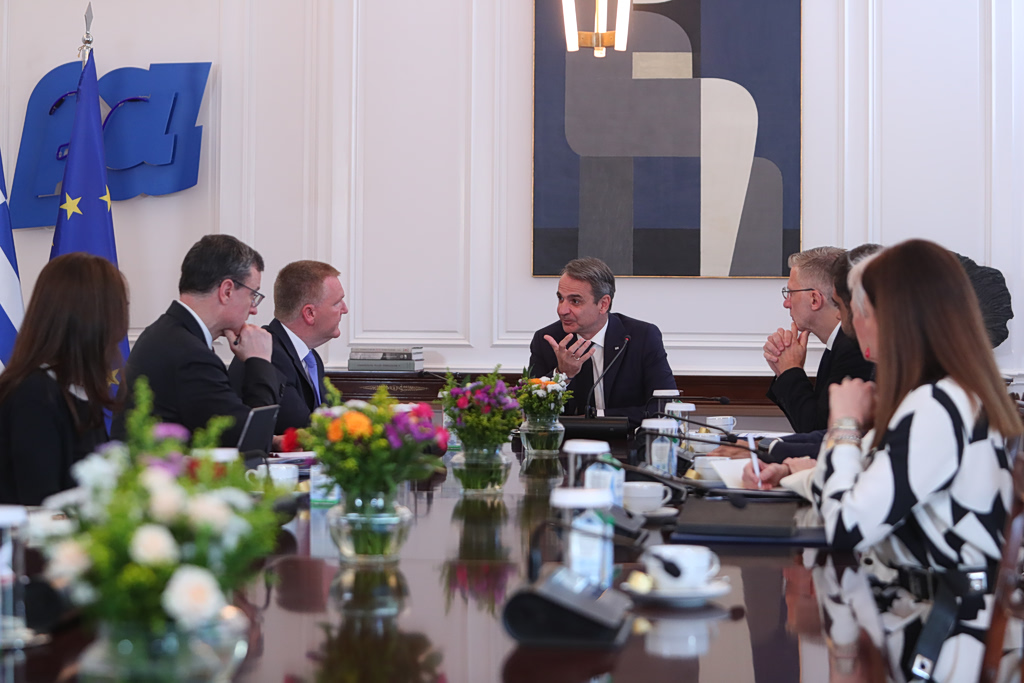
Prime Minister Kyriakos Mitsotakis meets with European Commissioner for Democracy, Justice, the Rule of Law and Consumer Protection Michael McGrath at Maximos Mansion, Tuesday, May 12, 2026. (SOTIRIS DIMITROPOULOS/EUROKINISSI)
The prime minister also outlined plans for a constitutional revision, a complex process under Greek law that requires approval across two consecutive parliamentary terms, with at least one requiring a reinforced majority. Among the proposed changes are reforms to how the leadership of Greece’s supreme courts is selected, and a revision of the provisions governing the potential criminal prosecution of ministers. On the latter, Mitsotakis said the government wants to reduce the role of parliament — which he described as having been excessively politicized in such proceedings — while retaining only a limited parliamentary filter before prosecutions of sitting or former ministers can proceed.
He framed the constitutional agenda as central to the government’s platform ahead of the next general election, due in 2027. “Our election campaign will be based on our proposals for revising the constitution, as we consider that this requires popular legitimisation,” he said.
McGrath noted that the EU’s Annual Rule of Law Report — next edition due to be approved in July — is not designed to rank or grade member states, but to serve as a collaborative tool. He also referenced plans under the next EU Multiannual Financial Framework to tighten the link between respect for the rule of law and access to EU funding.
The commissioner flagged two additional initiatives: a forthcoming Digital Fairness Act, expected later this year, which will address consumer protection in online environments and strengthen safeguards for children; and the work of a task force on child online safety convened by European Commission President Ursula von der Leyen.
Also attending the meeting from the Greek government side were Minister of State Akis Skertsos, Deputy Minister and Government Spokesman Pavlos Marinakis, the director of the Prime Minister’s Diplomatic Office Ambassador Katerina Nasika, and the director of the Prime Minister’s Office for International Strategic Planning and Communication, Aristotelia Peloni. McGrath was accompanied by the deputy head of the EU Representation in Greece, Mariz Koutsouradi, and colleagues from the Commission’s Directorate-General for Justice.