 Μake us preferred on Google
 A parliamentary session on the state of the rule of law in Greece turned into a sharp political confrontation Thursday, as Prime Minister Kyriakos Mitsotakis and opposition leaders traded accusations over a string of controversies that have accumulated over the course of the current government’s tenure.
The debate, requested by the center-left PASOK, centered on three overlapping issues: an illegal wiretapping scandal involving spyware known as Predator, an ongoing investigation by the European Public Prosecutor’s Office into agricultural subsidy fraud, and questions over the professional qualifications of Makarios Lazaridis, the newly appointed Deputy Minister of Rural Development.
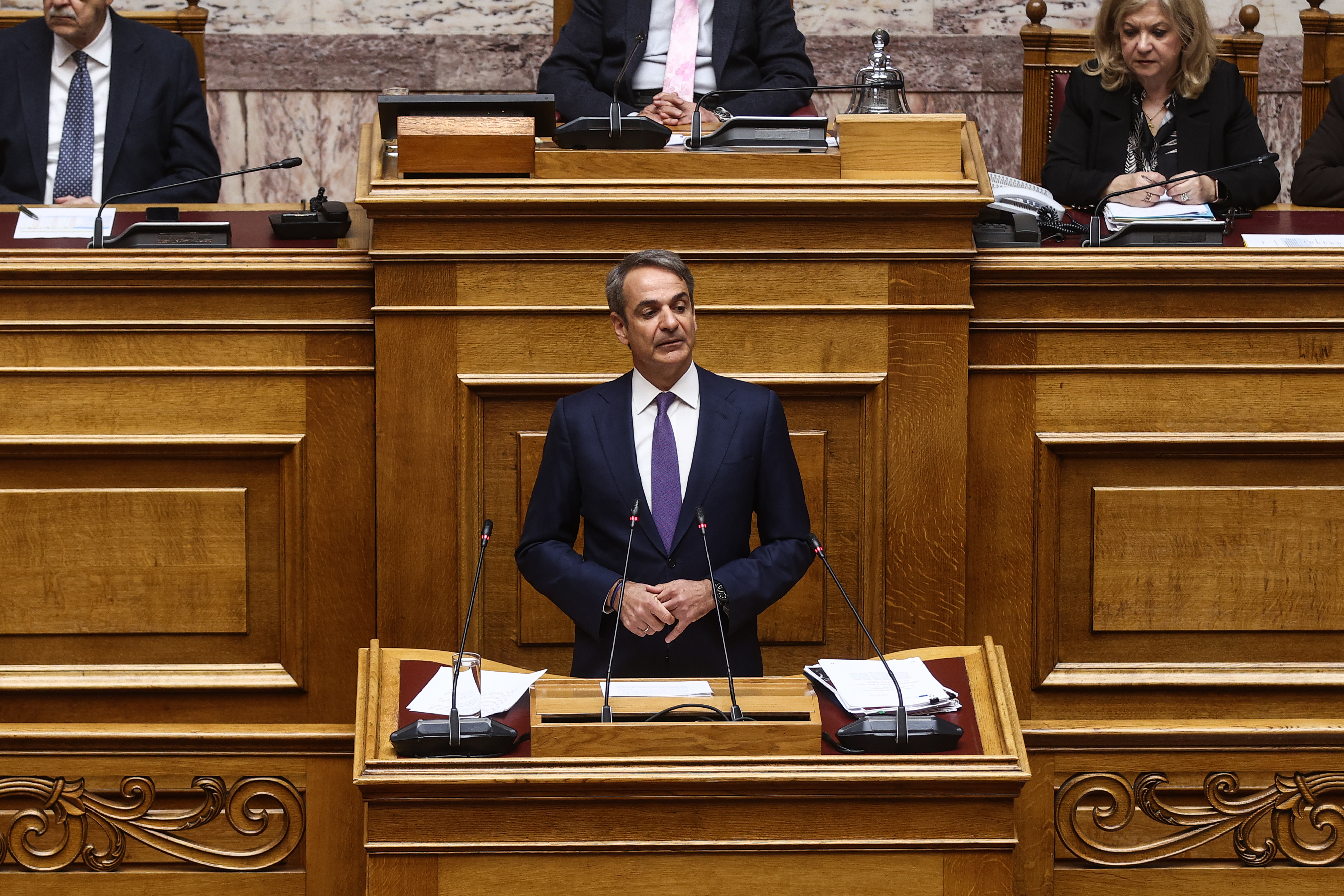
Mitsotakis: toxicity, institutions, and the limits of debate
Speaking first, as is customary, Mitsotakis opened with remarks about the tone of political discourse in Greece. His comments were given additional weight by the fact that Deputy Minister Giorgos Mylonakis — a close aide who holds the deputy to the prime minister portfolio — remained hospitalized in serious but stable condition after suffering a possible brain aneurysm on Wednesday. Mitsotakis used the occasion to condemn what he described as the personal cost of aggressive political attacks on public figures and their families, saying that “words can turn into bullets.”
On the wiretapping scandal, Mitsotakis largely sidestepped the substance of the accusations. The affair has trailed his government for years. Rather than address the specifics, he noted that the matter had already been the subject of a parliamentary inquiry and had been put before voters in two successive elections. With the case now before the courts, he suggested, the opposition’s insistence on relitigating it in parliament amounted to little more than political point-scoring. “Is the Supreme Court good when it convicts Golden Dawn,” he asked — referring to the neo-Nazi party whose leadership was jailed following a landmark 2020 ruling — “and bad when it rules on wiretapping?”
He was more expansive in his defense of the National Intelligence Service, known by its Greek acronym EYP, arguing that public debate about the agency’s activities risked damaging Greece’s intelligence relationships with its allies and handing ammunition to hostile foreign actors. “As prime minister, I will not allow the work of EYP to be undermined,” he said.
On the PASOK charge that his government had institutionalized political patronage, Mitsotakis was sardonic: “According to PASOK, patronage began in Greece in 2019. Give me a break,” he said pointedly. The remark was a not so subtle reference to PASOK’s own long history in government, during which the practice of rewarding political loyalists with public sector positions became deeply entrenched in Greek political culture.
He also addressed the European Public Prosecutor’s Office investigation, saying his government respected the institution but would not tolerate what he described as “selective leaks and piecemeal disclosures,” and called on the prosecutor’s office to move quickly to resolve the cases under review.
He closed by arguing that parliament should be focusing on Greece’s response to global economic turbulence, developments in the Middle East, and recent domestic initiatives — including restrictions on social media access for under-16s and new labor regulation measures. The opposition, he said, was “stuck on yesterday’s slogans.”
Androulakis: “The countdown has begun”
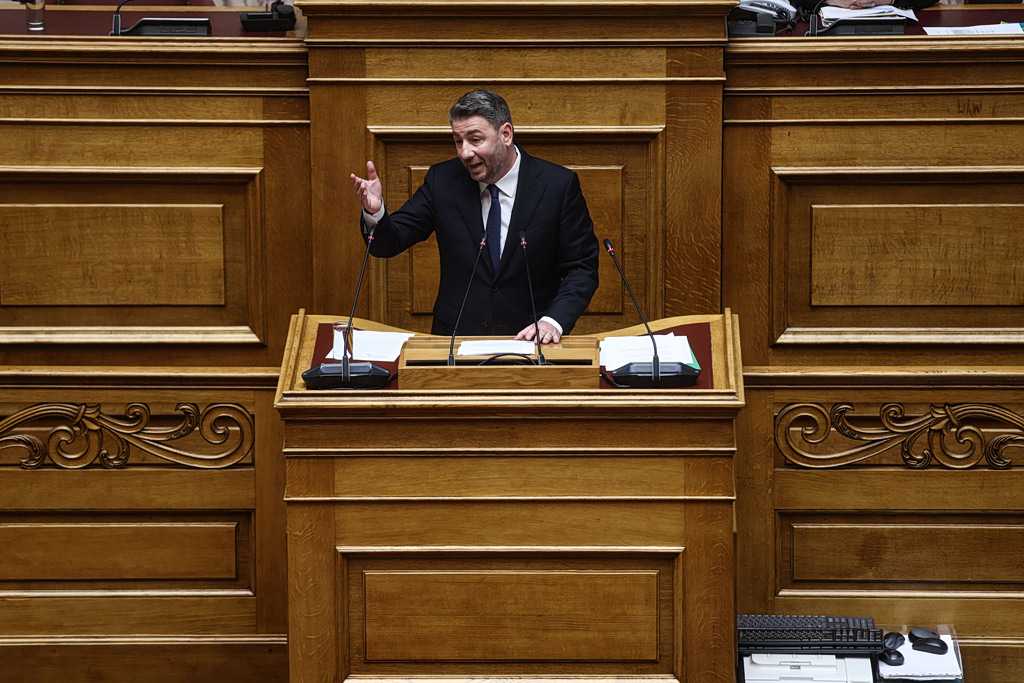
PASOK leader Nikos Androulakis followed with a wide-ranging attack on the government, holding Mitsotakis personally responsible for what he described as years of institutional erosion.
He pressed the prime minister on why he had not taken legal action against Tal Dilian — the former Israeli military officer and founder of the company Intellexa behind the Predator spyware, who has made public statements implicating the Greek government. “I expected you today to file a lawsuit against Mr. Dilian,” Androulakis said. He accused Mitsotakis of being willing to go after the EU’s chief prosecutor on other matters while remaining conspicuously silent about what he characterized as direct public pressure from Dilian over the surveillance scandal.
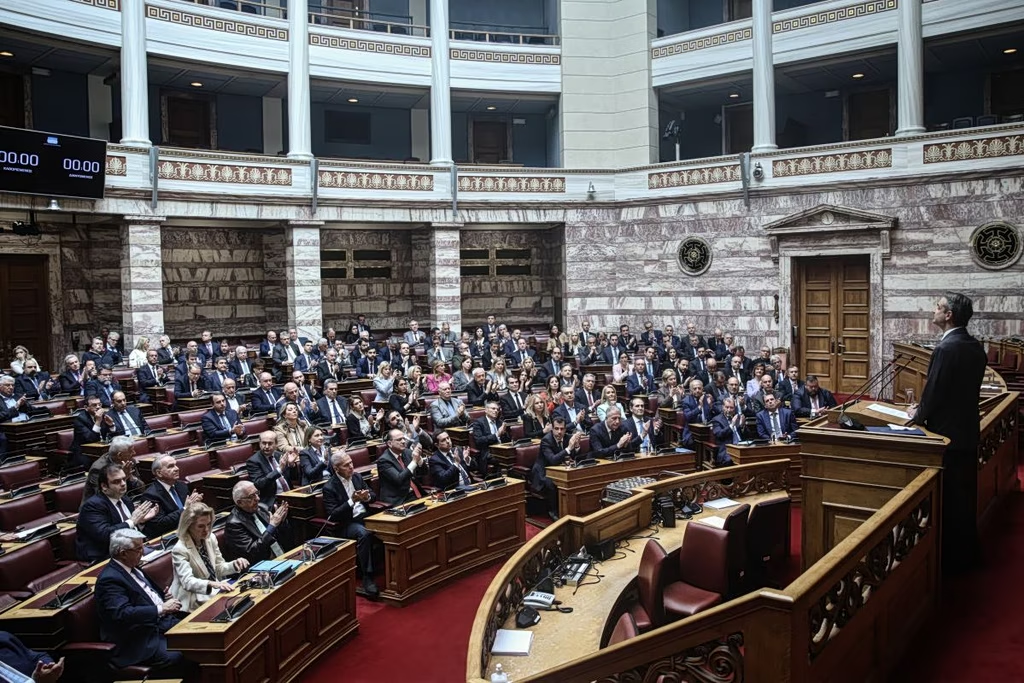
A plenary session of the Hellenic Parliament on the state of the rule of law, institutions and the functioning of parliament in Greece, Athens, April 16, 2026.
He also turned to the Lazaridis case. Earlier this week, the newly appointed Deputy Minister of Rural Development appeared on national television to defend his academic record, brandishing his degree live on air. The controversy centers on his 2007 appointment as a “special scientific advisor”; a post that legally requires a recognized university degree. Lazaridis has acknowledged that the degree he submitted at the time was from the College of Southeastern Europe, a private institution whose qualifications were not recognized as equivalent to those of Greek public universities, a key requirement for the role.
Androulakis was also pointed about his own experience of the surveillance scandal. In 2022, a European Parliament investigation confirmed that his phone had been targeted by Predator spyware. He recalled that government-aligned social media accounts had responded at the time by spreading false rumors about him, and told Mitsotakis directly that his handling of the affair fell short of what the situation required.
Androulakis also invoked Richard Nixon telling Mitsotakis he risked going down in history as “the Greek Nixon.” The wiretapping affair has itself been dubbed by some as Greece’s Watergate. Androulakis called for the government’s resignation and early elections. “The only way for Greece to move forward is for you to step down,” he said.
Famellos and Koutsoumbas add to the pressure
Sokratis Famellos, leader of SYRIZA, covered similar ground, cataloguing what he described as the government’s scandals and calling for Mitsotakis to resign. He criticized the prime minister for briefly leaving the chamber during opposition speeches, though Mitsotakis later returned. Famellos addressed both the wiretapping affair and the Lazaridis case, arguing that each reflected a broader pattern of impunity within the ruling circle.
Dimitris Koutsoumbas, leader of the Communist Party of Greece (KKE), accused the prime minister of attempting to present himself as a detached observer of developments that unfolded directly under his watch.