 Μake us preferred on Google
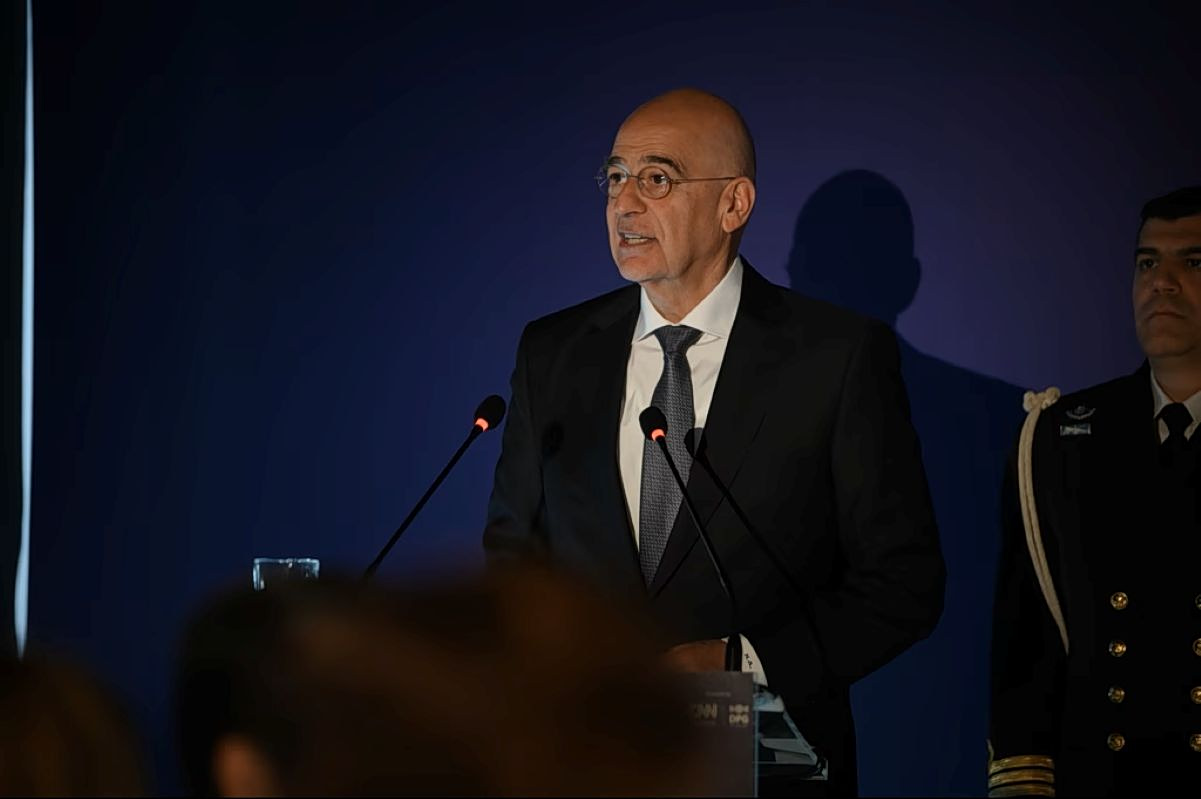
 Speaking at the 3rd International Conference on Maritime Security held Tuesday, April 28 at the Eugenides Foundation under the auspices of President Konstantinos Tasoulas, Defense Minister Nikos Dendias delivered a pointed critique of Turkey, framing his remarks against the backdrop of ongoing regional tensions and differing interpretations of maritime law.
As keynote speaker, Dendias accused Ankara of advancing what he described as an “idiosyncratic” reading of the United Nations Convention on the Law of the Sea. He highlighted Turkish claims that islands lack continental shelf rights and exclusive economic zones (EEZs), even citing Crete as an example. Such positions, he argued, would not withstand basic academic scrutiny.
“If a first-year law student submitted such arguments, they would either fail outright or be met with laughter,” he said, stressing that Greece regards UNCLOS as a “sacred compass” for global order and economic stability.
Turning to defense strategy, Dendias outlined a shift toward a more technologically advanced and cost-effective model for safeguarding the Aegean. Future capabilities will integrate missile systems, unmanned surface and underwater vessels, and smaller, agile naval units. This approach, he said, will enhance deterrence while allowing larger platforms greater operational freedom.
Despite his criticism, Dendias emphasized that Greece should not adopt a Turkey-centric strategic outlook. “Turkey is not—and must not become—our primary concern,” he noted, adding that the country’s focus should remain on maintaining sufficient capability to deter any threat from its neighbors.
He also detailed elements of Greece’s “Agenda 2030” and the defense concept known as the “Achilles Shield,” which envisions a comprehensive system combining modern platforms, satellite infrastructure, and skilled personnel. Plans include deploying a national satellite system to provide real-time imagery for military analysis, as well as launching Greece’s first domestically owned communications satellite.
Describing the broader transformation, Dendias said Greece is moving away from a traditional naval structure centered on frigates toward a multi-layered defense ecosystem. This new model integrates unmanned systems, space-based assets, and advanced communications to ensure maritime security in areas of vital national interest.
Addressing hypothetical scenarios of territorial incursions—implicitly referencing Turkish rhetoric about sudden actions—Dendias warned that any aggressor would face a robust response. He pointed to Greece’s growing capacity to deploy strategic missiles from protected platforms across the Aegean and Eastern Mediterranean.
Finally, commenting on the EU’s naval operation Operation ASPIDES in the Red Sea, Dendias expressed concern over limited European participation. With only Greece and Italy contributing vessels, he argued that Europe must do more if it seeks to be taken seriously as a geopolitical actor.