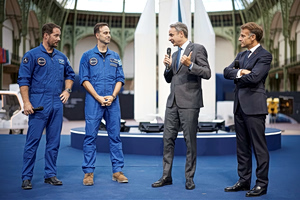
French President Emmanuel Macron called on Thursday for Europe to build its own capability to send astronauts into space within the next decade, part of a wider effort to strengthen the continent’s space industry. He made the announcement at an international space summit taking place in Paris this week, an event several major US companies, including SpaceX and Blue Origin, chose to skip.
His remarks followed comments from European Space Agency chief Josef Aschbacher, who told ministers and officials in a closed-door session the night before that Europe needs greater resources to build an independent space sector, framing the choice facing the continent as whether it would remain a passenger or become a pilot in the next era of space exploration.
Aschbacher pointed to the pace of progress being made worldwide in satellite technology and lunar and Martian exploration, arguing that Europe needs to establish itself as an essential partner with capabilities of its own. Despite pursuing more independence in space in recent years, Europe has never carried out a crewed mission on its own, relying instead on Russian and American rockets and capsules.
Macron set out a series of targets for the coming decade. He wants Europe’s Nyx cargo capsule to dock with the International Space Station within two years, and its Argonaut lunar lander to touch down on the Moon within five. His most ambitious target: within 10 years, a European crewed capsule carrying European astronauts, alongside astronauts from other countries, would launch from the Kourou spaceport in French Guiana.
Building out this capability won’t come cheap. Aschbacher estimated the plan would require roughly one billion euros a year in investment over the next decade. But he argued that staying dependent on outside partners carries its own costs, noting that buying seats for European astronauts from foreign providers would run about five billion euros over 10 years, money that would support other countries’ space industries rather than build up jobs, technology, and independence in Europe.
ESA’s member states are set to hold a ministerial meeting in December to decide how to proceed. Last year, the agency secured a record 22.1 billion euro budget to fund its programs over the next three years.