 Μake us preferred on Google
The meetings were meant to be confidential, with non-disclosure agreements and strict instructions to all parties to stay quiet. But when the US president’s eldest son comes to town — Secret Service in tow — word tends to spread fast.
Donald Trump Jr’s world tour to Mongolia, Estonia and Poland in the early autumn attracted press attention and Instagram stories. But the discussions with potential business partners received less publicity — as did his conversations with senior government figures.
Trump Jr and his brother Eric have made a habit of meeting foreign officials and politicians: the FT has documented at least 18 such encounters since their father began his second term in January 2025.
These include conversations with at least six current and former prime ministers or heads of state, nine senior ministers or officials, and two groups of politicians from places as diverse as Vietnam, Serbia and Somaliland.
As sons of the sitting US president, Trump Jr and Eric often seem to be greeted as emissaries of the Trump administration — despite the fact that neither man holds a formal government role.
Richard Painter, a former White House ethics lawyer in the Bush administration and Trump critic, says it would be “highly improper” for Trump’s sons to meet with foreign leaders in any diplomatic capacity, as they are not official emissaries nor subject to conflict-of-interest laws. “We have no way of knowing what was said in these conversations,” he says.
Trump Jr’s spokesperson said he always clarifies with any government official he meets that he is not an emissary nor involved in his father’s administration. “Don is a private citizen and has the same First Amendment rights that any other law-abiding American has,” the spokesperson said.
However it might appear, the Trumps have seized the moment to maximise the profits of their businesses, building a tangled web of financial connections with the potential for conflicts of interest.
A huge chunk of President Trump’s personal income last year, which topped $2bn, came from his sons’ ventures. He reaped over $500mn from sales of tokens from World Liberty Financial, the crypto business co-founded by the brothers, as well as hundreds of millions from the family’s traditional real estate company.
The Trump Organization has earned tens of millions from at least 20 new projects launched overseas since Trump’s 2024 campaign, according to the company’s announcements and the president’s ethics disclosure.
Because Trump Jr and Eric are not government employees, their business relationships and finances are more opaque. The brothers have investments and advisory roles in companies across industries — including some being transformed by US policy such as crypto, defence and critical minerals.
Voters are worried about the potential for impropriety ahead of next week’s midterm elections. Over two-thirds (69 per cent) of registered voters in the US said they were “very” or “somewhat” concerned about “corruption, self-dealing or conflicts of interest”, according to an FT/Focaldata poll published last weekend.
Painter compares the brothers’ worldwide business dealings to those of Hunter Biden, who was investigated by congressional Republicans over his investments in and board seat on Ukrainian energy company Burisma while his father served as vice-president. Both Bidens deny any wrongdoing.
“I made a big stink about Hunter Biden,” Painter says. “We had to take a firm stance that this was wrong.”
But the Trump sons, he says, are a different magnitude. “Donald Trump, he’s encouraging it. And it’s 1,000 times worse than [what] Hunter Biden did.”
Dining with Don
Trump Jr’s private jet touched down in Estonia at 5am on September 6 this year, for a one-day business visit followed by a 13-person dinner held in the modernist red-and-white offices of an online casino software company. The day was topped off by an after-party at a cigar lounge.
The Americans at the dinner included former Trump campaign manager Brad Parscale, Fyre Festival founder Billy McFarland, and former New York mafioso Michael Franzese. Guests at the after-party were similarly eclectic, including celebrity poker players, an Estonian actress and the 2026 Miss World Estonia.
“Everyone involved who has factual knowledge is under a 55-page NDA, which is understandable given the guest list,” Craig Hilton, Studioworks’ founder and the evening’s host, tells the FT.
Another of the dinner guests was decidedly more establishment: Margus Tsahkna, Estonia’s foreign minister. He was not there to strike a business deal — the small country wants a stronger US and Nato military presence to deter potential Russian aggression after their neighbour’s invasion of Ukraine.
Tsahkna told Estonian broadcaster ERR that “the topic of Ukraine was on the table quite a lot”.
“It was very interesting to meet someone who — while not an active politician — wields significant influence, and to see his attitude towards us,” said Tsahkna. “It also provided an opportunity to present our own vision of security and economic policy. Perhaps such contacts with unconventional figures within the administration of the President of the United States will be useful someday.”
Tsahkna declined to answer the FT’s questions about the dinner.
Despite the presence of Estonia’s top diplomat, Trump Jr and others involved in the dinner described it as a private visit. The president’s son announced to guests he was not there in an official capacity, Trump Jr’s spokesperson says. “He’s obviously opinionated about various political issues, but always makes clear his views are only representative of himself and not the US government.”
View this post on Instagram
But it was not even the first time that week that Trump Jr had met with a senior foreign official.
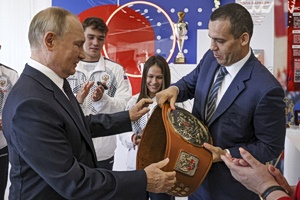
Shortly before the trip to Estonia, Trump Jr dined with the president of Mongolia, Ukhnaagiin Khürelsükh, in Ulaanbaatar, the country’s capital. Their meeting was documented with photos on the Facebook account of a government spokesperson, who wrote they discussed US-Mongolian relations and business ties.
Then the photos vanished. Reached on the phone by the FT, the government spokesperson said someone from Trump Jr’s side had asked him to delete the post.
Trump Jr’s spokesperson said his US team was not aware of the post nor asked for its deletion. He said the Mongolian president’s office requested the meeting, and Trump Jr only accepted after clearing it with US secretary of state Marco Rubio and making clear it was unofficial. The men spoke mostly of the outdoors and not of business, the spokesperson added.
In a statement, the Mongolian president’s office told the FT that “the President had an informal meeting and had a meal with Trump’s son. Relations are on fairly good terms. They did not discuss politics or official visits.”
After Trump Jr’s visit to Estonia, he flew to Poland for a 12-hour stop and a series of meetings also shrouded in secrecy.
Travelling with the group was Adrian Thiess, a Romanian political consultant who has helped host events with Trump’s two eldest sons in Hungary, Romania, Serbia and Bulgaria in the past.
Thiess declined to comment on the meetings in Warsaw. Trump Jr’s spokesperson said he was in Europe for speaking opportunities organised by Salem Media, a conservative group.
Breaking ground
Trump Jr’s younger brother Eric, who has become the face of the family real estate empire, has meanwhile embarked on his own global dealmaking tour to partner with foreign developers on Trump-branded projects.
In most cases, the group doesn’t own buildings itself: instead, it offers the Trump brand to project developers and consults on the construction process in exchange for licensing and development fees.
And in Donald Trump’s second term, the family brand is more valuable than ever. Its finances, included in Trump’s annual ethics disclosures, show an ever-expanding global empire with a range of partners building commercial, residential and hotel projects that each earn the family millions per year.
The Trump Organization has announced 15 new projects overseas since Trump’s 2024 re-election campaign, according to FT analysis, including in Bucharest, Dubai and Vietnam.
Trump’s ethics disclosures list five more projects that are yet to be officially announced: one in Romania, two in India and two in Abu Dhabi. The disclosures show that these foreign licensing, development and management revenues increased 40 per cent to $63mn between 2024 and 2025.
During Trump’s first term, the Trump Organization announced it would pause international deals. This time, the family business released guidance that allows foreign deals so long as they are not with government counterparties. Last year, the FT asked Eric Trump why the family decided to undo its earlier pledge.
“It’s very simple,” Eric responded. “We didn’t have to do it in 2017. We did it. We got absolutely no credit for doing it, and we’ve done everything right.”
But these private deals have brought Eric and Trump Jr — both of whom are executive vice-presidents of the Trump Organization — into proximity with government officials and politicians in the course of their family business. In many cases, these officials hope the Trump brand will help them build a better relationship with the White House.
In Georgia last month, hundreds of the country’s elite gathered to celebrate the announcement of Trump Tower Tbilisi — set to be the country’s largest skyscraper — with traditional dances, a drone light show and a speech by Prime Minister Irakli Kobakhidze.
Eric Trump, appearing live via video, praised Kobakhidze and highlighted Georgia’s high GDP growth. “The Georgian people love the United States, and the United States loves the Georgian people,” he added.
View this post on Instagram
The remarks were at odds with the US’s official stance on Georgia, as relations have become frosty over the ruling party’s posture towards Russia. Kobakhidze is a close ally of his predecessor Bidzina Ivanishvili, a billionaire who was placed under sanctions by the Biden administration in 2024 for “undermining the democratic and Euro-Atlantic future of Georgia for the benefit of the Russian Federation.”
One week after he spoke at the Trump Tower launch event, Kobakhidze had brief conversations with President Trump and Rubio at a reception on the sidelines of the UN General Assembly meetings in New York.
“Thankfully, these attacks have been stopped and relations are substantially healthier,” Kobakhidze said at a press appearance this month. “We remain optimistic that the strategic partnership will be restored, but the rest depends entirely on the US administration.”
Sometimes, governments have explicitly tied Trump projects to diplomatic efforts. In Vietnam, the government has seized on a new Trump resort in the country’s north. The then prime minister called it “significant to strengthening Vietnam-US relations” at its groundbreaking in May 2025, just seven weeks after Trump’s “liberation day” tariffs hit the country’s export industries. Since then, the government has provoked local controversy, asking thousands to move and planning to relocate bodies from a cemetery to make room for a golf course.
A spokesperson for the Trump Organization denied it had any ties to US foreign policy. “The company operates completely separately from the presidency and is in full compliance with all ethics and conflict-of-interest laws.”
In some places the Trump brand has lost its lustre. Altus Property Group dropped the Trump name from a tower it is developing on Australia’s Gold Coast following protests and a petition with 120,000 signatures.
“When the war [in Iran] started, the pressure here built up to a frenzy,” CEO David Young tells the FT, adding that not paying — and thereby scuttling the deal — was an unfortunate necessity. “Despite my best efforts to explain it to Eric and the Trump Organization, they really didn’t want to hear about it.”
“Mr Young’s attempt to blame certain world events for our termination of the agreement is merely a ploy to distract from his own defaults and failures,” said the Trump Organization spokesperson.
Walker Davis, deputy research director at the Citizens for Responsibility and Ethics in Washington (Crew) watchdog, who has studied Trump’s empire, says agreements that are not explicitly political still present an ethical hazard for the president.
“How could it not be a factor for Trump, that his business — which he still owns and profits from, which is run by his family members — is expanding into these countries,” Davis says, even while Trump sets US policy towards them.
“It at least raises questions about influence on the presidency, and whether the millions of dollars that those deals are generating from foreign sources may factor into official decisions,” he adds.
Familial interests
Back home, the brothers have built a diverse portfolio of crypto businesses, investment funds and advisory roles — often in industries that are being transformed by their father’s decisions in the White House.
Trump Jr has pursued investments through his role as a partner in 1789 Capital, co-founded by investors and Republican donors Omeed Malik, Christopher Buskirk and Rebekah Mercer. The venture fund has said its assets under management have jumped from $200mn to over $3bn since it was founded in 2023, after going on a dealmaking spree with many of the leading privately held AI companies.
1789 Capital has gained access to investment rounds in popular companies that are regularly oversubscribed and unavailable to most investors.
The brothers also have investments in a number of prediction market and crypto ventures, some of which have benefited from the Trump administration’s actions to deregulate the industry.
Donald Trump Jr was handed about $300,000 worth of equity in prediction market Kalshi after joining the company as a strategic adviser in early 2025. He also serves as an adviser to Kalshi’s competitor, Polymarket, in which 1789 Capital has a stake.
Both companies have benefited from a more permissive approach from the Trump administration’s regulator, the Commodity Futures Trading Commission, allowing the prediction markets to offer sports bets that have fuelled their skyrocketing growth.
“Don is a big believer in the power of prediction markets,” his spokesperson says. “He never interfaces with the federal government as part of his role with any company that he advises or invests in.”
The Trump sons’ crypto venture World Liberty Financial has made most of its money issuing a stablecoin called USD1. The company earns interest on assets it holds to back the token, which has $4.1bn in circulation. Among its investors are Sheikh Tahnoon bin Zayed al-Nahyan, the United Arab Emirates’ national security adviser.
World Liberty Financial’s application for a US banking licence was approved this summer by the Office of the Comptroller of the Currency. Bank licensing has historically been a tightly regulated process, made easier by the Trump administration’s aim to promote crypto banks.
A spokesperson for World Liberty said that while the brothers are co-founders, they are not involved in day-to-day operations, and that the company “neither sought nor received special treatment”.
Additionally, the brothers have interests in a number of defence and critical mineral companies — strategic priorities for the US which often rely on government financing and contracts.
Last year, the FT reported that Trump Jr’s 1789 Capital invested in rare earths start-up Vulcan Elements, shortly before it received a $620mn loan from the Pentagon. Another company, Trump Jr-backed drone group Unusual Machines, also received a military contract. And this year, US start-up Reflection AI, a 1789 Capital portfolio company, struck an agreement to deploy its technology in classified Pentagon networks.
A spokesperson for 1789 said: “Don Jr does not have a role on the investment committee at 1789; therefore, he does not decide who gets money from 1789,” noting that defence companies in its portfolio have received contracts under both Trump and Biden administrations. “1789 takes minority stakes in companies, which has nothing to do with government contracts.”
The brothers are also invested in American Ventures, a series of special-purpose vehicles that manage about $1bn investing in “US-based leaders in new technologies”. Together, they own about 12 per cent of American Ventures’ management company, Dominari Holdings, which is headquartered in Trump Tower.
Through American Ventures, the brothers have a stake in a construction company that is set to merge with a mining developer that earlier secured access to critical minerals in Kazakhstan with the Trump administration’s direct support.
The brothers’ spokespersons said Eric and Trump Jr are passive investors with no involvement in the day-to-day operations or activities of American Ventures. Dominari Holdings’ chief executive Anthony Hayes said that they have a “relatively small ownership percentage” in its vehicles.
Other Trump Jr projects are more varied, including a hunting magazine, a podcast, and a Washington DC members’ club called Executive Branch. According to a 2025 version of the club’s bylaws seen by the FT, annual membership can be as high as $15,000, on top of initiation fees reportedly in the six figures.
Painter says these ventures could look like profiteering on the presidency. “When you name your company 1789 Capital — after the founding of the Constitution — or you have a social club called Executive Branch, that they’ve started up to sell memberships . . . it’s not subtle.”
Before leaving Ulaanbaatar last month, Trump Jr had breakfast with Unenburen Ulziiburen, a Mongolian entrepreneur with a series of crypto ventures.
Like Trump Jr, Ulziiburen is a political scion: his mother is former environment minister and member of parliament in Mongolia’s opposition Democratic Party.
View this post on Instagram
Photos posted to Instagram show what appears to be a printout of a pitch deck on the table, but none of the meeting attendees would comment on its topic.
Trump Jr’s spokesperson said he has no plans for any business in Mongolia.
Trump Jr’s travels still leave open many questions: precisely who he met with, what they discussed, and what, if any, business ventures may emerge from it. While President Trump’s ethics disclosures offer some insight into Eric’s work on the real estate empire, much of the sons’ dealings remain opaque.
What is public already raises concerns about conflicts of interest in presidential decision-making, says Crew’s Davis — not to mention what is unknown. “We shouldn’t have to wonder whether those decisions are what’s best for Americans, or what’s best for Trump’s bottom line.”
Additional reporting by Chris Campbell, Eenee Purevdorj, Richard Milne and A. Anantha Lakshmi
Link To FT.com: https://www.ft.com/content/a89fa128-8fcb-4ff4-bd8b-6bb591ccd9c1
Copyright The Financial Times Limited 2026
© 2026 The Financial Times Ltd. All rights reserved. Please do not copy and paste FT articles and redistribute by email or post to the web.