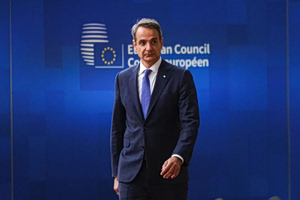
Greece is approaching Prime Minister Kyriakos Mitsotakis’ meeting with Turkish President Recep Tayyip Erdoğan in Ankara with modest expectations but clear red lines, at a time when Ankara is once again raising sensitive issues such as the demilitarization of Aegean islands, controversial NAVTEX notices and so-called “grey zones.”
The summit takes place amid contradictory dynamics. On the one hand, both sides see value in preserving the relatively calm climate in the Aegean and Eastern Mediterranean—something today’s fluid geopolitical environment encourages. On the other, tensions are steadily fueled by the re-emergence of Turkey’s revisionist agenda.
Both delegations—at the leaders’ level and within the framework of the High-Level Cooperation Council, where several ministers will also participate—want to project the message that Greek-Turkish dialogue is continuing as normal. Still, the structural differences dividing the two sides of the Aegean cannot be fully set aside.
That was always going to be difficult nearly a year and a half after the last one-on-one meeting between the two leaders, especially after a period marked by initiatives from both sides but also episodes of friction. Most of these disputes remained at the diplomatic level and did not escalate on the ground.
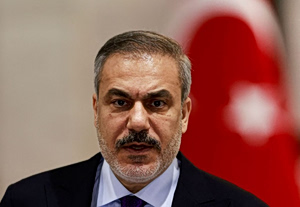
In this context, the latest statements by Turkish Foreign Minister Hakan Fidan and AKP party spokesperson Ömer Çelik—made just hours before Mitsotakis’ departure for Ankara—are seen as Ankara reintroducing two of the most problematic items on its agenda.
Turkey’s Signals Before the Meeting
Following the pattern set by Turkey’s unusual open-ended NAVTEX (maritime advisories reserving sea areas for exercises or research), Çelik once again demanded the demilitarization of Greek Aegean islands. Fidan, meanwhile, accused Athens of conducting foreign policy through the lens of domestic politics.
Çelik’s remarks signal that Ankara persists in what Athens views as an unreasonable demand to weaken Greece’s first line of defense on its eastern islands. In recent months, Turkey has also linked this stance to the upgrading of Greek-Israeli cooperation.
Within Turkey’s public discourse, the idea has been methodically promoted that the country risks being “encircled” by a perceived alliance triangle of Athens–Nicosia–Tel Aviv (Greece–Cyprus–Israel). It is considered almost certain that Erdoğan will raise this with Mitsotakis. The Greek prime minister has publicly stressed that Greece’s ties with Israel are not directed against Turkey. In any case, Athens does not intend to justify—let alone apologize for—its foreign policy in the Eastern Mediterranean.
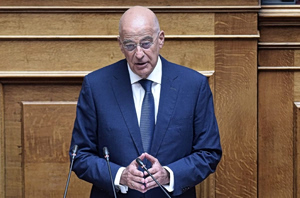
Fidan’s comments—his second nearly identical intervention in recent weeks—are viewed in Athens as bordering on diplomatic impropriety. By appearing to distinguish between Mitsotakis and Foreign Minister George Gerapetritis on one side and a supposedly “hardline” Defense Minister Nikos Dendias on the other, Ankara seems to be trying to shift blame for the lack of substantive progress in bilateral talks onto Greece.
This comes despite the fact that Turkey itself is well known, over time, for using foreign policy as a tool to maximize domestic communication gains.
Mitsotakis’ Agenda
Mitsotakis is also expected to bring a pointed agenda to the table. He has repeatedly committed to raising a range of issues with Erdoğan: starting with the latest NAVTEX and NOTAM (aviation notices) and moving to major disputes such as the lifting of Turkey’s casus belli—its standing parliamentary threat of war if Greece extends its territorial waters beyond six nautical miles—the rejection of the legally unfounded “grey zones” theory, and the long-discussed Greece-Cyprus electricity interconnection project.
The casus belli threat is likely to be a major flashpoint. Athens has directly linked it to Turkey’s potential participation in European defense initiatives such as SAFE and, more broadly, in Europe’s evolving security architecture.
For months, the prospect of a Greek veto has angered the Turkish leadership. Erdoğan and Fidan frequently argue that Athens and Nicosia are obstructing Europe’s push for greater defense autonomy, even calling on Brussels and key EU states—such as Germany, France, Spain and Italy—to pressure Greece and Cyprus to change course.
The Cable Dispute
The electricity interconnection cable between Greece and Cyprus—raised by Athens at every high-level meeting but without the desired response—remains frozen due to disagreements between Athens and Nicosia. At the same time, it is seen by Greece as a clear sign of Turkish intransigence.
Ankara states explicitly that beyond the 25th meridian east, no Greek initiative should proceed without Turkish approval or participation. Greek analysts view this as part of a broader Turkish strategy to confine Greece to six nautical miles of territorial waters.
It is no coincidence, they argue, that Turkey interprets parts of the Athens Declaration of December 2023 in this way. Under this reading—echoing elements of the 1976 Bern Protocol—Greece would be expected to inform Turkey about activities in non-delimited areas.
Athens counters that research and the laying of interconnection cables fall under the regime of the high seas, not the continental shelf or Exclusive Economic Zone. Turkey, however, claims authority to issue research permits in these areas, challenging Greek sovereign rights in parts of the Eastern Mediterranean included in Ankara’s “Blue Homeland” doctrine—a strategic concept asserting broad Turkish maritime claims.
A Delicate Balancing Act
All these issues are certain to feature in the Mitsotakis–Erdoğan talks, which will take place in the presence of foreign ministers and diplomatic advisers. The open question is which topics will be mentioned publicly and how they will be framed.
While both sides will have a sense of each other’s positions in advance, that does not guarantee Erdoğan will stay strictly on script. During Mitsotakis’ last visit to Ankara, the two leaders engaged in a tightly managed but real disagreement over the characterization of Hamas.
The delicate balance at Turkey’s presidential complex—often referred to as the “White Palace”—is also shaped by broader geopolitical instability: the ongoing Russia-Ukraine war, the fragile situation in the Middle East and the unpredictability of Donald Trump’s foreign policy.
Both Athens and Ankara know there is little room for additional tension. At the same time, they are wary of the prospect of outside—particularly American—intervention to settle their disputes. This is why emphasis is placed on advancing a “positive agenda” through the signing of additional bilateral agreements during the ministerial meetings in Ankara.
What Comes Next
It remains to be seen whether Turkey will show any real willingness to isolate the maritime delimitation dispute from its broader revisionist agenda—something that for now appears unlikely, despite Fidan’s references to dialogue.
That skepticism was reinforced by a statement from Greece’s Foreign Ministry spokesperson Lana Zochiou shortly before the High-Level Cooperation Council, saying the conditions are not ripe for launching such discussions.
If that remains the case, Greece and Turkey may find themselves, for the foreseeable future, simply managing the dangerous gap that separates their shores in the Aegean and the Eastern Mediterranean, rather than truly closing it.