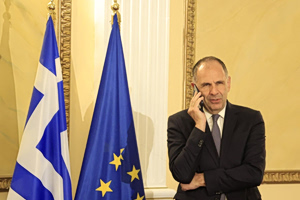
George Papandreou, former prime minister of Greece and current member of parliament for the socialist Pasok-KINAL party, has called on Athens to immediately recognize the State of Palestine. Writing in a lengthy article published on his personal page, Papandreou argued that recognition is not a symbolic act but a necessary step toward breaking what he described as a destructive cycle of denial and violence.
“The two-state solution remains the only realistic road to peace in the region,” he wrote, stressing that Greece, with its historic ties to both Israel and Palestine, has both the responsibility and the capacity to act as a bridge.
Recognition as a starting point
Papandreou rejected fears that recognition of Palestine would harm Israel or reward Hamas. Instead, he argued that it would strengthen moderate voices committed to coexistence. Recognition, he said, should be understood as “a beginning, not an end” — a political foundation for credible negotiations.
He recalled his government’s previous efforts to support peace initiatives, including cooperation with Israeli leaders and sustained engagement with the Palestinian Authority, while emphasizing Greece’s tradition of balancing relations with both sides. From his time as prime minister to his international role in the Socialist International, Papandreou pointed to past experiences that convinced him peace is possible.
The urgency of peace and humanitarian action
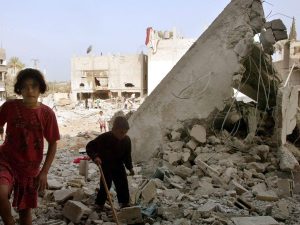
Papandreou underlined that the ongoing war in Gaza, coupled with the humanitarian crisis and the plight of hostages, makes immediate action imperative. He called for unrestricted humanitarian aid, medical programs for children, and reconstruction efforts in Gaza.
“The release of hostages and access to humanitarian assistance are not bargaining chips,” he wrote. “They are bridges that connect suffering to hope.”
Civil society and the voices of peace
Papandreou drew attention to massive citizen-led demonstrations in Tel Aviv and across Israel demanding an end to war and a return to negotiations. These movements, he argued, show that peace is not an abstract hope but a living demand shared by Israelis, Palestinians, Arabs, Druze, and civil society groups.
He insisted that Greece and Europe must stand with these voices: “With the recognition of Palestine, Greece and Europe support those courageous Israelis and Palestinians who are fighting for peaceful coexistence and democratic values.”
Greece’s role in Europe and the Mediterranean
Papandreou argued that Greece is uniquely positioned to act as a regional mediator, thanks to its history of engagement in Middle Eastern diplomacy. He cited past Greek initiatives — from welcoming Yasser Arafat in Athens in the 1980s to the 2015 parliamentary resolution calling for recognition of Palestine — as proof that the country can play a constructive role.
Looking ahead, he urged Athens and Brussels to move beyond symbolic gestures and commit to a comprehensive strategy. This, he proposed, should include coordinated EU recognition of Palestine, humanitarian guarantees, support for civil society and youth initiatives, and the use of Europe’s economic leverage with Israel to encourage compliance with international law.
A call for decisive leadership
Papandreou closed by framing recognition as both a moral imperative and a strategic opportunity for Greece and Europe.
“Inaction is not neutrality; it is complicity,” he warned. “Recognition of Palestine is not the end of diplomacy — it is the beginning.”