 Μake us preferred on Google
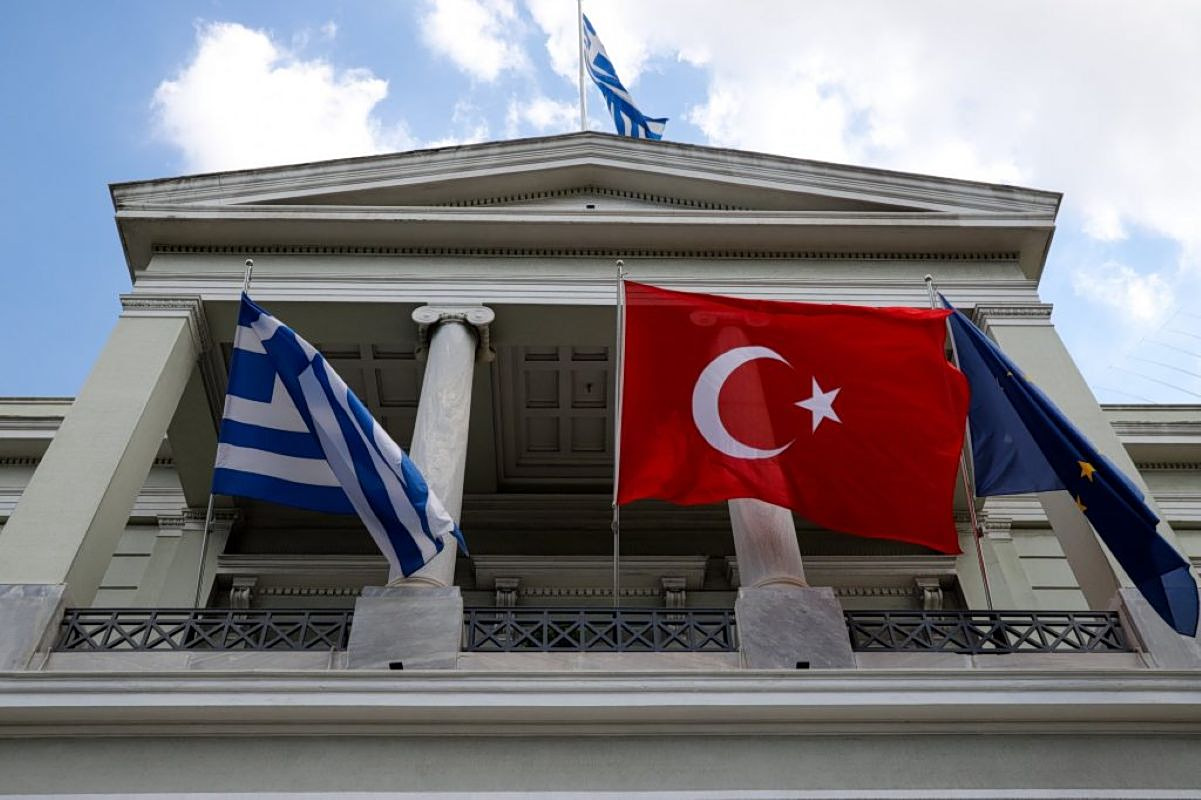
 Is Turkey truly being encircled—and if so, by whom and to what end? A glance at the country’s public discourse in recent weeks reveals a climate of mounting concern. More suspicious voices go further, suggesting that a carefully crafted sense of alarm is taking hold: Greece, Cyprus, and Israel are moving in coordination, deepening defense and diplomatic ties while strengthening their regional standing—at Ankara’s expense.
This narrative gained further traction following French President Emmanuel Macron’s recent visit to Athens. His explicit pledge of military support in the event of a threat to Greek sovereignty was widely interpreted in Turkey as an implicit warning. Much of the Turkish press framed it as evidence of a “Greek-French alliance against Turkey,” reinforcing the perception of a widening anti-Turkish axis.
Deep-Seated Fears—and Present Realities
The notion of encirclement is not new in Turkey. It is often linked to the so-called “Sèvres Syndrome,” rooted in the Treaty of Sèvres—a moment still regarded as one of the most humiliating in Turkish history. The treaty, involving Greece and Allied powers including France, is remembered as an attempt to dismantle the Turkish state.
Today’s context, however, is shaped by fast-moving geopolitical shifts, particularly following the Russian invasion of Ukraine. Against this backdrop, Athens has undertaken a series of initiatives aimed at consolidating its position in the Aegean and the Eastern Mediterranean. For Greek diplomacy, the broader instability in the Middle East has also served as an opportunity to reinforce national security.
From Ankara’s perspective, these moves appear as a coordinated pushback against Turkey’s revisionist agenda. Greek officials counter that each initiative is a direct response to specific Turkish claims or actions. These include maritime spatial planning challenging Ankara’s continental shelf assertions, the creation of marine parks in contested zones, and the deployment of Patriot missile systems to islands such as Karpathos. Energy exploration south of Crete—led by companies like Chevron—is framed in Athens as a strategic counter to the Turkish-Libyan maritime agreement.
Meanwhile, joint military signaling between Greece and Cyprus, including the presence of F-16s and naval assets, underscores a shared stance on external threats.
A Shifting Balance
Greece’s broader military modernization—highlighted by the acquisition of Rafale fighter jets and Belh@rra frigates—alongside renewed defense commitments with France, signals a long-term strategic alignment. The deepening partnership with Israel and expanded diplomatic engagement in the Gulf further add to Ankara’s unease.
Turkish analysts increasingly warn of a return to pre-detente tensions. As one columnist in the English-language Daily Sabah noted, the accumulation of disputes—combined with visible military movements—suggests a relationship once again tilting toward confrontation.
What concerns Turkey most, however, is its limited ability to shape developments in the wider Middle East. At the same time, it faces what officials describe as “irreversible facts on the ground” created by Greece’s actions. Ankara’s sharpest reaction came after Greek deployments to Cyprus and Karpathos, prompting Turkey to raise the issue of Aegean militarization within NATO and the EU, while reinforcing its own military presence in Northern Cyprus.
Strategic Signaling, Strategic Ambiguity
Greek officials insist these moves reflect resolve rather than escalation. “When it comes to national security, there is no hesitation,” sources in Athens say, while emphasizing that the overarching doctrine remains unchanged: maintaining “calm waters.” As diplomats point out, Greece used a period of relative stability to strengthen its defenses and build international partnerships—now translating that groundwork into visible presence.
Yet a key question remains unanswered: will Greek forces eventually return to their bases, or will their extended deployment in areas such as Cyprus, Karpathos, Evros, and Lemnos become a lasting feature of the new regional reality?
The Broader Equation
What is clear in Athens is that Turkey will continue to pursue a leading role in the Eastern Mediterranean, upholding agreements like the Turkish-Libyan memorandum and intervening in regional energy and security initiatives—regardless of third-party involvement.
Diplomatically, Ankara is also attempting to frame Greece as aligned with Israel, and by extension with its military actions. Greek officials dismiss such claims, insisting that their alliances are sovereign choices, not subject to external approval. From the Turkish viewpoint, Israel is seen as the principal architect of the perceived encirclement, with Greece and Cyprus acting as its instruments.
France now appears firmly embedded in this equation. Beyond its bilateral defense pact with Greece, French forces are cooperating with Cyprus’s National Guard, while discussions are underway to strengthen ties between their respective defense industries. Paris also strongly supports efforts by Greece and Cyprus to update Article 42.7 of the EU treaty, which provides for mutual defense in the event of an attack on a member state—a clause Ankara is well aware could apply to its own actions.
Whether viewed as strategic balancing or deliberate containment, the shifting alignments in the Eastern Mediterranean are reshaping the region—and deepening the sense of uncertainty in Ankara.