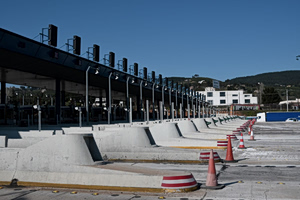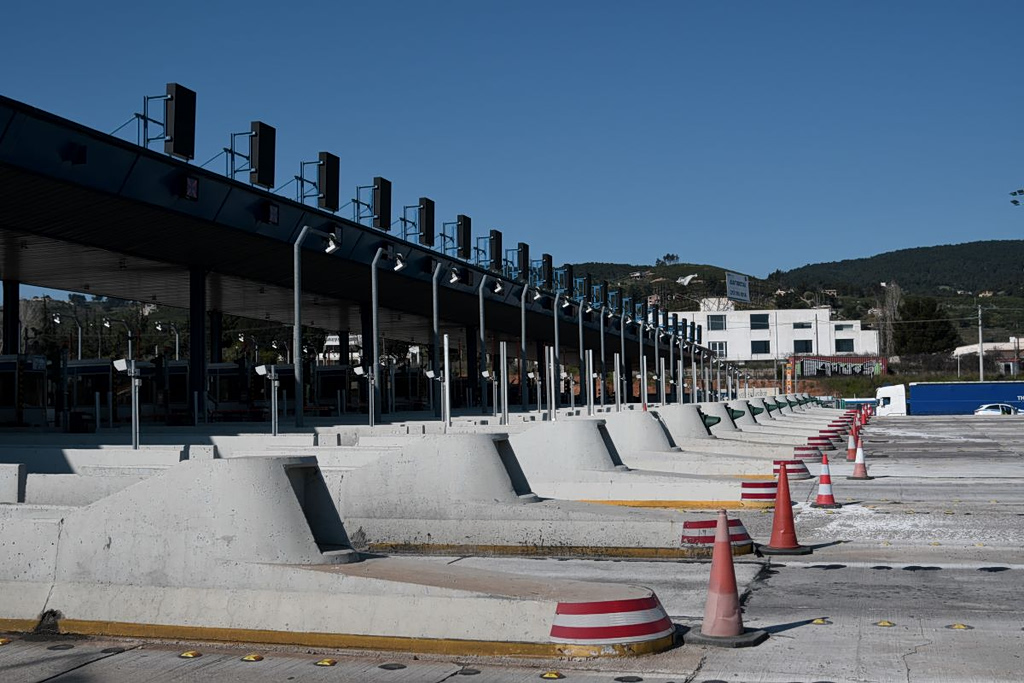

On the E65 highway, near Karditsa, over 1,500 tractors lined up in a row form a colorful, moving wall. Alongside modern tractors equipped with cabins, automatic guidance, and telematics, stand worn but proud older machines—relics of the mechanization of agriculture in the previous century. And while farmers negotiate with the government over the present of the sector, the country negotiates the future: whether modernization will become a decisive collective transition or entrench a multi-speed primary sector, where a few move forward while many remain behind.
The latest Hellenic Statistical Authority (ELSTAT) data from the 2023 annual agricultural survey record 361,584 agricultural tractors, roughly 2.5% more than in 2022. However, these figures do not concern tractors alone, as they include single-axle machines such as rotary tillers and garden tractors. According to publicly available data from the Association of Machinery Importers and Representatives (SEAM), the active fleet of professional agricultural tractors does not exceed 160,000. Based on the same data, the fleet appears aged and of low productive capacity, with over 50% of tractors being older than 25 years. A 2019 study by IOBE, supported by SEAM, shows that the purchase of new tractors—compatible with the technological requirements and standards of precision agriculture—is associated with a 10% increase in revenues, an 18% reduction in costs, and a 41% rise in net income for professional farmers.
“Same Problem, Different Packaging”
As Dimitris Lianos, Deputy Manager at LKN Analysis, notes in Vima, with years of experience designing and evaluating agricultural development programs for Greece under Pillar II of the Common Agricultural Policy (CAP), “The exact number of tractors is unknown, since the withdrawal process and license plate return are not properly tracked. Many machines do not move on the roads, are not insured like a car, remain in the fields, and thus disappear from any reliable registry.” For Mr. Lianos, who participated in drafting Greece’s strategic plan for the new CAP 2023-27, modernization of the primary sector cannot be equated with buying new tractors. “Tractors are not the answer to the great challenge of strengthening the competitiveness of Greek agriculture. Without building an ecosystem of data, knowledge, and management, we will face the same problem with a different wrapper.”
The competitiveness of the primary sector, defined by Eurostat as the ratio of fixed capital investment to gross value added, presents a distorted picture in Greece in 2025. While total investments in the country rose by 12.8%, with transport equipment (including tractors) growing by 28%, the actual effectiveness of these investments remains weak. Eurostat’s “X-ray” for 2025 is revealing: while the EU saw agricultural labor productivity increase by 9.2%, Greece recorded one of the largest decreases, at -8.8%. This means Greek producers invest more to produce less value compared to European competitors, attributed both to falling producer prices (e.g., olive oil down -37%) and high operating costs. At this point, statistics cease to be mere “diagnosis” and become a policy question: what kind of investments do we need, and, most importantly, who can actually make them?
Shifting Toward Competitiveness
Speaking to Vima, Argyro Zerva, Secretary General for Union Resources and Infrastructure (Ministry of Rural Development and Food), describes this new phase as a shift “from subsidy to investment,” with modernization now achieved through targeted investments for resilience and competitiveness, under the pressures of climate change and production costs. The numbers are clear: in 2025, payments of approximately €240 million were recorded through Improvement Plans, supporting investments of over €450 million—the “best performance ever”—while the 2023 call saw 85% of approved plans activated despite tight implementation timelines.
The same dynamic was evident in greenhouse crops. This year’s call closed in early December with proposals totaling €269 million, nearly double the available budget, emphasizing energy efficiency, automation, digitization, and precision agriculture technologies that “increase productivity and reduce costs.” As Ms. Zerva notes, a new cycle of Improvement Plans follows, with public funds exceeding €260 million, covering not only machinery and agricultural buildings but also digital production management, renewable energy installations for self-consumption, water-saving investments (irrigation systems, land improvements), and circular economy/energy efficiency measures (such as agricultural waste management).
The “critical element” of the new period, according to Ms. Zerva, is the timely activation of financial tools. Through the Agricultural Entrepreneurship Fund, three instruments are being activated with an initial public expenditure of €160 million, which, through leverage, can mobilize investments exceeding €350 million—with guarantees for loans/working capital, small interest-free loans, interest subsidies, and a special tool for young farmers combining loans with non-repayable support and technical assistance.
Low Frequency Produces Immature Plans
Referring to the Improvement Plans, the primary sector’s main investment tool, Mr. Lianos highlights the very low frequency of related calls. “In Greece, we usually issue only one Improvement Plan call per programming period. The result is immature proposals, a huge backlog of applications delaying evaluations, political pressure to increase the budget, and ultimately, everyone wants to enter the plans but almost no one cares whether or how they are completed.” Mr. Lianos proposes models followed in other countries: more frequent calls with smaller budgets and competitive criteria for applicants to improve the quality of proposals.
A key factor in this equation is human capital. Only 6.7% of Greek farmers have specialized training in new technologies, while the overwhelming majority (94.1%) rely solely on experiential knowledge. This “digital gap” may explain why the adoption of precision agriculture remains stuck at 5%: farmers buy machinery but lack the expertise to utilize the data and automation that would reduce costs and increase labor productivity. The CAP 2023-27 strategic plan seeks to address this gap by funding 48,000 new training positions, an effort expected to show its first measurable results by the end of 2026.