 Μake us preferred on Google
 Our galaxy appears to have formed gradually through the merging of smaller galaxies that were absorbed over the course of its cosmic evolution. Astronomers can identify which stars originated in other galaxies by examining the eccentricity of their orbits and their heavy-element content. This makes it possible to identify clusters of stars that reveal the characteristics of the galaxies they came from. This data offers valuable insight into the formation history of the Milky Way.
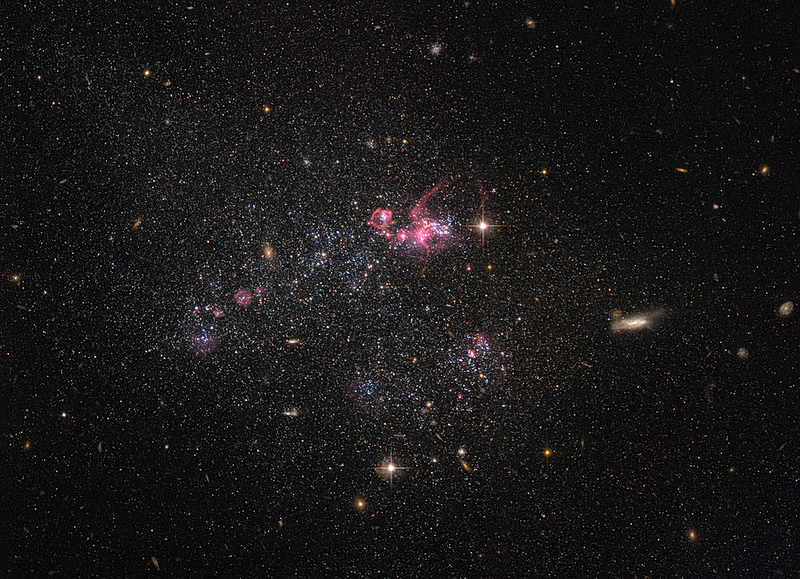
A team of astronomers recently studied 20 stars they believe formed together in a dwarf galaxy, which they named “Loki.” This galaxy is estimated to have merged with our own in the earliest stages of its evolution.
The research, published in the Monthly Notices of the Royal Astronomical Society, shows that these stars are metal-poor but differ from other metal-poor stars found in the Milky Way’s halo. The findings shed new light on the origins and evolution of our galactic environment.
Metal-Poor Stars as Building Blocks of the Universe
The first stars in the universe consisted primarily of hydrogen and helium. Through nuclear fusion, they produced heavier elements, which then became the raw material for subsequent generations of stars. Astronomers describe stars with low concentrations of heavy elements, such as iron, as “metal-poor.” Galaxies containing such stars served as building blocks of the early universe.
As the study’s authors explain, these building blocks merged in the earliest stages, scattering their stars, gas, and dark matter into the proto-galactic structure. The most metal-poor stars are therefore expected to be found in the inner regions of the galaxy, while those added later were likely scattered into the outer halo.
A Dwarf Galaxy Hidden in the Galactic Plane
The new study examined the chemical properties of a group of 20 metal-poor stars in the galactic plane. The group included both prograde and retrograde stars, all with highly eccentric orbits. The scientists compared their chemical composition with that of halo stars, dwarf galaxy stars, and simulated populations.
The results showed that these stars bear traces of enrichment from high-energy supernovae, stellar explosions, rapidly rotating massive stars, and neutron star mergers — but not from white dwarf explosions. This suggests they originated in a short-lived, energetic dwarf galaxy. The similarities in the chemical signatures of both the prograde and retrograde stars reinforce the hypothesis of a shared origin.
The researchers note that the sample is small, but future large-scale spectroscopic surveys such as the WEAVE and 4MOST programs are expected to shed further light on the origins of metal-poor stars in the galactic plane.