The first “science book” Michaela Louka ever held was when she was just two years old, still living in Greece. It was actually a children’s book about the human body, given to her as a gift. Her mother didn’t think much of it, saying it was for older kids and not appropriate for Michaela’s age. But the little girl loved it so much that she eventually memorized it cover to cover, word for word, to the point where her mother would sit and read it aloud to her on demand.
That was the beginning of a childhood, and later a school career, in which an innate curiosity and deep commitment to learning took the young woman down paths far off the beaten track.
Born in Athens, with roots in Lesvos on her mother’s side and Elefsina on her father’s, Michaela moved to Australia at age four, her mother’s home country. There, she crossed paths early on with a series of dedicated teachers who inspired her and nurtured her love of learning. “I was always drawn to programming, even in elementary school. One of my teachers, a young Greek woman, had started a club where she taught us about computers and coding at a very basic level. I think I just saw myself in her. I looked at her and thought: she’s exactly the kind of Greek woman I want to be when I grow up.”
Even after elementary school, she kept learning on her own, mostly self-taught, about what she calls the “magical world” of computers. Michaela belongs to a generation that grew up immersed in technology, with a fluency and familiarity that older teachers can rarely match, especially now, with artificial intelligence evolving at such a breakneck pace.
That gap became especially apparent during her final year of high school. While preparing for the Australian equivalent of university entrance exams, she also enrolled in a few elective courses.
One of them was Science Extension, a structured research course in which selected students design and carry out original scientific research in a field of their choosing, following processes that mirror real academic research. The project unfolds over an entire school year and concludes with a formal research report.
As Michaela tells it: “Even though it gives students a lot of freedom to study whatever they want, it requires a huge amount of work, on top of everything else you’re studying for finals. That’s why not many students choose it, and it had never been offered at my school before. But because I was so interested, the head of the science department decided to run it. At first, there were two of us, me and another girl, also Greek. She ended up dropping out about two months in, so I was essentially on my own, just me and my teacher. Within that course, I developed my own AI model for detecting breast cancer and continued my research by studying and analyzing the model’s own outputs.”
The title of her paper: “Assessing the Accuracy and Interpretability of a Recurrent Neural Network for Breast Cancer Classification and Molecular Subtyping Using Ribonucleic Acid Sequencing Data.”
Her teacher, impressed by the results, submitted Michaela’s work on her behalf to the Science Teachers’ Association of NSW (STANSW) for the Young Scientist of the Year award. The research swept first place at the state level, then advanced to the national competition across all of Australia, where it took the top prize. National magazine features and television appearances followed.

On the stage of the Today Show, a news and entertainment channel in Sydney. December, 2025
And all of it happened without any advanced technical guidance from her school. “My teacher essentially taught me how scientific research works. She taught me how to analyze data, how to write a lab report. But she didn’t know much about AI herself. She told me: ‘The AI part, you’re going to have to figure out on your own.'” And so she did.
Michaela also credits something else for how naturally programming languages come to her: “I think growing up bilingual, speaking both English and Greek, although I’ll admit my Greek has faded a bit and I try to speak it as often as I can with my grandmother, helped me enormously. Behind learning any language, there’s a pattern recognition process that has to happen in your mind. You recognize different patterns, different grammar, different syntax, and you try to internalize those rules and figure out how they apply across different contexts. So I believe being bilingual gave me a huge advantage in understanding programming more intuitively.”
A Personal Motivation
Her path was also shaped by something deeply personal, something that pushed her toward the fight against cancer. “My father has been through four different types of cancer: Hodgkin’s lymphoma, lung cancer, thyroid cancer, and skin cancer. On top of that, he has dealt with many long-term health complications as a result of his treatments.”
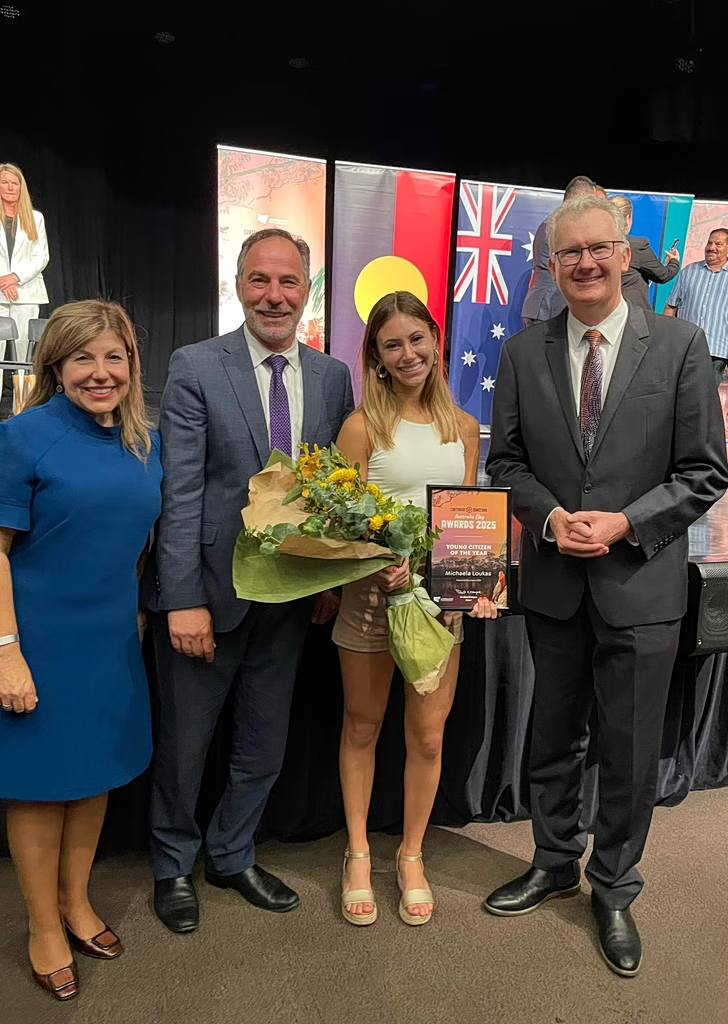
Michaela holding her award at the Young Citizen of the Year Awards
Although her father has now moved past the most serious of his health issues, the experience left a deep mark on Michaela. “Growing up and watching everything my father went through, I started thinking about how important it is to be able to personalize treatments as much as possible. The doctors did everything necessary to keep him alive, but I hope that in the future, science will allow us to choose even more targeted therapies, reducing the risk of secondary cancers and other complications that show up years later. That’s why I care so much about developing tools like the model I created. The idea of personalized medicine, being able to better understand each patient’s biology and tailor treatment to their specific needs, is something that truly captivates me. I hope that in the future, fewer people will have to go through what my father went through.”
The 98% Result and Unexpected Findings
The model that Michaela began developing at 16 and completed at 17, during her final year of high school, draws on the capabilities of a Recurrent Neural Network (RNN). As she explains, the whole effort started with mapping an enormous volume of data. “When I started, I used an open-source database called The Cancer Genome Atlas (TCGA). What I did was take the gene expression profiles of 20,000 genes. To put it simply, every cell in our bodies contains those 20,000 genes, which essentially act like dimmer switches. Depending on which dimmers are turned up or down, the behavior of the cell is determined. When tissue is healthy, those dimmers sit in a specific, stable configuration. When cancer appears, that configuration changes entirely.”
She trained the AI to recognize those patterns, and the results were striking: 98% accuracy in distinguishing whether a breast tissue sample was healthy or cancerous. She then pushed the model further, using it to perform a multiclass analysis to differentiate among the four main molecular subtypes of breast cancer, reaching an accuracy of 77.6%.
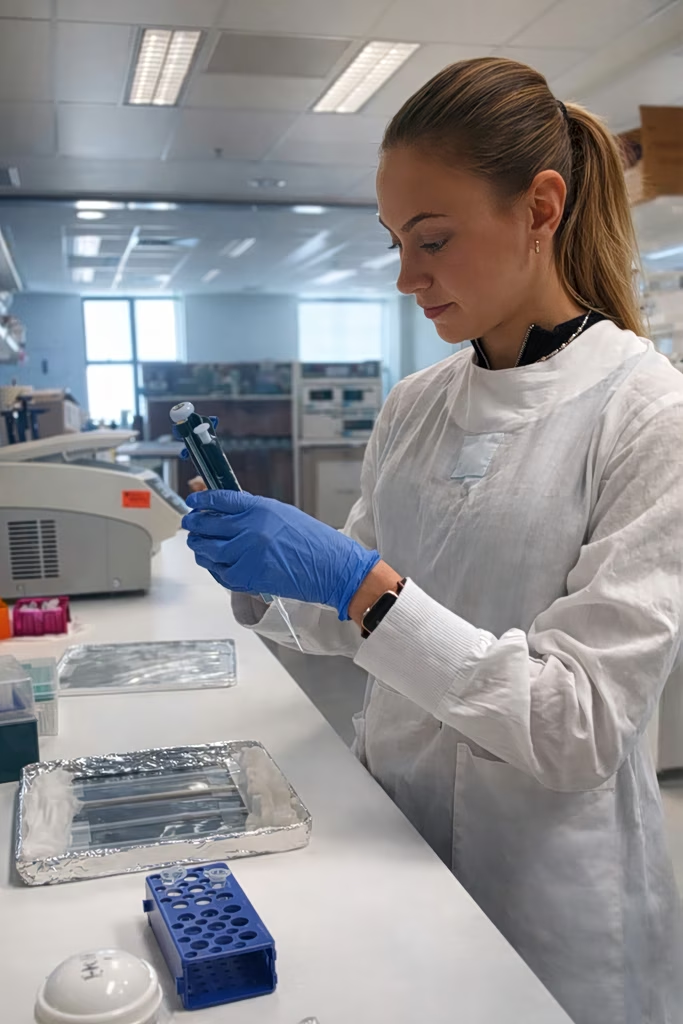
At the Medical Research Institute of her University
The problem with genetic analysis up to now, she explains, is sheer data volume. “We have trillions of cells in our bodies. And if every cell contains all 20,000 genes, that’s an enormous amount of data to process. Using AI, scientists are able to handle these massive quantities of data at ever-increasing speeds.”
What even she didn’t expect, though, was something even more valuable. “The model didn’t just make predictions. When I analyzed which genes were most influencing its decisions, I found that some of them are currently at the center of new research efforts. One was transferrin, which is linked to iron metabolism. While it has been known to the scientific community for many years, there has been renewed interest in recent years in its possible role in therapeutic approaches for breast cancer. The fact that the model independently identified such a gene was one of the most exciting findings of the research.”
While the model has not been developed for clinical use and requires further research and validation, Michaela believes it highlights one of modern medicine’s greatest promises: personalized treatment. “Today we know that two patients can have the same diagnosis and respond very differently to the same therapy. The goal of personalized medicine is to better understand the biology of each tumor and each patient, so that treatment decisions can be made with greater precision. What particularly interested me was that the model didn’t just classify samples. It also flagged genes like ARFIP2 and MSN, which have recently been linked in the international scientific literature to resistance to trastuzumab, a targeted therapy used in certain forms of HER2-positive breast cancer. That doesn’t mean we can yet make treatment decisions based solely on those genes. But it shows how AI can help researchers identify patterns in genetic data and surface elements that may in the future contribute to more targeted and effective therapies.”
Turning Down Investors and Looking Ahead
The success of the model, built over nine months (“it’s my baby,” she says with a laugh), naturally drew investor interest. Michaela, however, resisted those temptations and chose to focus entirely on her studies. “I received offers from various investors who were interested in funding the further development of the model and exploring its potential clinical applications.
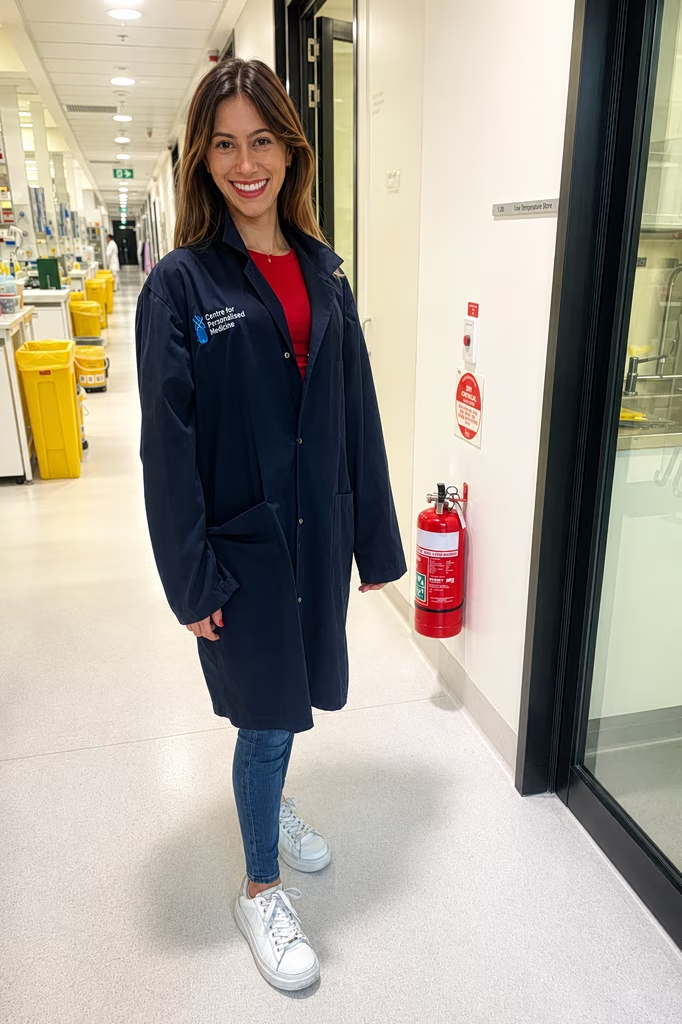
At the John Curtin School of Medical Research, last May
I was initially intrigued, but suddenly there were conversations about intellectual property, patents, regulatory issues, and business development, areas where I had no knowledge or experience yet. At that point I was a student who had just finished high school, exhausted from an incredibly demanding year, and about to start university. So I decided to temporarily put the project on hold and focus on my studies, with the goal of returning to it when I have more knowledge, experience, and the right people around me. Meanwhile, my paper had been submitted for peer review, which for me was just as important as any investment offer.” A few days ago she received the confirmation she had been waiting for: her research was officially accepted for publication in the Young Australians Science Journal.
Now 18, Michaela is studying on a full scholarship at the University of New South Wales (UNSW), in a demanding double degree program: Advanced Science with a focus on Genetics and Bioinformatics Engineering. She has six years of study ahead of her. “By the time I graduate, technology will have advanced so dramatically that I’m sure someone else will have developed something very similar to what I’ve done. But if I was able to build a program using knowledge I had to teach myself, I believe that in six years, after everything I’ll have gained from university, with connections, access to labs, different technologies, and people who can actually support me, I’ll have achieved something even more impactful.”
Despite all the goals she has set for her future, the first-year student is making sure to enjoy university life the way any young woman her age does in Australia, balancing her studies with going out, trips to the beach, and her job as a waitress, which she started at 14. “I try to take advantage of as many opportunities as the university offers and to explore different fields. I know I’m drawn to science, technology, and health, but I don’t yet know exactly where this path will lead me. Everything is still open. What I know for sure is that I really want to come to Greece very soon!”