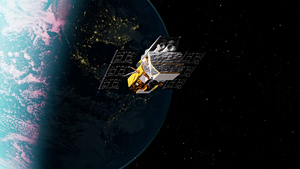
NASA is gearing up to launch its next major space observatory, the Nancy Grace Roman Space Telescope, a mission built to tackle some of astronomy’s biggest open questions: what dark matter and dark energy actually are.
The telescope will also put Einstein’s general relativity to the test on a cosmic scale and hunt for worlds orbiting distant stars.
Set to launch this Sunday from Kennedy Space Center in Florida aboard a SpaceX Falcon Heavy rocket, the roughly $4 billion mission is heading to orbit nine months earlier than NASA originally planned.
Roman observes in infrared and will match the image quality of the Hubble Space Telescope, but with a field of view 100 times wider. Its 2.4-meter mirror actually started life as hardware for a spy satellite before it was eventually repurposed for NASA’s use.
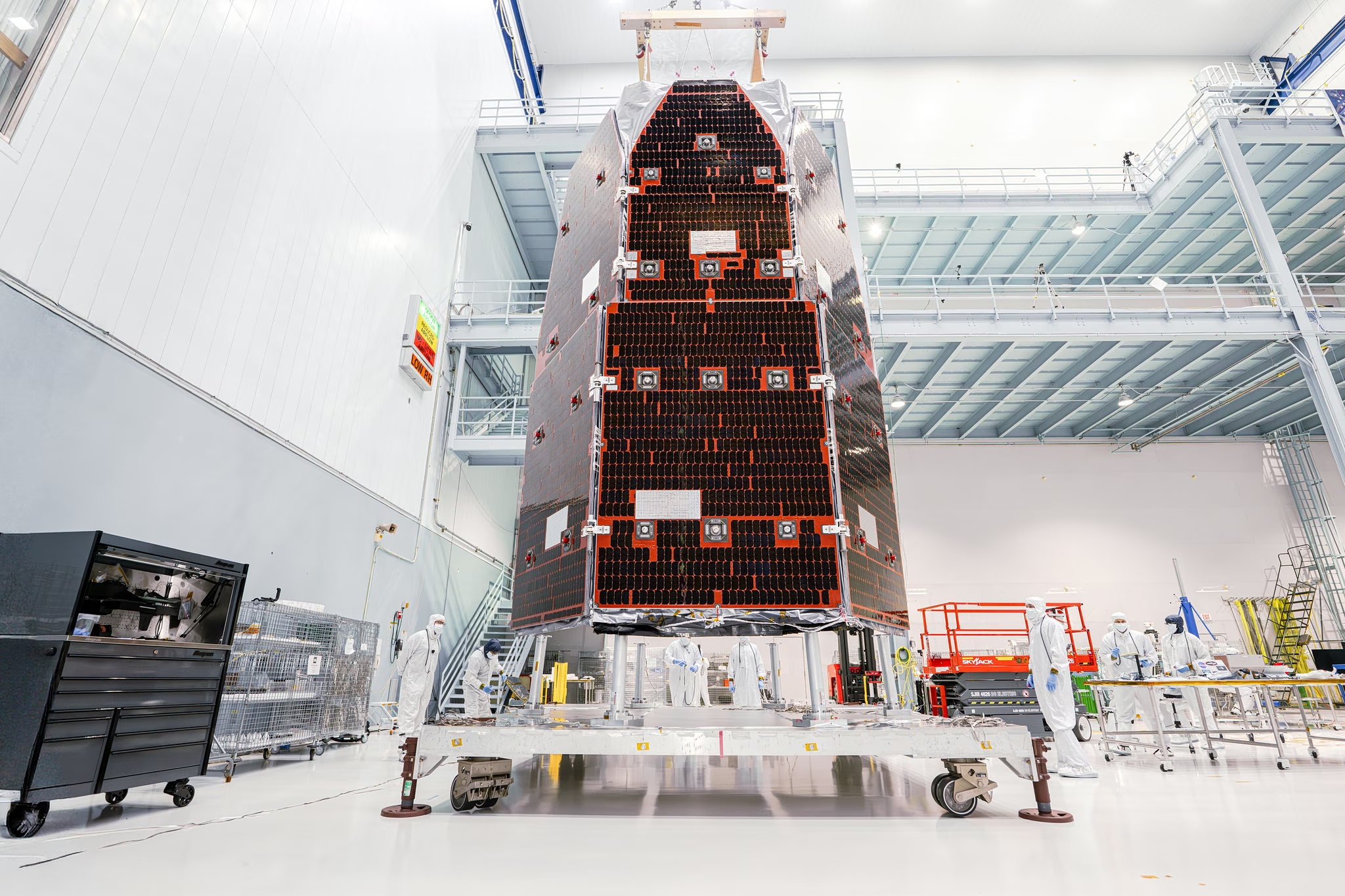
From the preparation of Nancy Grace Roman in NASA’s labs (NASA/Sydney Rohde)
Project scientist Julie McEnery of NASA’s Goddard Space Flight Center said the telescope’s core instrument pairs sharp performance and sensitivity with the ability to survey huge patches of sky rapidly, calling its capabilities powerful enough to reveal things that are strange, rare, or otherwise unusual.
Over a mission lasting more than a year, Roman is expected to observe upward of two billion galaxies, giving researchers insight into how stars, galaxies, and galactic clusters have formed and evolved. It will also track the pace of cosmic expansion over time, work McEnery says is central to pinning down the true nature of dark matter, dark energy, and the structure of the universe itself.
Ever since the Big Bang roughly 13.8 billion years ago, the universe has been expanding, and in 1998 researchers found that expansion is speeding up, a phenomenon usually chalked up to dark energy, a mysterious force scientists still can’t directly detect.
Dark matter presents a separate puzzle Roman will investigate: an unseen substance inferred from the way galaxies spin, believed to have shaped how galaxies came together in the first place. Ordinary matter makes up only about 5% of everything in the universe, while dark matter is estimated at 27% and dark energy at a dominant 68%.
University of Texas at Dallas cosmologist Mustapha Ishak, part of the Roman science team, told Reuters that the key open question is whether dark energy behaves as a fixed property of empty space or shifts over time.
He pointed to recent findings from the DESI survey suggesting dark energy’s influence may not be constant, adding that the alternative explanation, that our understanding of gravity itself needs revision at cosmic scales, remains one of the biggest unresolved puzzles in cosmology today.

The telescope is named after Nancy Grace Roman, NASA’s first chief astronomer, seen here in a 1972 photo (NASA)
Testing Einstein, hunting for new worlds
Roman will also map how galaxies cluster and how light bends around massive objects, a phenomenon called gravitational lensing, offering a way to check whether Einstein’s 1915 theory of general relativity holds up across billions of light-years or needs modification at the grandest scales.
With more than 6,350 exoplanets already catalogued, the search for worlds beyond our solar system continues to expand. Roman is expected to conduct one of the most thorough exoplanet surveys ever attempted, potentially adding thousands of new discoveries and producing the first broad statistical picture of planetary systems similar to our own.
Once released from its rocket, Roman will travel to Lagrange Point 2, roughly 1.6 million kilometers from Earth, the same neighborhood occupied by the James Webb Space Telescope. Its primary mission is slated to run five years, with the possibility of extension if fuel supplies allow.
The telescope has faced funding threats before: the Trump administration proposed cutting or scrapping its budget during both of its terms, though Congress restored the funding each time. Roman is named for Nancy Grace Roman, NASA’s first chief astronomer, who died in 2018 at age 93.