 Μake us preferred on Google
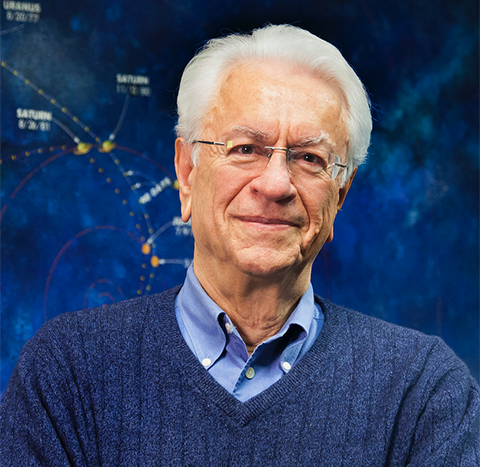
 Having devoted more than six decades to exploring the Solar System, Stamatios Krimigis used the occasion of an honorary award to raise a question that concerns all of us: what can we learn from space about survival on our own planet?
The distinguished Greek scientist was named an honorary doctor of the School of Applied Mathematical and Physical Sciences (SEMFE) of the National Technical University of Athens (NTUA) on Monday, October 12. In his speech, titled “Lessons From Space on the Survival of the Passengers of Spaceship Earth,” he sought to shed light on the fragile conditions that make life on Earth possible. His starting point was three different destinations of space exploration: Venus, Mars and the icy moons of the outer Solar System.
Three Lessons From the Solar System
On Venus, where the atmosphere is about 96.5% carbon dioxide, the surface temperature reaches about 462 degrees Celsius (about 864 degrees Fahrenheit). The extreme greenhouse effect explains why a planet similar in size to Earth has developed into such a different environment. Venus is not a forecast of Earth’s climate future. However, it offers a striking lesson in how decisive the composition of the atmosphere is for the conditions on a planet’s surface.
Mars offers another side of the same story. It once had a thicker atmosphere and water on its surface. Today it is a cold, dry planet without a strong, global magnetic field. Comparing it to Earth, Krimigis highlighted the protective role of Earth’s magnetic field against the solar wind, the constant flow of charged particles from the Sun. The loss of much of the Martian atmosphere shows that a planet’s ability to host life depends on interacting physical mechanisms, which change over geological time.
The third lesson comes from the moons of the distant planets. Missions such as Voyager and Cassini revealed that oceans can be hidden beneath icy surfaces. A notable example is Enceladus, a moon of Saturn, where Cassini’s measurements confirmed the existence of an underground ocean. The finding strengthens the search for environments that could support life beyond Earth, without amounting to a discovery of extraterrestrial life.
According to what the distinguished scientist presented, these discoveries do not make the vision of human relocation any simpler. The enormous distances, the conditions on other planets and the difficulties of crewed space travel feed his doubts about permanently settling even Mars. Earth remains the only known planet that hosts life, though in his view probably not the only one.
From Vrontados, Chios, to Voyager
Born in 1938 in Vrontados on the island of Chios, Stamatios Krimigis studied physics in the United States. At the University of Iowa, he completed his doctoral thesis under James Van Allen, the scientist who gave his name to the radiation belts around Earth. Since 1968, he has been associated with the Johns Hopkins University Applied Physics Laboratory (APL), whose Space Department he later headed.
The range of his career is exceptional. According to APL itself, he has developed scientific instruments for or taken part in missions to all nine “classical” planets, including Pluto, which is now classified as a dwarf planet. In total, he has worked on the development, operation and scientific use of 21 instruments on NASA and European Space Agency missions. His record includes the historic Voyager 1 and 2 missions and Cassini-Huygens.
He was the principal investigator for the Voyager charged particle instrument, whose data helped establish that Voyager 1 crossed into interstellar space in 2012. Just this past April, after nearly 49 years of operation, NASA turned off that instrument on Voyager 1 to save the spacecraft’s increasingly limited power.
The NTUA Honor and the “Pandora’s Boxes”
At the ceremony, NTUA Rector Ioannis Chatzigeorgiou described Krimigis’s career as an example of scientific excellence and dedication to knowledge. SEMFE Dean Apostolos Kyritsis focused on his contribution to applied physics, while Professor Alexandros Kehagias presented his work and discussed prospects for collaboration with the School. The event concluded with the presentation of the NTUA Medal.
A member of the Academy of Athens since 2004 and its president in 2024, Stamatios Krimigis has also represented Greece on the Council of the European Space Agency (ESA) and has served as president of the National Council for Research and Technology.
In the final slide of his speech, his focus returned to Earth. “Humanity has opened two Pandora’s boxes at the same time, artificial intelligence and climate change,” he said. This was followed by a reminder that the survival of the human species depends on how well we manage both.
For a scientist who has devoted his life to exploring space, the closing message carried a special symbolism: the more we learn about the universe, the better we understand what is at stake on Earth.