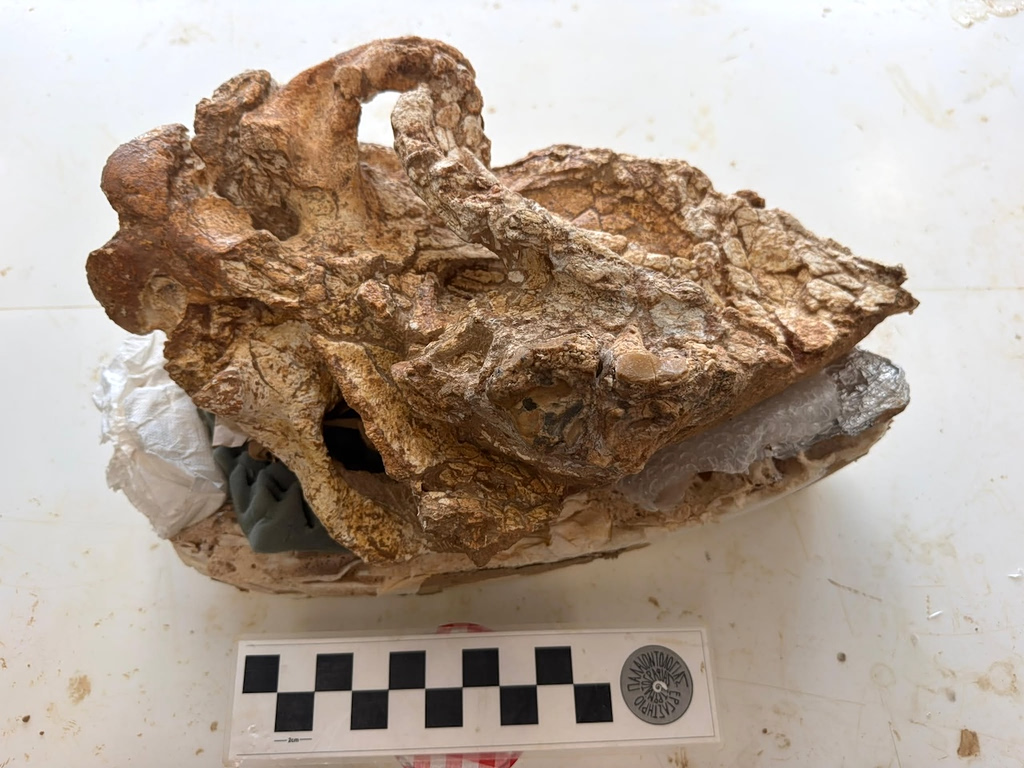
A prehistoric rhinoceros skull discovered in the Sitia Geopark, part of the UNESCO Global Geoparks Network, is shedding new light on Crete’s rich paleontological history.
The fossil, found during a survey in the Magantze and Trapeza areas inside the Geopark, has been identified as belonging to Dihoplus pikermiensis, a two-horned rhinoceros that lived during the Late Miocene. It is estimated to be between 8 and 8.5 million years old. It emerged in a newly-discovered fossil-bearing site containing numerous bones.
Research was led by George Iliopoulos, Professor of Paleontology and Stratigraphy, together with a team from the Laboratory of Paleontology and Stratigraphy at the Department of Geology of the University of Patras.
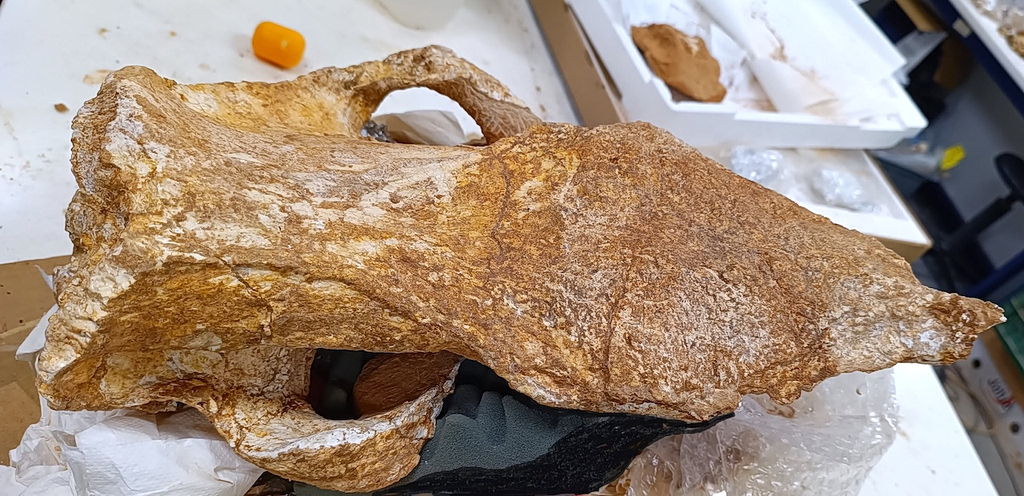
Photo: Sitia UNESCO Global Geopark
The fossils were subsequently transferred to the University of Patras laboratory, where they were cleaned and conserved. Further examination revealed that the large skull belonged to a rhinoceros.
According to Iliopoulos, the skull’s morphological characteristics identified it as Dihoplus pikermiensis, a species of two-horned rhinoceros that inhabited Eurasia during the Late Miocene. The species, he said, is associated with the so-called Pikermian Fauna, a collection of Late Miocene animal fossils found across Eurasia. Similar remains have also come to light at other Greek fossil sites, including Pikermi in Attica.
Iliopoulos told ANA-MPA that the rhino dates to roughly the same period as the giant Deinotherium proavum – an extinct genus of large, elephant-like animals that lived from the Middle Miocene until the end of the Early Pleistocene – discovered at Agia Fotia in Sitia, which has also been estimated to be between 8 and 8.5 million years old.
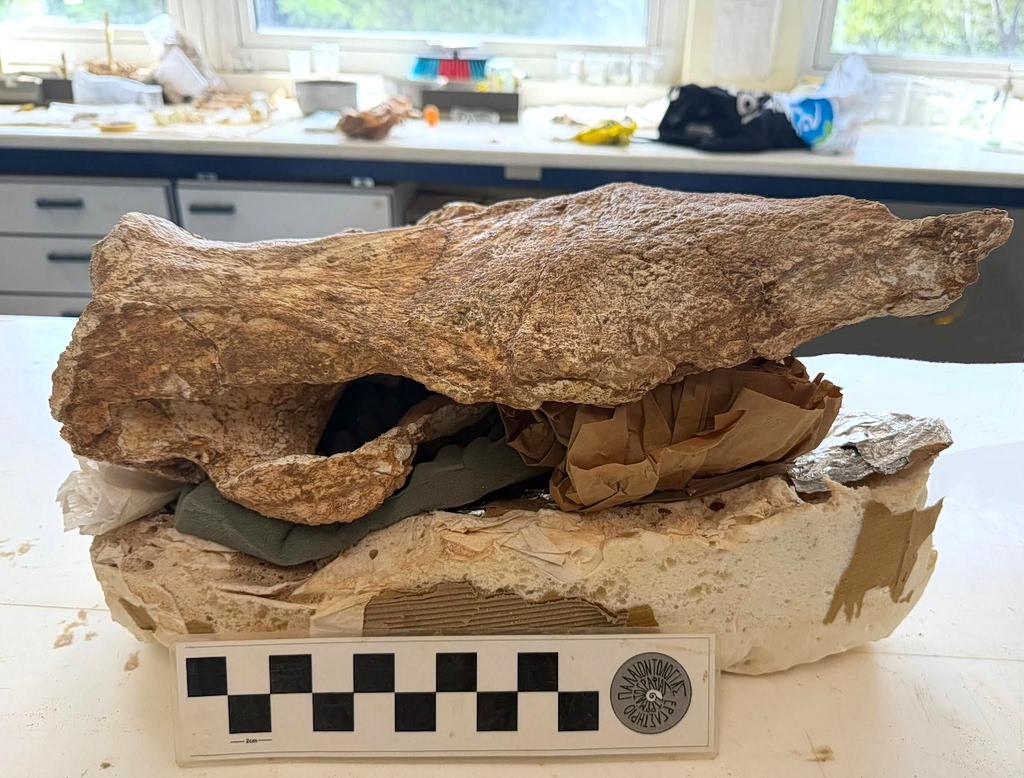
Photo: Sitia UNESCO Global Geopark
He highlighted the significance of the Sitia UNESCO Global Geopark, whose geological and paleontological record spans almost 300 million years. The area contains evidence ranging from Carboniferous plant remains and Cretaceous rudists to the giant Miocene Deinotherium and endemic dwarf mammals from the Pleistocene.
One particularly striking aspect of the Sitia rhino discovery, Iliopoulos said, is its location relatively close to the coast. The find could mark the beginning of a series of significant new discoveries in the area, he added.
Research is expected to continue with the support of the Sitia Geopark and the Municipality of Sitia. Iliopoulos’ research team also included Penelope Papadopoulou, Irena Pappa, Dimitra Valavani, Benoit Ficart and Thomas Beard.