 Μake us preferred on Google
Britain is facing a growing security challenge in the Arctic, as Russia intensifies its military activity in the High North and develops the capabilities to threaten European security both above and beneath the sea.
From submarine operations and suspected sabotage of critical infrastructure to cyber attacks and the disruption of vital communications networks, the Kremlin’s activities are forcing London and its European allies to reconsider their defence priorities.
The warning from Britain’s military leadership is stark.
On 9 November, Air Chief Marshal Sir Richard Knighton, Chief of the Defence Staff, said the UK was falling behind its European allies in responding to what he described as a “very real” Russian threat, urging the country to “catch up with our European allies”.
“This is the most dangerous period I’ve known in my adult life,” he said, adding that the threat, “principally from Russia, but more broadly globally”, was rising.
Knighton’s intervention came as the House of Commons Defence Committee published a report examining Britain’s defence posture in the High North, an increasingly important strategic region encompassing the Arctic and parts of the North Atlantic.
Taken together, the warning and the parliamentary findings point to a fundamental question for British security: whether the country has the naval strength, technology and resources to protect its northern approaches against an increasingly assertive Russia.
The war beneath the waves
For London, the threat is no longer confined to conventional military confrontation. Knighton warned that the description of Russian activity as merely “hybrid” no longer adequately captures its seriousness.
“We’re talking about targeted assassinations, we’re talking about sabotage, we’re talking about cyber attacks,” he said. “These are very real, real things [by] the Russian state we have proof of in Europe and to some extent in the UK.”
The Arctic has become particularly important because of its strategic geography and the military infrastructure concentrated there. Melting ice is opening new maritime routes and commercial opportunities, while exposing previously inaccessible Russian military facilities.
According to the Defence Committee, approximately two-thirds of Russia’s strategic nuclear missiles are based in the High North, alongside submarines, intelligence-gathering vessels and specialised underwater sabotage capabilities.
The consequences extend far beyond the Arctic itself. Russian naval operations could threaten NATO’s transatlantic supply routes, undersea energy pipelines and the communications cables connecting Britain to Europe and North America.
Speaking to To Vima, Dr Marc DeVore, Senior Lecturer at the University of St Andrews’ School of International Relations, identified Russia’s submarine forces as the principal source of danger.
“The UK’s greatest challenges in the High North are its low availability of warships, particularly anti-submarine frigates and nuclear-powered attack submarines,” he said.
DeVore explained that the Russian submarine threat operates on three levels. Special mission submarines operated by GUGI are designed to map, tap and potentially sabotage underwater infrastructure. These operations could target data cables, energy connections and oil and gas pipelines during peacetime as well as conflict.
A second threat comes from Russia’s Yasen-class cruise missile submarines. Moscow currently possesses five, with another five under construction. Each carries 32 long-range cruise missiles capable of striking military and infrastructure targets.
Finally, Russia maintains a further six to nine nuclear-powered hunter-killer submarines designed primarily to attack and sink enemy vessels.
In a crisis, DeVore warned, Moscow could initially use covert sabotage to disrupt underwater infrastructure while maintaining plausible deniability. Missile strikes could follow once hostilities began, while hunter-killer submarines would seek to destroy allied warships moving towards the High North.
Britain’s naval vulnerability
The central weakness in Britain’s position is the availability of its naval fleet. The Defence Committee acknowledges that the Ministry of Defence has developed a strategy to respond to the Russian threat, including its Atlantic Bastion programme, which aims to transform the Royal Navy’s ability to monitor and defend the North Atlantic.
The Government has also committed £1.3 billion up to 2030 to its Hybrid Navy concept, integrating crewed and uncrewed vessels.
However, the gap between strategic ambition and operational capability remains considerable.
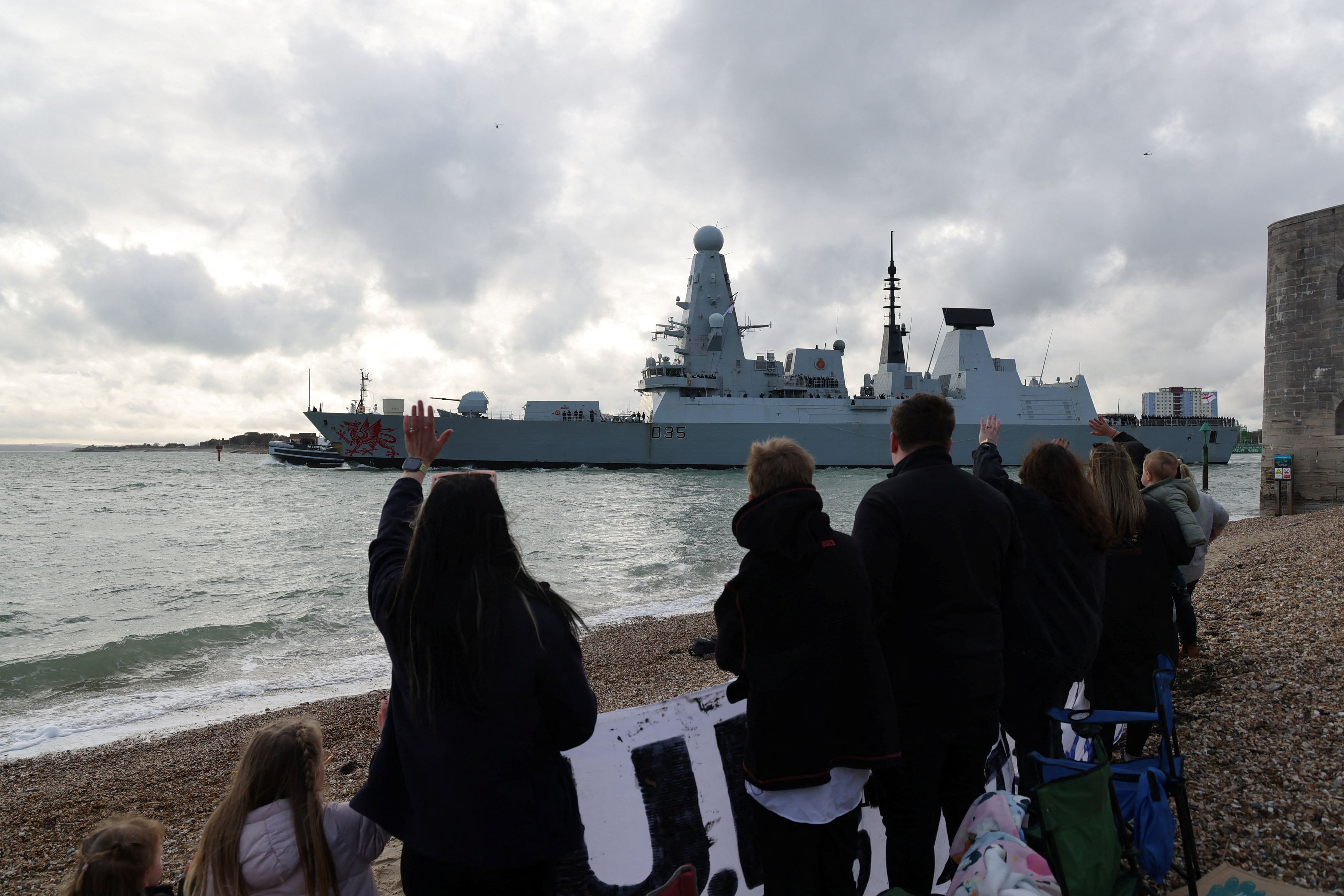
DeVore highlighted the dramatic decline in Britain’s frigate numbers, essential for anti-submarine warfare. The UK had 12 active frigates in 2022, when Russia invaded Ukraine. That number has fallen to five and is expected to reach a minimum of three in 2028 as older Type 23 vessels are retired before their replacements become available.
“This is leading to a catastrophic drop in frigate numbers,” he warned.
His assessment is that Britain should consider extending the service lives of its remaining Type 23 frigates while accelerating construction of the new Type 26 and Type 31 vessels. Acquiring unmanned maritime systems more quickly would also strengthen surveillance and operational capabilities, although additional defence spending would be required.
The problem is compounded by competing international commitments. DeVore pointed to Britain’s deployment of its aircraft carrier battle group to the Pacific in 2025, the dispatch of its only Astute-class submarine at sea to Australia in early 2026, and the deployment of a Type 45 destroyer to the Eastern Mediterranean.
With such limited naval resources, he argued, Britain must reconsider where its warships are most urgently needed.
A northern alliance takes shape
The response is increasingly European. On 10 November, the ten maritime members of the Joint Expeditionary Force (JEF), led by Britain and comprising the Netherlands and Nordic and Baltic countries, signed the Northern Navies Initiative.
The programme aims to improve coordination between allied fleets, integrating maritime drones and conventional warships through joint patrols, exercises and logistical cooperation. Its longer-term purpose is to ensure that participating navies can respond rapidly to a crisis and operate together under NATO command when necessary.
For Professor Basil Germond, Professor of International Security at Lancaster University, the initiative represents an important step towards addressing the vulnerabilities of Europe’s northern flank.
“Russia poses a challenge on NATO’s northern flank, both through its submarine capabilities and through maritime grey zone activities, including threats to critical undersea cables and energy infrastructure,” he told To Vima.
He stressed that the protection of the High North is directly connected to Britain’s national security.
“For the UK, protecting the High North and North Atlantic is not a distant commitment: it is an essential part of homeland defence, because the same waters contain Britain’s vital connections to Europe and North America, both sea lanes of communication and undersea data cables.”
But increasing the number of warships alone will not provide a sufficient answer. Germond argues that Britain must also invest in persistent surveillance, infrastructure resilience and the ability to repair damaged underwater networks.
“Now, the answer to these challenges is not only to increase the number of hulls, which is part of the picture but not the sole remedy. Indeed, it is also crucial to maintain persistent surveillance above and below the water, strengthen the resilience and repairability of critical infrastructure, and ensure that allied forces can operate together, support one another and respond collectively across the boundary between grey zone activity and armed conflict.”
He added that the Northern Navies Initiative should allow participating countries to plan and train together, provide mutual logistical support and transition more smoothly into NATO operations.
The 2030 warning
The urgency is reinforced by the Government’s own assessment of the potential timeline for a direct confrontation. In June 2026, the then Prime Minister, Sir Keir Starmer, said: “…it is our intelligence assessment, and the assessment of other countries in NATO, that there could be an attack by Russia on NATO as soon as 2030”.
The Defence Committee has consequently warned that Britain’s existing shortages of anti-submarine frigates, amphibious vessels and available submarines could undermine its ability to deter Russian aggression. It has also highlighted the country’s dependence on American capabilities, including ballistic missile defence, long-range strike and intelligence and surveillance assets, which would take considerable investment and time to replace.
The challenge, therefore, is not simply to prepare for a possible war, but to convince Moscow that aggression would be met with a credible and coordinated response.
Germond believes that deterrence ultimately depends on demonstrating readiness rather than merely announcing commitments.
“A key point is that preparedness is indispensable to deterrence. War is not inevitable, but deterrence succeeds only when potential adversaries believe that allies are united, capable and ready to act.”
Knighton, meanwhile, has warned that preparing for a more dangerous security environment cannot be left entirely to the armed forces. Speaking to the BBC, he revealed that he and his wife had been considering the Government’s advice on household emergency supplies, even installing extra shelves after discovering that “there’s a lot of tins in the Knighton household”.
“I put some extra shelves in,” he said. “But this is something, though, we should all be thinking about.”
For Britain, however, the more pressing task lies beyond the kitchen cupboards.
With Russia strengthening its military position in the Arctic and the North Atlantic becoming an increasingly contested strategic space, London must turn its defence commitments into operational capability.
The new northern alliance is an important beginning. Whether it will be enough to close the gap before 2030 is another matter.