The Municipality of Andros has announced it will appeal to the Council of State, Greece’s highest administrative court, seeking to annul the ministerial decision that established the government’s new spatial planning framework for renewable energy. The framework was published in the Government Gazette a little over two weeks ago.
The move follows a unanimous vote by the island’s municipal council authorizing its legal department to prepare the case for filing. Andros is now on track to bring the first major legal test of the spatial framework the government designed to give investors clarity and communities more say over where wind and solar projects can go.
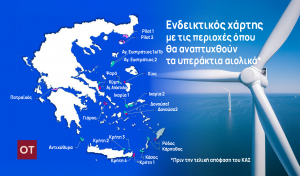
The new framework, sets out exclusion zones, environmental restrictions, maximum coverage ratios and landscape protections for wind and solar development, and coordinates those rules with a separate spatial plan covering tourism. One of its central provisions bans new wind installations outright on any island smaller than 300 square kilometers.
That threshold leaves out most of the Aegean’s smaller islands but allows the development of wind and solar farms in 13 larger ones: Lesvos, Chios, Limnos, Samos, Thasos, Karpathos, Rhodes, Andros, Naxos, Kefalonia, Lefkada, Evia and Crete.
A second layer of restrictions, tied to the tourism spatial plan, narrowed that list further by excluding areas classified as saturated or already developed for tourism. Thasos was removed from the eligible category entirely under that rule, along with pockets of other large islands. Andros, however, was not.
The municipality’s objection
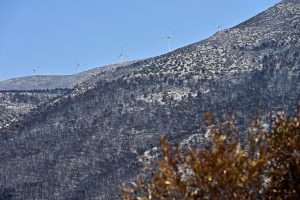
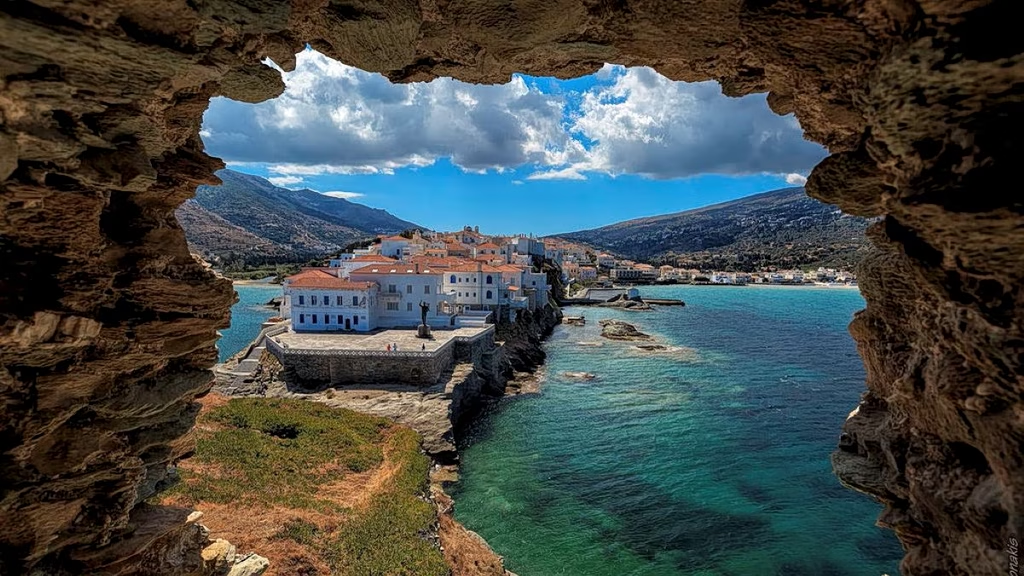
Andros is a Cycladic island known for its tourism economy, distinctive landscape and cultural heritage, and has already drawn significant investor interest in developing wind farms on the island. The municipal council’s decision argues that this combination is exactly why the island should not have been excluded, and why it is asking for a specific rule protecting Andros from further wind development and blocking projects that have not yet been built.
The municipality had raised the issue with the government as early as June, requesting that the island be excluded from the zones the framework designates for accelerated, priority or general renewable energy development. Once the framework was published without that exclusion, the council opted to pursue a direct legal challenge rather than further lobbying.
The new framework arrives after Andros had already moved well into the licensing process for a number of wind projects. According to available data, more than a dozen projects on the island hold production licenses or producer certificates, with combined capacity exceeding 264 megawatts, and a significant share of them have also cleared environmental licensing.
The new framework includes transitional provisions that protect projects already holding licenses, environmental approvals or completed environmental impact studies at specific stages, allowing them to continue under the previous rules. That means even if the Council of State rules in favor of Andros and blocks future projects, the wind farms that have already advanced through the licensing rounds would likely still be built under the framework’s transitional rules.
To get a full accounting of where things stand, the municipality has started formally requesting data from the Ministry of Environment and Energy, the Regulatory Authority for Waste, Energy and Water, and the operators of Greece’s electricity transmission and distribution networks, IPTO and HEDNO, the Hellenic Electricity Distribution Network Operator, asking for a complete record of every wind project tied to Andros and its stage in the licensing process.
The municipal council frames the appeal as more than an institutional decision. Its resolution states that 4,500 residents signed a petition supporting the effort, alongside 68 local associations and organizations. It describes the legal challenge as the formal continuation of a broader mobilization within the island’s community.
The new framework does include a provision requiring a specific landscape study for wind projects, in recognition of landscape as a protected factor. That is the provision Andros intends to invoke, arguing its case fits the exception the framework itself was built to allow.
Barely two weeks after the framework took effect, one of the Aegean islands most exposed to wind development is preparing to test in court a set of rules the government had presented as a way to reduce uncertainty for investors and build local support for renewable energy projects.